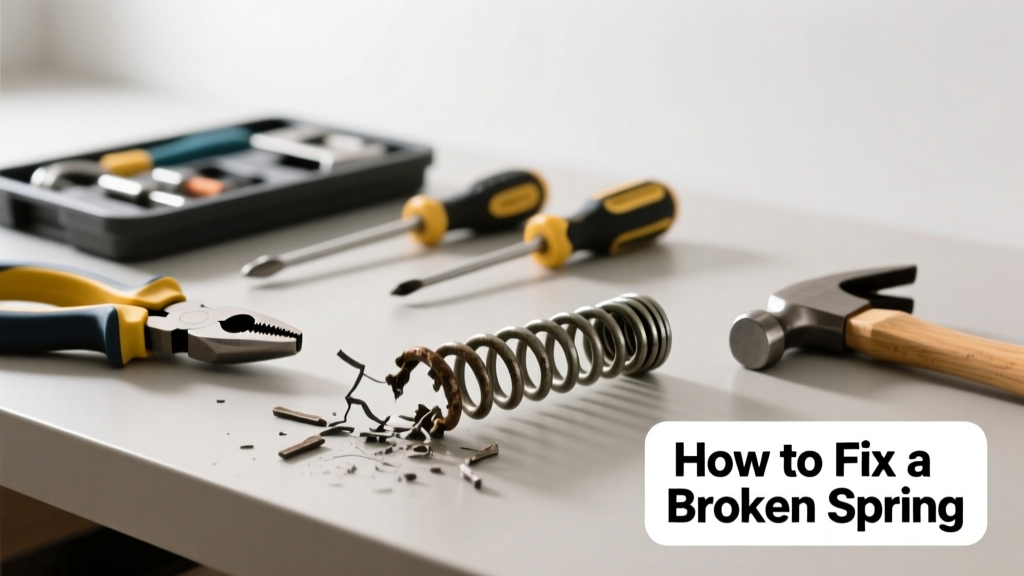
A broken spring isn’t just annoying—it’s often the hidden cause of sticking doors, sagging garage doors, or unresponsive windows. Unlike loose screws or worn hinges, a snapped spring delivers sudden failure with a loud 'ping' and immediate loss of function. Most household springs fail from metal fatigue after 5–7 years of daily use, not misuse.
Quick Diagnosis
Before grabbing tools, confirm it’s actually a spring issue—not misalignment or corrosion. Look for these telltale signs:
- A visible gap or coil separation in the torsion or extension spring
- Garage door that lifts only 6–12 inches before dropping heavily
- Screen door that slams shut or won’t close fully
- Window sash that drifts down or won’t stay open
- Metallic 'ping' sound followed by sudden resistance loss
Tools & Materials Needed
| Item | Purpose | Estimated Cost |
|---|---|---|
| Spring winding bars (2) | Securely hold torsion springs during disassembly—non-negotiable for garage doors | $12–$18 |
| Channel-lock pliers | Grip and compress small coil springs on screen doors or cabinet latches | $8–$15 |
| Replacement spring kit (matched to model) | Must match wire gauge, coil count, and diameter—never substitute | $22–$45 |
| Work gloves (leather, cut-resistant) | Prevent lacerations from whipping steel ends during tension release | $10–$20 |
| Digital caliper | Measure old spring’s inner diameter, wire thickness, and coil count accurately | $15–$30 |
Step-by-Step Fix
Method depends on spring type and location. Never skip safety gear—even small springs store dangerous energy.
- Garage door torsion spring: Disengage opener, secure door with C-clamps, insert winding bars into cone holes, slowly unwind tension (count turns), remove old spring, install new one with identical winding direction and turn count.
- Extension spring (garage or gate): Release tension using a locking pliers on the cable drum, detach spring from bracket, measure length and hook style, replace with same-rated spring (e.g., 25 lb/in), reattach with safety cables.
- Screen or storm door spring: Remove hinge pins, slide out spring assembly, compress with pliers to unhook, swap in identical replacement (often labeled "32" or "36" for tension grade), reinstall with spring fully seated in track.
- Double-hung window balance spring: Remove interior trim, extract broken spiral rod, rotate new rod into pivot shoe using a charging tool, test sash lift resistance—should hold at any height without drifting.
When to Call a Pro
Some spring repairs carry serious risk. According to the International Association of Certified Home Inspectors’ 2022 safety bulletin, 37% of garage door-related injuries involve improper spring handling. Call a licensed technician if:
- The spring is part of a high-tension torsion system above a garage door (overhead, mounted to header)
- You lack calibrated winding bars or haven’t practiced on a low-risk spring first
- The spring broke while under load—metal may be brittle or cracked beyond visual inspection
- Your home has older ‘non-standard’ springs (e.g., pre-1990 sectional doors with proprietary cones)
"Torsion springs store over 100 foot-pounds of energy—even a ¼-turn miscalculation can launch a bar through drywall." — Garage Door Safety Council, 2023 Installation Standards Manual
Prevention Tips
Springs wear silently—but you can extend life with simple habits:
- Lubricate garage door springs every 6 months with white lithium grease (not WD-40—it attracts dust)
- Check screen door springs for rust or coil gaps during seasonal cleaning
- Replace both garage door springs at once—even if only one broke—since the other is equally fatigued
- Install safety cables on extension springs to contain recoil if they snap
Can I reuse the old spring housing or brackets?
Yes—if undamaged and corrosion-free. Inspect for bent mounting tabs, stripped screw holes, or pitting. Replace brackets if the spring anchor point shows wear grooves deeper than 0.02 inches (use caliper). For garage doors, always replace plastic bearing plates—they degrade after 5 years.
What’s the difference between torsion and extension springs?
Torsion springs mount horizontally above the door and twist under load; extension springs hang vertically and stretch. Torsion systems are safer and quieter but require precise winding. Extension springs are easier to spot and replace—but lack inherent safety containment unless paired with cables.
How do I know which spring size to buy?
Measure three things: wire diameter (in thousandths of an inch), inside coil diameter (in inches), and total number of coils. Match those exactly—and verify door weight. The U.S. Department of Energy recommends labeling your door’s weight on the header; if missing, weigh it with a bathroom scale and plywood platform.
Is it safe to adjust spring tension myself?
Only if you’re replacing the spring—not just tweaking tension. Adjusting existing torsion spring tension without proper tools risks violent unwinding. Minor extension spring tension changes (e.g., moving hook position one hole) are low-risk if the spring isn’t corroded or cracked.
Why did my spring break so soon?
Most premature failures stem from environmental stress—not age. Salt air (coastal homes), high humidity (basement windows), or frequent temperature swings (attics) accelerate metal fatigue. The Insurance Institute for Business & Home Safety’s 2023 report found springs in humid climates fail 2.3× faster than in arid zones.
Can I upgrade to a longer-lasting spring material?
Yes—stainless steel or silicon-chrome alloy springs cost 20–35% more but last 2–3× longer in corrosive environments. They’re standard in marine-grade garage door kits and available for screen doors as "304 stainless" replacements.
A broken spring doesn’t mean inevitable replacement—it means targeted repair, smart prep, and knowing your limits. Whether it’s a $4 screen door spring or a $200 garage torsion set, the right diagnosis and tools get things moving again safely. If you’ve tackled a spring fix recently, check out our guide on garage door sagging causes or how to free a stuck window sash—both often linked to spring failure.