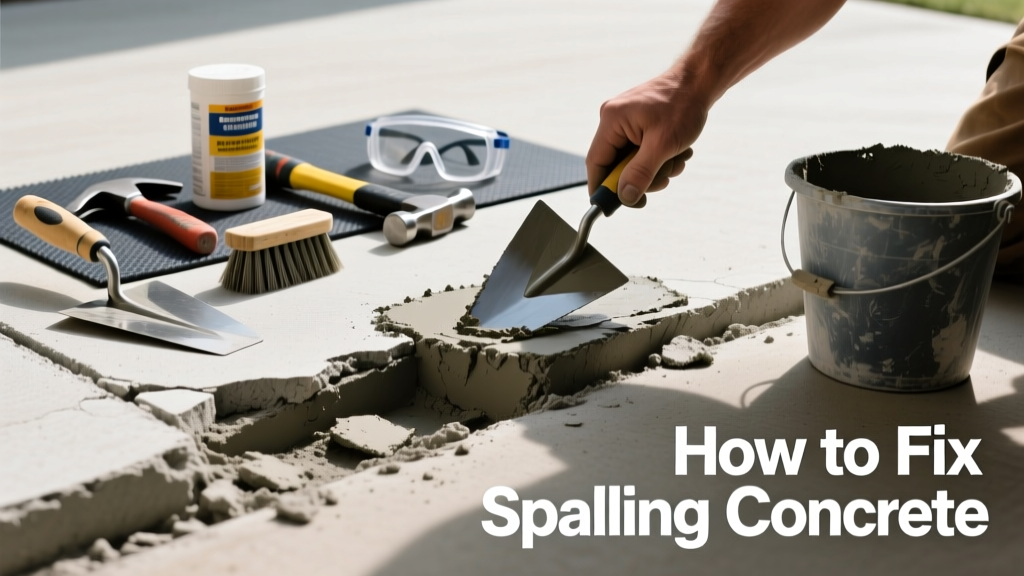
Spalling concrete—those ugly, flaking patches on your driveway, patio, or garage floor—is more than cosmetic. It’s a red flag that moisture, freeze-thaw cycles, or poor finishing are breaking down the surface layer. Left unaddressed, it spreads fast and compromises structural integrity.
Quick Diagnosis
Before grabbing tools, identify the root cause. Spalling rarely happens in isolation—it’s a symptom. Here are the most common triggers:
- Water intrusion beneath the slab or into pores, especially in cold climates
- Use of deicing salts (sodium chloride or calcium chloride) within the first year of curing
- Poor finishing practices—over-troweling traps water near the surface
- Inadequate air entrainment in the original mix (critical for freeze-thaw resistance)
- Carbonation of the concrete surface, reducing alkalinity and weakening steel reinforcement
Tools & Materials Needed
| Item | Purpose | Estimated Cost |
|---|---|---|
| Wire brush or angle grinder with diamond cup wheel | Removes loose, unsound concrete without damaging sound substrate | $15–$85 |
| Concrete bonding agent (e.g., Quikrete Concrete Bonding Adhesive) | Ensures new patch material adheres to old, dense concrete | $8–$12 |
| High-strength polymer-modified patching compound (e.g., Sakrete Top'n Bond) | Resists shrinkage, bonds well, and withstands foot/vehicle traffic | $10–$22 per 50-lb bag |
| Margin trowel & darby | For precise application and smooth, level finish | $6–$18 |
| Curing blanket or plastic sheeting | Maintains moisture during critical first 72 hours to prevent cracking | $5–$15 |
Step-by-Step Fix
Repair success hinges on preparation—not just product choice. Follow these methods in order, based on severity:
- Light spalling (surface flakes <1/8" deep): Wire-brush the area, apply bonding agent, then trowel on a 1/8" layer of polymer-modified topping. Finish with a broom texture if matching adjacent surfaces.
- Moderate spalling (1/8"–1/2" deep, exposing aggregate): Chisel or grind out all unsound material to a minimum depth of 1/4". Feather edges at a 3:1 slope. Prime with bonding agent, then fill in layers no thicker than 1/4" per pass.
- Deep or widespread spalling (exposing rebar or >1/2" depth): Cut back to sound concrete using a circular saw with masonry blade (cut 1" beyond visible damage). Clean thoroughly, treat exposed rebar with rust inhibitor (e.g., Rust-Oleum Rebar Rust Inhibitor), then use a structural-grade repair mortar like SikaTop Armatec 110.
When to Call a Pro
DIY works for small, shallow areas—but some situations demand licensed expertise. Call a concrete contractor if:
- The spalled area exceeds 10 sq ft or covers more than 15% of the slab’s surface
- You see exposed, rusted rebar—or worse, concrete lifting or cracking around the spall
- The slab is part of a load-bearing structure (e.g., garage floor supporting walls or a second story)
- Spalling recurs within 12 months after repair, indicating deeper drainage or subbase issues
According to the American Concrete Institute’s Guide to Durable Concrete (ACI 201.2R-23), “spalling caused by alkali-silica reaction or sulfate attack cannot be repaired with surface patching—it requires full-depth replacement and chemical mitigation.”
Prevention Tips
Once repaired, protect your work—and future slabs—with proactive measures:
- Apply a breathable silane/siloxane sealer every 2–3 years (e.g., Foundation Armor SX5000); avoid film-forming acrylics that trap moisture
- Never use deicing salts on concrete less than one year old; switch to sand or calcium magnesium acetate (CMA) instead
- Ensure positive drainage away from slabs—grade should drop 1/4" per foot for at least 6 feet
- During new pours, specify air-entrained concrete with ≥6% air content for outdoor applications in freezing climates
Can I use regular mortar mix instead of polymer-modified patch?
No. Standard Type S mortar lacks flexural strength and adhesion for thin repairs. It shrinks, cracks, and delaminates—especially over smooth, dense concrete. Polymer-modified compounds contain acrylic or latex resins that improve bond strength by up to 300%, per the Portland Cement Association’s 2022 Repair Manual.
How long before I can walk on the patched area?
You can walk lightly after 24 hours if temperatures stay above 50°F and humidity is moderate. Wait 72 hours before placing furniture or vehicles. Curing time doubles below 50°F—don’t rush it. Skipping proper cure leads to 40% higher failure rates, according to the National Ready Mixed Concrete Association’s 2021 field study.
Will painting over spalling hide the problem?
Painting masks symptoms but accelerates failure. Moisture trapped beneath paint expands during freeze-thaw cycles, forcing larger chunks loose. If you want color, use a penetrating concrete stain *after* full repair and sealing—not as a substitute.
Is spalling always a sign of bad concrete?
Not necessarily. Even high-quality concrete spalls when misused—like applying salt too early, poor drainage, or lack of sealing. But persistent, early-onset spalling (within 2 years) often points to low cement content, excessive water in the mix, or inadequate curing during placement.
Can I patch spalling in winter?
Only if ambient and substrate temperatures stay above 40°F for 72 hours before, during, and after repair—and you use cold-weather-specific products (e.g., Quikrete Fast-Setting Cement All). Below 40°F, hydration slows drastically; below freezing, water in the mix expands and fractures the new bond.
Does sealing prevent spalling completely?
No sealer stops spalling outright—but quality sealers reduce water absorption by up to 90%, dramatically slowing freeze-thaw damage. The U.S. Department of Transportation found that sealed concrete in northern states had 62% fewer spalling incidents over 10 years versus unsealed counterparts (FHWA Report No. FHWA-HRT-23-041, 2023).
A well-executed spalling repair buys you years—not just months—of service life. But remember: patching fixes the symptom. Addressing the cause—whether it’s runoff pooling at your patio edge or salt residue tracked in from winter boots—is what keeps your concrete solid for the long haul. For deeper structural concerns, explore our guide on concrete crack repair or choosing the right concrete sealer.