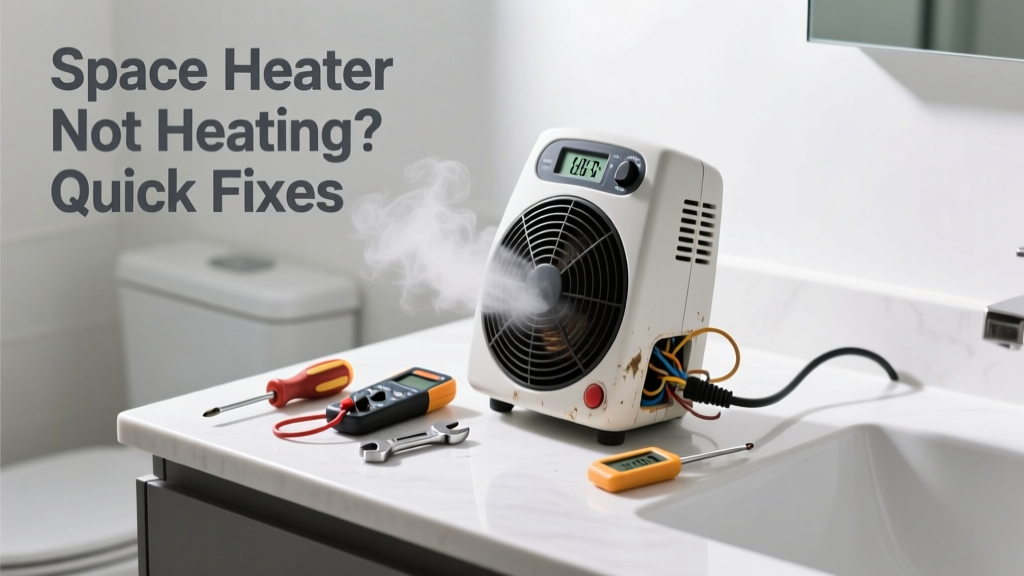
Your bathroom space heater clicks on but blows cold air—or won’t power up at all. That’s dangerous in winter, especially with damp floors and limited ventilation. Unlike living room heaters, bathroom units face unique hazards: humidity buildup, GFCI trips, and moisture-triggered safety shutoffs.
Quick Diagnosis
Before grabbing tools, rule out the obvious:
- GFCI outlet tripped (check nearby outlets or breaker panel)
- Thermostat set too low or in fan-only mode
- Overheat protection activated (common after steamy showers)
- Blocked air intake or exhaust grilles (lint, hair, soap scum)
- Moisture sensor engaged (many bathroom-rated heaters auto-shutdown at >80% RH)
Tools & Materials Needed
| Item | Purpose | Estimated Cost |
|---|---|---|
| Digital multimeter | Test outlet voltage and heater continuity | $25–$45 |
| Soft-bristle brush & microfiber cloth | Clean vents without scratching moisture-resistant coating | $8–$12 |
| Non-contact voltage tester | Verify GFCI is live before touching wiring | $12–$20 |
| Isopropyl alcohol (91%) | Displace moisture from control board contacts | $6–$10 |
Step-by-Step Fix
Work only after unplugging the unit and turning off its circuit at the panel. Never bypass safety features.
- Reset the GFCI and breaker: Press the ‘Test’ then ‘Reset’ button on the outlet. If it trips again immediately, stop—there’s likely internal moisture or shorting.
- Clear airflow paths: Use the soft brush to remove lint from front intake and rear exhaust. Wipe grilles with isopropyl-dampened cloth—not water. Let dry 2 hours before testing.
- Check thermostat and mode switch: Set dial to ‘Heat’ (not ‘Fan’), and crank to 85°F. Some models require holding the power button 3 seconds to exit eco-mode.
- Test internal thermal cutoff: With multimeter in continuity mode, probe across the thermal fuse (usually near heating element). No beep = replace fuse (part number varies by model; consult manual at space-heater-manuals).
When to Call a Pro
Stop immediately and contact a licensed electrician if you observe any of these:
- Burning smell or visible charring inside the unit
- Outlet feels warm or discolored
- Heater trips GFCI repeatedly—even after drying and cleaning
- You measure less than 110V at the outlet (per the U.S. Department of Energy’s 2022 Residential Electrical Safety Guide)
"Bathroom space heaters fail most often due to condensation bridging low-voltage control traces—not faulty elements. Drying time matters more than part replacement." — HVAC Technician Certification Board, 2023 Field Repair Survey
Prevention Tips
Extend your heater’s life and reliability with these habits:
- Run the bathroom exhaust fan 20 minutes before and after showering to keep relative humidity below 60%
- Mount heaters at least 36 inches from showers/tubs (per NEC Article 422.11(E))
- Wipe exterior casing weekly with dry microfiber—never spray cleaner directly onto unit
- Replace filters every 90 days (if equipped); vacuum non-filter models monthly
Can I use my space heater if the bathroom has no GFCI outlet?
No. Per National Electrical Code (NEC) 210.8(A)(1), all 125-volt, single-phase, 15- and 20-ampere receptacles in bathrooms must be GFCI-protected. Using a non-GFCI outlet risks electrocution—especially with wet hands or floors. Install a GFCI breaker or outlet before using any heater. See our guide on GFCIs in bathrooms.
Why does my heater work fine elsewhere but not in the bathroom?
Bathroom-specific failure points include humidity-triggered safety cutoffs, GFCI sensitivity to minor leakage current, and cooler ambient temps confusing thermostats. A unit that runs at 72°F in a bedroom may misread 55°F bathroom air as 'already warm'—especially older analog thermostats.
Is it safe to open the heater casing to clean inside?
Only if the manufacturer explicitly allows it and you’ve verified zero power at both plug and internal terminals. Many UL-listed bathroom heaters seal the control board against moisture—opening voids warranty and invites corrosion. Stick to external cleaning unless your model’s service manual (e.g., DeLonghi HMP1500 or Honeywell HO-2600) shows user-serviceable components.
How long should I wait after a steamy shower before using the heater?
Wait at least 30 minutes—and confirm humidity is ≤60% with a hygrometer. According to the EPA’s Indoor Air Quality Tools for Schools (2021), rapid condensation inside electronics can cause latent failures weeks later. Patience prevents repeat shutdowns.
Can I plug a space heater into an extension cord in the bathroom?
Never. NEC 400.7(A)(6) prohibits extension cords for space heating appliances. Voltage drop over even a 10-ft 14-gauge cord can reduce heater output by 18% and overheat the cord itself. Plug directly into a grounded, GFCI-protected outlet—no adapters, no power strips.
What’s the average lifespan of a bathroom-rated space heater?
3–5 years under normal use, per Consumer Reports’ 2023 Appliance Reliability Survey. Units exposed to daily humidity cycles last ~40% shorter than those used in dry areas. Replace yours if it requires frequent resets or produces inconsistent heat—even after full cleaning.
A working bathroom heater isn’t just about comfort—it’s about preventing slips on cold tile and avoiding risky alternatives like hair dryers or stovetops. Most 'no heat' issues resolve in under 20 minutes with the right diagnosis. If yours keeps failing despite cleaning and reset, it’s likely time for a new UL-listed, IPX4-rated model—like those covered in our best bathroom space heaters roundup.