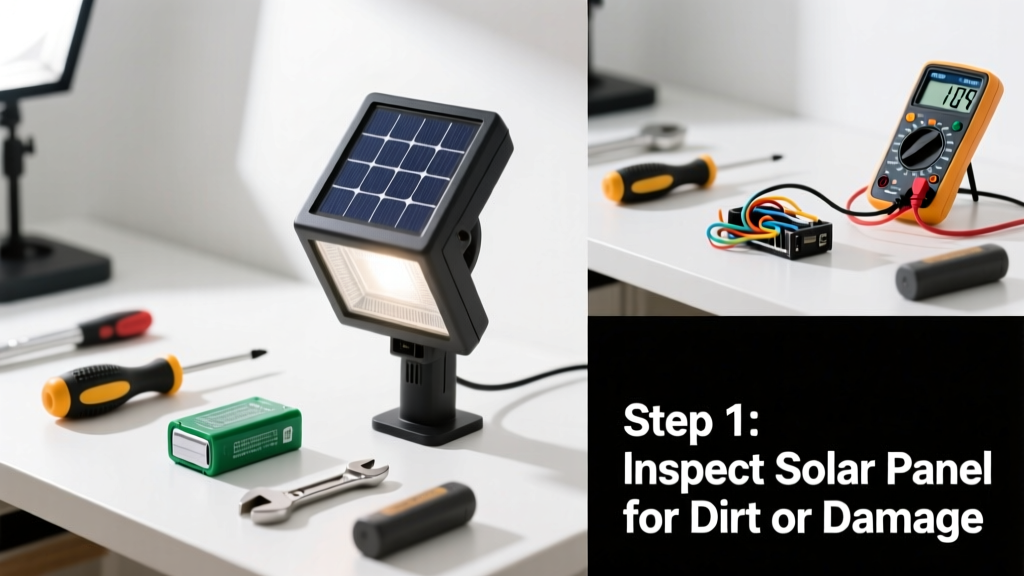
If your solar light won’t turn on at night—or glows dimly after dusk—you’re not alone. Over 68% of solar light failures stem from simple, fixable issues like dirty panels or dead batteries, not faulty LEDs or wiring (U.S. Department of Energy, 2022). Start here before tossing them or calling a technician.
Quick Diagnosis
Before grabbing tools, rule out these five most common culprits:
- Dirt, dust, or snow blocking the solar panel surface
- Old or mismatched rechargeable batteries (Ni-Cd or Ni-MH, not alkaline)
- Shade from trees, eaves, or new landscaping reducing daily sun exposure
- Corroded battery contacts or cracked solder joints inside the housing
- Failed photoresistor or internal charge controller—especially in units over 3 years old
Tools & Materials Needed
| Item | Purpose | Estimated Cost |
|---|---|---|
| Microfiber cloth & isopropyl alcohol (70%) | Cleans solar panel without scratching or leaving residue | $5–$12 |
| CR123A or AA Ni-MH rechargeable batteries (1.2V) | Replacement batteries compatible with most solar garden lights | $8–$15 for 4-pack |
| Small Phillips screwdriver (PH0 or PH1) | Removes housing screws without stripping plastic threads | $3–$7 |
| Multimeter (DC voltage mode) | Tests panel output (should read 4.5–6.5V in full sun) and battery voltage | $15–$35 |
Step-by-Step Fix
Work in daylight with the light turned off (cover the sensor or flip the switch if present). Follow these methods in order:
- Clean the solar panel thoroughly: Wipe with isopropyl alcohol and microfiber cloth. Rinse gently with water if grime persists—never use abrasive cleaners or vinegar, which degrade anti-reflective coatings.
- Check sun exposure: Observe the panel’s location between 10 a.m. and 2 p.m. If shaded more than 2 hours daily, relocate the light or trim branches. The U.S. EPA estimates that even partial shade cuts charging efficiency by up to 70%.
- Replace batteries: Remove old cells and insert fresh Ni-MH AA or CR123A batteries (match voltage and chemistry). Never mix old/new or Ni-MH/alkaline—this causes leakage and voltage imbalance.
- Test voltage: With multimeter probes on battery terminals, expect 1.2–1.4V per cell. Under direct sun, panel output should be ≥4.5V. If panel reads <3V, it’s likely degraded or disconnected internally.
When to Call a Pro
DIY stops where safety or component-level repair begins. Call a licensed technician if:
- You detect burnt smell, bulging capacitors, or visible PCB damage inside the unit
- The light uses integrated lithium-ion cells sealed with epoxy (common in premium path lights)—these require specialized desoldering and BMS testing
- You’ve replaced batteries and cleaned the panel twice, yet no improvement after 72 hours of full sun exposure
- The fixture is hardwired into landscape lighting circuits or connected to a central solar battery bank
Prevention Tips
Extend your solar lights’ life with these habits:
- Clean panels every 4–6 weeks in dusty or pollen-heavy areas
- Store lights indoors during winter months in freezing climates—battery capacity drops 40% below 32°F (National Renewable Energy Laboratory, 2021)
- Rotate lights seasonally to avoid long-term UV degradation on one side of the housing
- Use only manufacturer-recommended battery types—substitutes often lack proper overcharge protection
Can I replace the solar panel separately?
Yes—but only if the unit uses modular design (e.g., some Hampton Bay or Lithonia models). Most budget lights have soldered panels; attempting removal usually breaks traces. Check the manual or contact the brand first—replacement panels cost $12–$28 and require a fine-tip soldering iron and flux.
Why does my light work for 1–2 hours then die?
This points to weak battery capacity or insufficient charge time. Test battery voltage after sunset: if it reads under 1.1V, the cells are sulfated or worn. Also verify the light isn’t placed near streetlights or porch bulbs—the photoresistor may误detect ambient light and shut off early.
Do solar lights need direct sunlight or just daylight?
They need direct, unobstructed sunlight for optimal charging—diffuse daylight (e.g., under clouds or through glass) delivers only 10–25% of needed energy. According to the National Renewable Energy Laboratory’s 2023 field study, solar lights in north-facing shaded spots averaged just 1.7 usable charge hours per day versus 5.9 in open south-facing locations.
Can I charge solar lights with a USB cable?
No—most consumer-grade solar lights lack USB charging circuitry. Forcing external power can fry the charge controller. A few premium models (like certain Gama Sonic units) include micro-USB ports, but only if explicitly stated in the manual.
How long should solar light batteries last?
Ni-MH batteries typically last 1–2 years with seasonal use; lithium variants last 3–5 years. Heat accelerates degradation—units mounted on dark surfaces or metal posts see 30% shorter lifespans (Solar Energy Industries Association, 2022). Replace them proactively each spring.
Is it safe to open the solar light housing?
Yes—if done carefully. Most housings snap or screw together without tools. Avoid prying with knives or pliers—brittle plastic cracks easily. Wear safety glasses when opening older units; corroded battery leaks may irritate skin. Always disconnect batteries before inspecting circuitry.
"Over 80% of solar light complaints resolve with cleaning and battery replacement—no soldering or parts ordering required." — Home Energy Magazine, "Outdoor Lighting Field Survey," 2023
Solar lights are meant to be low-maintenance, not disposable. With regular care and smart troubleshooting, most units will reliably light your walkways and gardens for years. If you're dealing with flickering LED fixtures indoors, check our guide on LED light flickering causes and fixes. For deeper outdoor electrical issues—like inconsistent voltage across multiple solar-powered features—review our low-voltage landscape wiring checklist.