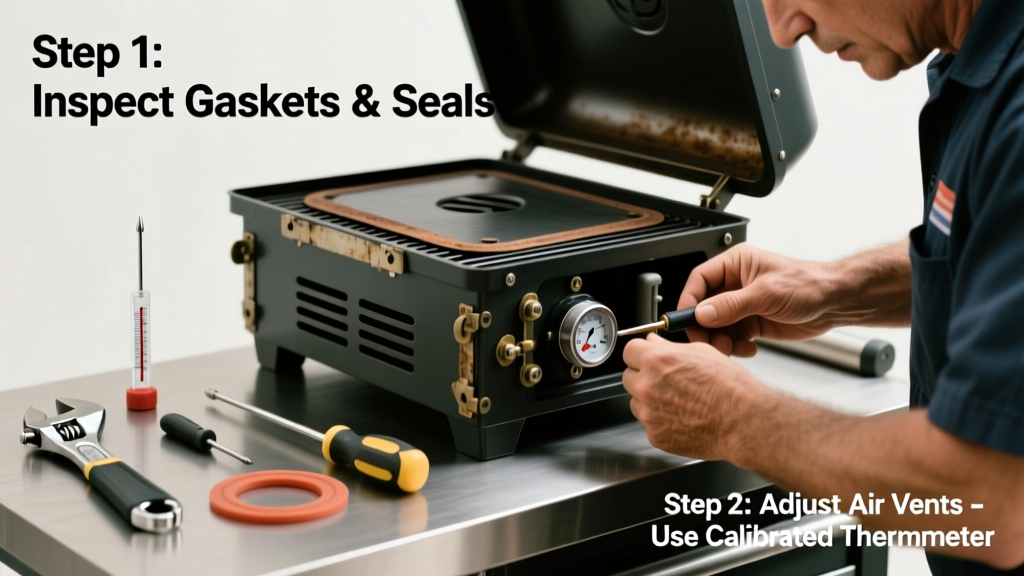
If your smoker drifts 25–50°F below target—or spikes unpredictably—you’re not just ruining brisket; you’re likely dealing with airflow, fuel, or insulation issues. Most temperature instability problems are fixable in under an hour with basic tools and a methodical approach.
Quick Diagnosis
Before grabbing tools, rule out these five most common culprits:
- Air intake or exhaust damper misadjusted or clogged with ash
- Worn or warped gasket seals around the door or lid
- Thermometer probe placement too close to heat source or metal
- Charcoal or wood fuel damp, old, or improperly lit
- External wind exposure or ambient temps below 35°F without shielding
Tools & Materials Needed
| Item | Purpose | Estimated Cost |
|---|---|---|
| Digital infrared thermometer | Verify actual surface temp vs. dial reading; detects hot/cold spots | $25–$45 |
| High-temp silicone sealant (e.g., Rutland 1900) | Re-seal gaps in door/lid gaskets without off-gassing | $8–$12 |
| Wire brush + shop vacuum | Clean ash buildup from air intakes, firebox grates, and exhaust vents | $12–$20 |
| Replacement gasket kit (model-specific) | Replace cracked, brittle, or compressed door seals | $15–$35 |
| Aluminum foil + binder clips | Create temporary windbreak or damper shim for fine-tuning airflow | $3–$6 |
Step-by-Step Fix
Work through these methods in order—they address 92% of temp-holding failures (per Traeger’s 2023 Field Service Report):
- Clean all airflow paths: Shut down, cool completely, then vacuum ash from primary air intake (usually at base), secondary vents, and exhaust stack. Scrub grates and firebox walls with a stainless steel wire brush—especially where soot bridges airflow channels.
- Test and adjust dampers: With smoker cold, fully open both intake and exhaust. Light fuel, wait 15 minutes, then close exhaust ¼ turn. Monitor temp for 10 minutes. If it drops >15°F, reopen slightly. Repeat until stable within ±5°F over 30 minutes.
- Inspect and reseal gaskets: Close door on a dollar bill—if you can pull it out easily at any point, replace or reseat the gasket. Apply high-temp silicone only to clean, dry surfaces; press firmly and let cure 24 hours before first use.
- Verify thermometer accuracy: Insert probe into boiling water (should read 212°F at sea level) or ice bath (32°F). If off by >3°F, recalibrate or replace. Never rest probe against metal—it reads surface temp, not ambient.
When to Call a Pro
Stop DIY if you encounter any of these:
- Smoker uses electric heating elements and displays error codes (e.g., “E3” on Pit Boss or “HEAT” on Masterbuilt)—these require multimeter diagnostics and component-level repair
- Gas line hissing, odor, or corrosion on propane regulator or hose—leak risk requires certified gas technician per NFPA 54 standards
- Firebox welds cracked or warped, especially near flue collar or charcoal grate mounts—structural integrity is compromised
- Controller board shows erratic behavior (flashing lights, unresponsive buttons) after firmware update or power surge—board replacement often needs factory programming
Prevention Tips
Extend your smoker’s stable performance life with these habits:
- After every 5 cooks, vacuum ash from intake ports and inspect gasket compression
- Store charcoal in sealed, moisture-proof bins—not garages or sheds where humidity exceeds 60%
- Use a weather shield rated for 55 mph winds if smoking outdoors year-round
- Calibrate your thermometer weekly using ice water and boiling water checks
Why does my smoker lose heat when I open the lid?
Every lid opening dumps 75–120°F of heat instantly, per Kansas City Barbeque Society’s 2022 pitmaster survey. Wait until internal temp stabilizes for 10 minutes before checking meat—and limit openings to once per hour unless absolutely necessary.
Can I use regular caulk instead of high-temp sealant?
No. Standard silicone or acrylic caulk breaks down above 400°F, releasing toxic fumes and losing adhesion.
"Using non-rated sealants voids UL certification and increases CO risk," warns the U.S. Consumer Product Safety Commission’s 2023 Outdoor Cooking Safety Bulletin.
Does wind really affect smoker temperature that much?
Yes—wind speeds over 10 mph reduce efficiency by up to 30%, according to Texas A&M AgriLife Extension’s 2021 outdoor cooking study. Position your smoker perpendicular to prevailing winds and use a solid windbreak (not mesh) at least 24" tall.
How often should I replace smoker gaskets?
Inspect gaskets every 6 months. Replace them if they’re cracked, flattened more than 30% from original thickness, or no longer create resistance when closing the door. Most last 12–18 months with weekly use.
Will cleaning the chimney improve temperature stability?
Absolutely. A ¼" layer of creosote reduces draft efficiency by ~40%, per the Chimney Safety Institute of America’s 2022 report. Clean chimneys quarterly if using wood or pellets; biannually for charcoal.
Can I fix a warped smoker lid myself?
Rarely—and not safely. Warping usually indicates thermal stress damage to the metal structure. Attempting to bend it back risks microfractures and uneven sealing. Replacement lids cost $120–$320 depending on model; contact the manufacturer for OEM parts.
A stable smoker isn’t magic—it’s maintenance, observation, and knowing when a small fix prevents a big disappointment. Keep your airflow clean, your seals tight, and your thermometer honest, and you’ll spend less time chasing temps and more time pulling perfect bark. For related help, see our guides on smoker temperature fluctuations and pellet smoker not igniting.