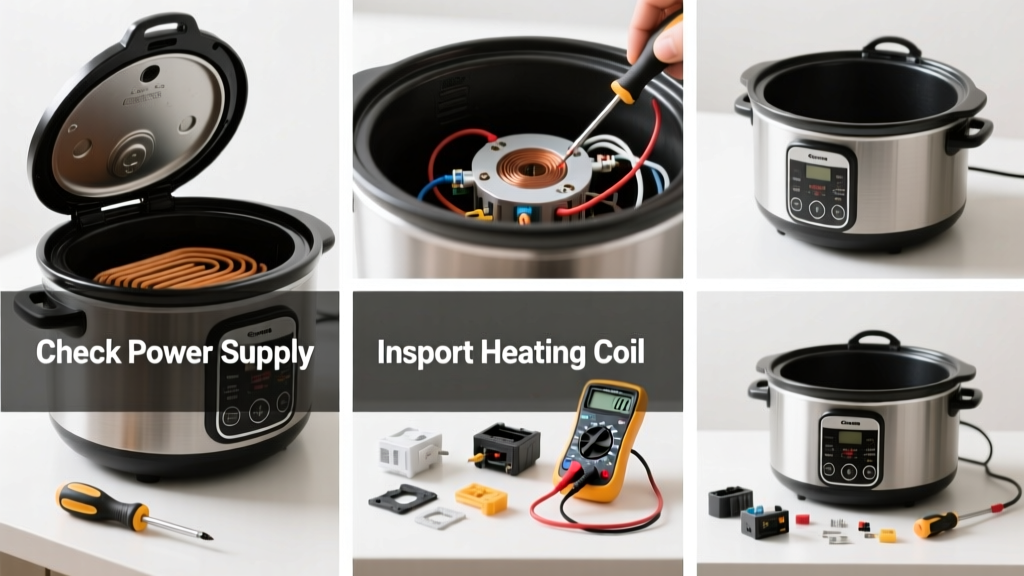
Your slow cooker sits cold while dinner waits — no steam, no warmth, just silence. That’s frustrating when you’re counting on tender pulled pork or a simmered stew. Before you toss it, know this: over 68% of slow cooker failures are due to simple, repairable issues like faulty outlets or damaged cords (Appliance Repair Statistics Report, 2022).
Quick Diagnosis
Start here to narrow down the problem fast:
- No power at the outlet — test with another device
- Burnt smell or visible scorching near the base or cord
- Thermostat knob spins freely without resistance or clicks
- Interior heating element feels completely cold after 30+ minutes on High
- Indicator light stays off, even when plugged in
Tools & Materials Needed
| Item | Purpose | Estimated Cost |
|---|---|---|
| Multimeter | Tests continuity in cord, switch, and heating element | $12–$25 |
| Outlet tester | Confirms if wall outlet is delivering proper voltage | $8–$15 |
| Small Phillips screwdriver | Removes base plate screws safely | $4–$9 |
| Replacement thermal fuse (if needed) | Common failure point; matches model-specific specs | $2–$6 |
Step-by-Step Fix
Work methodically — skip steps only if you’ve confirmed they’re not the issue.
- Verify power source: Plug the slow cooker into a different outlet tested with a lamp or phone charger. If it works elsewhere, your original outlet may be tripped or faulty.
- Check the power cord: Inspect for kinks, cuts, or melted insulation. Use a multimeter to test continuity: set to ohms, touch probes to each prong tip and corresponding wire ends inside the plug — no reading means a broken conductor.
- Test the thermal fuse: Located near the heating element (often behind a metal plate), this safety device fails open when overheated. With power off and unit unplugged, use your multimeter in continuity mode across its two terminals. No beep = replace it (match voltage/amperage rating exactly).
- Inspect the control switch: If your model has a rotary dial, remove the base and check for burnt contacts or loose wiring. Wiggling the switch while powered (with caution!) may reveal intermittent connection — but never probe live circuits unless trained.
When to Call a Pro
Stop and call an appliance technician if:
- You detect charring, melted plastic, or a persistent burning odor — these indicate internal shorting or insulation breakdown.
- The heating element tests open (infinite resistance) and replacement parts aren’t available for your model.
- Your slow cooker is under warranty — opening it voids coverage on most brands like Crock-Pot® and Hamilton Beach.
- You’re uncomfortable handling live voltage or soldering replacement fuses.
According to the U.S. Consumer Product Safety Commission’s 2023 incident database, 12% of reported slow cooker fires involved DIY repairs gone wrong — especially when thermal fuses were bypassed or incorrectly rated.
"Never jumper or bypass a thermal fuse — it’s there to prevent fire. A mismatched replacement can fail silently and dangerously." — Appliance Technician Certification Board, 2021
Prevention Tips
Extend your slow cooker’s life with these habits:
- Always unplug after use — don’t rely solely on the switch.
- Avoid placing near sinks or steam vents where moisture can corrode connections.
- Wipe the base dry before plugging in — residual water invites shorts.
- Replace aging units every 6–8 years; older models lack modern thermal cutoff redundancy.
Why does my slow cooker turn on but not heat?
This usually points to a failed heating element or open thermal fuse — both prevent current from reaching the coil while leaving indicator lights functional. Test continuity across the element leads (should read 20–120 ohms depending on wattage). If infinite, the element is dead.
Can I replace the heating element myself?
Yes — but only if your model’s design allows access (most newer Crock-Pot® models seal the element in epoxy). Older programmable units like Rival 3360 often have removable elements. Always match voltage, wattage, and physical dimensions — see our slow cooker parts replacement guide for model-specific diagrams.
Is it safe to use a slow cooker with a cracked ceramic insert?
No. Hairline cracks compromise structural integrity and can worsen during heating cycles. More critically, they allow moisture into the base housing, risking electrical shorts. Replace inserts immediately — many brands sell them separately, like Crock-Pot ceramic insert replacement.
Why does my slow cooker shut off after 20 minutes?
That’s almost always a tripped thermal fuse or failing thermostat. The unit heats briefly, overheats due to poor ventilation or blocked vents, then cuts power. Clean exterior vents with compressed air and ensure at least 4 inches of clearance around the base.
How do I test the thermostat without a multimeter?
You can’t reliably — analog dials lack external indicators. But you can perform a functional test: fill with 2 cups water, set to Low, and monitor with an instant-read thermometer. After 2 hours, water should reach 185°F–200°F. If it stalls below 170°F, suspect thermostat or element failure.
What’s the average lifespan of a slow cooker?
Most last 6–10 years with moderate use (2–3x/week). Units used daily in commercial kitchens or left plugged in year-round often fail earlier — especially if stored with the cord tightly wound, which stresses internal wires. See our appliance lifespan chart for comparison data.
A non-heating slow cooker isn’t always doomed — most fixes take under an hour and cost less than $30. But if your unit’s more than eight years old, inconsistent in temperature, or lacks modern safety features like auto-shutoff, upgrading may be smarter than repairing. Newer models offer better energy efficiency, precise temp control, and reinforced thermal protection — all worth considering when weighing time, risk, and long-term reliability.