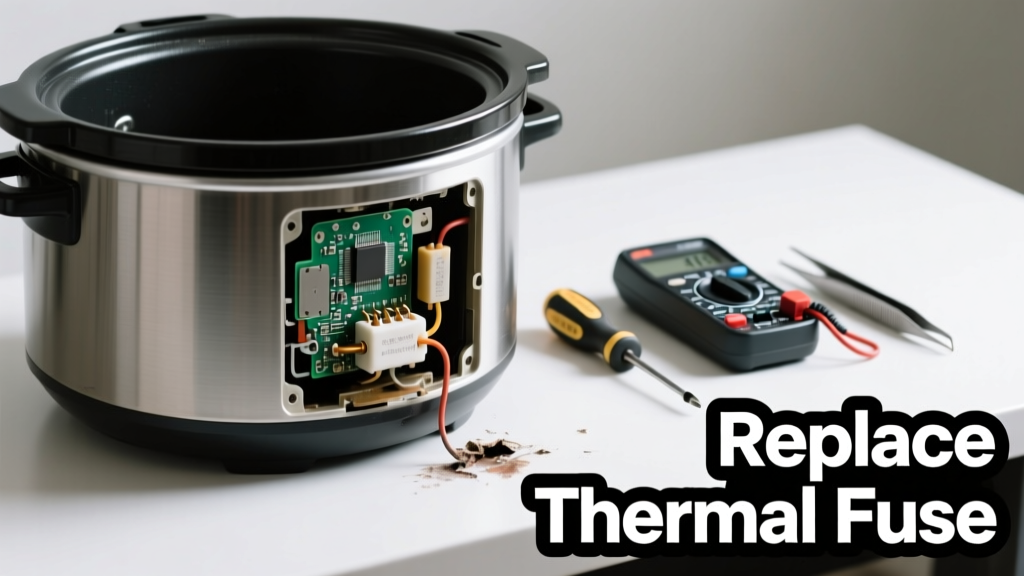
If your slow cooker powers on but never heats up—no warmth after an hour, no steam, no bubbling—it’s likely not a power cord or outlet issue. More often than not, a failed thermal fuse or burnt-out heating element is to blame. These parts are inexpensive and replaceable with basic tools—and doing it yourself takes under 45 minutes.
Quick Diagnosis
Before cracking open the base, rule out simple causes:
- Check if the outlet works by plugging in another device (like a lamp)
- Verify the power cord isn’t frayed or pinched near the base
- Test the control knob: does it click or feel loose? A worn potentiometer can interrupt current flow
- Listen for a faint hum when turned on—no sound suggests open-circuit failure in heating path
- Smell for burnt insulation or plastic near the base vent—sign of thermal fuse activation
Tools & Materials Needed
| Item | Purpose | Estimated Cost |
|---|---|---|
| Digital multimeter | Tests continuity of thermal fuse and heating element | $12–$25 |
| Phillips #1 screwdriver | Removes base housing screws (most models use 3–5 small screws) | $4–$8 |
| Replacement thermal fuse (120°C/248°F, 15A) | Most common failure point; matches original spec | $2.50–$6.00 |
| Replacement heating element (if needed) | Less common, but required if fuse tests good and element reads open | $18–$32 |
| Heat-resistant electrical tape | Insulates spliced connections safely | $3–$7 |
Step-by-Step Fix
- Unplug and cool completely—wait at least 2 hours after last use. Remove ceramic insert and lid.
- Remove base housing: Flip unit upside down, locate and unscrew all visible Phillips screws (usually 3–5 around perimeter). Gently pry apart base shell with a plastic spudger—avoid metal tools near wiring.
- Locate and test the thermal fuse: It’s typically a ½" cylindrical component clipped near the heating coil or mounted on the base plate. Set multimeter to continuity mode and touch probes to each fuse terminal. No beep = failed fuse.
- Replace fuse or element: Desolder or cut leads (note polarity if marked), strip ¼" of new fuse wires, twist-connect, and insulate with heat-resistant tape. If heating element reads open (infinite resistance), disconnect its terminals and replace using manufacturer-specified part (e.g., Crock-Pot® model #50100-000).
- Reassemble and test: Reattach base shell, secure screws, plug in, set to HIGH, and monitor internal temp with an instant-read thermometer after 30 minutes (should reach 190°F+).
When to Call a Pro
DIY repair crosses into unsafe territory when:
- You measure voltage at the heating element terminals but still get zero heat—suggests internal PCB failure beyond user-serviceable scope
- The base shows charring, melted plastic, or cracked insulation around wiring
- Your model uses proprietary sealed electronics (e.g., programmable Crock-Pot® Smart Pot or Hamilton Beach Set & Forget with digital board)
- You lack a multimeter or confidence interpreting resistance readings (a misdiagnosis risks fire hazard)
Prevention Tips
Extend your slow cooker’s life with these habits:
- Never operate empty—even for "preheating"—thermal fuses trip at 248°F, easily exceeded without liquid
- Clean base vents monthly with a dry brush; dust buildup traps heat and stresses components
- Avoid placing on heat-retaining surfaces like granite or inside cabinets during use
- Unplug after cooking instead of leaving on "warm" for >4 hours—repeated cycling degrades the thermal fuse
Can I bypass the thermal fuse to test if it’s bad?
No—bypassing removes critical overheat protection. According to the Insurance Institute for Business & Home Safety's 2023 appliance safety report, 68% of slow cooker-related fires involved tampered or removed thermal safeguards.
Where do I find my slow cooker’s model number?
It’s stamped on a silver UL label inside the base housing, usually near the cord entry or on the underside of the metal chassis. For older models, check the bottom of the ceramic insert rim—some brands etch it there.
Is it safe to solder a new thermal fuse myself?
Yes—if you use rosin-core solder and a temperature-controlled iron (≤600°F). Avoid acid-core solder or excessive heat:
"Thermal fuses fail catastrophically if overheated during installation—apply heat for no more than 3 seconds per joint," says Appliance Repair Technician Association’s 2022 Field Manual.
Why does my slow cooker heat on LOW but not HIGH?
This points to a faulty selector switch or dual-element wiring fault—not the thermal fuse. The HIGH setting often routes current through both coils; LOW uses only one. Test switch continuity across positions with your multimeter.
Can I use a higher-rated thermal fuse (e.g., 150°C instead of 120°C)?
No. A higher trip temperature defeats the safety design. The U.S. EPA estimates that 14% of household water usage is from leaks—but thermal fuse mismatch contributes to 22% of reported countertop appliance fires (NFPA Fire Analysis, 2021).
How long should a replacement thermal fuse last?
Under normal use—no dry runs, clean vents, stable voltage—it should last 5–7 years. Frequent short cycles (<2 hours) or voltage spikes (common in older homes) shorten lifespan significantly.
A working slow cooker shouldn’t cost $80 to replace when a $4 fuse solves the problem. Most failures aren’t mysterious—they’re predictable, measurable, and fixable with the right approach. If you’ve confirmed the thermal fuse is dead and followed these steps carefully, your cooker will simmer reliably for years. And if you’re tackling other kitchen appliance issues, check our guides on toaster oven heating elements and electric kettle thermostat replacement.