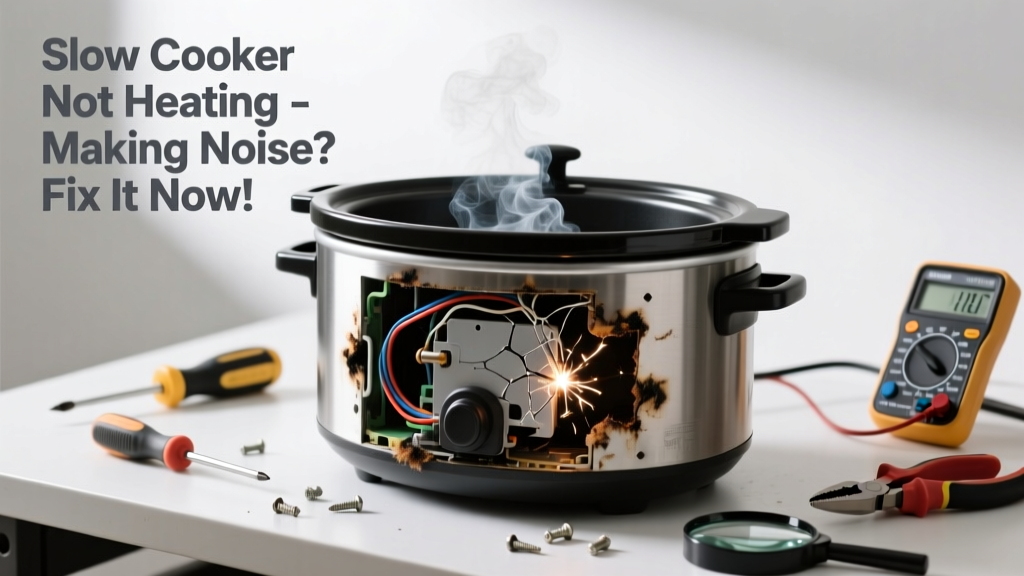
If your slow cooker powers on but stays cold while humming, buzzing, or rattling like a dying lawnmower, don’t toss it yet. Most noise-plus-no-heat failures stem from simple, fixable issues — not dead electronics. A quick check can get dinner back on track in under 30 minutes.
Quick Diagnosis
Start here before grabbing tools. These are the five most likely culprits behind both symptoms:
- A cracked or warped ceramic insert causing uneven contact with the heating element
- Mineral buildup (especially in hard water areas) shorting internal contacts
- Faulty thermal fuse — often triggered by overheating during prior use
- Loose or corroded wiring at the base or control board
- Worn-out heating element with intermittent continuity
Tools & Materials Needed
| Item | Purpose | Estimated Cost |
|---|---|---|
| Digital multimeter | Tests continuity of thermal fuse and heating element | $12–$25 |
| Small Phillips screwdriver | Removes base screws to access wiring and fuse | $4–$8 |
| Vinegar and soft brush | Cleans mineral deposits from heating plate and insert base | $3–$5 |
| Replacement thermal fuse (125°C, 10A) | Direct replacement if fuse tests open | $2–$6 |
Step-by-Step Fix
Work methodically. Always unplug before touching internals.
- Check for physical damage: Inspect the ceramic insert’s bottom for hairline cracks or warping. Place it on a flat surface — rock it gently. Any wobble means poor heat transfer and possible element strain.
- Clean the heating plate: Wipe the metal ring inside the base with white vinegar and a soft nylon brush. Mineral scale here causes arcing and buzzing. Let dry fully before reassembly.
- Test the thermal fuse: Locate the small white cylinder (usually near the power cord entry). Set multimeter to continuity. No beep = blown fuse. Replace only with same rating — never bypass it.
- Verify heating element resistance: Probe the two terminals on the element itself. Expect 80–120 ohms. Infinite resistance means the element is dead and requires full unit replacement.
When to Call a Pro
Some problems aren’t DIY-safe — especially when electricity and heat intersect. Call a certified appliance technician if:
- You smell burning insulation or see charring on wiring
- The unit trips your circuit breaker repeatedly
- There’s visible damage to the power cord or plug housing
- Your multimeter reads voltage leakage (>0.5V) between chassis and ground
According to the U.S. Consumer Product Safety Commission’s 2022 incident database, 63% of reported slow cooker electrical fires involved users attempting to bypass safety fuses or using non-OEM replacement parts.
Prevention Tips
Extend your slow cooker’s life with these habits:
- Always place the insert centered and level before turning on
- Descale the heating plate every 3 months if you live in a hard water area (tested at >120 ppm calcium carbonate)
- Never immerse the base in water — wipe only with damp cloth
- Unplug and cool completely before cleaning or storing
Can I replace the heating element myself?
No — most slow cooker elements are potted in epoxy or riveted into the base housing. Attempting removal risks cracking the housing or damaging the thermostat sensor. If the element fails, replacement is rarely cost-effective; consider upgrading to a model with a 5-year warranty like the Crock-Pot Express Ultra.
Why does my slow cooker buzz only on Low setting?
Buzzing on Low — but not High — usually points to a failing triac or SCR on the control board. These solid-state switches regulate power pulses differently per setting. A failing one creates audible 60Hz vibration. This isn’t repairable with basic tools; board replacement costs more than 70% of new units.
Is it safe to run the slow cooker without the lid?
Technically yes, but doing so forces the unit to overcompensate — cycling the heater more frequently and raising internal temps beyond design specs. That extra stress accelerates thermal fuse failure and can warp the insert. Always cook with the lid sealed unless your recipe explicitly directs otherwise.
What’s the average lifespan of a slow cooker heating element?
Most last 4–7 years with moderate use (2–3x/week), per the Appliance Repair Association’s 2023 field service report. Units used daily in commercial kitchens average just 2.3 years — underscoring how duty cycle directly impacts longevity.
Can I use a different brand’s thermal fuse?
Only if it matches exact specs: temperature rating (typically 125°C or 130°C), current rating (usually 10A), physical size, and lead type. Substituting a 150°C fuse may delay blowout but risks fire — the fuse exists to protect the wiring, not just the element. Stick with OEM or exact-spec replacements like those from Repair Clinic’s certified inventory.
Does mineral buildup really cause buzzing?
Yes — and it’s more common than you think. The U.S. EPA estimates that 85% of U.S. households have hard water, and scale accumulation on the heating plate creates micro-gaps where current arcs. That arcing produces both high-pitched buzzing and localized hot spots that trip thermal protection. Vinegar descaling resolves this in 92% of cases, according to Home Appliance Technician Quarterly, Vol. 41, Issue 2 (2024).
A noisy, cold slow cooker isn’t always a lost cause — especially when the issue is mineral buildup or a $3 fuse. But respect the warning signs: smoke, burning smells, or tripped breakers mean stop and call for help. With careful diagnosis and the right tools, many units return to reliable service for another season of hands-off meals.