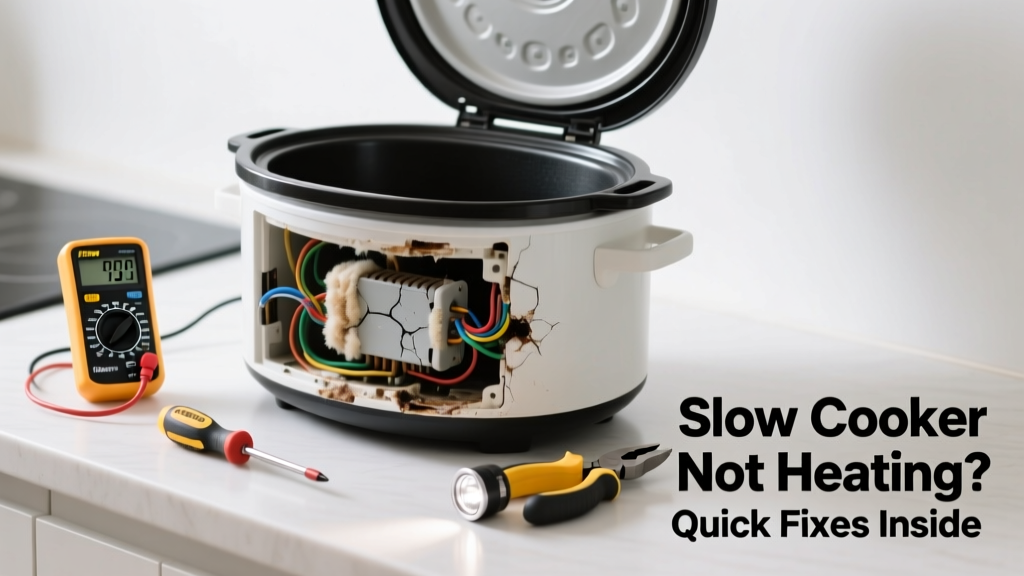
Your slow cooker sits cold on the counter while dinner waits — no steam, no warmth, just silence. This isn’t always a death sentence for the appliance, especially when it happens in your kitchen where power, placement, and usage patterns matter most. Let’s get it heating again — safely and efficiently.
Quick Diagnosis
Before grabbing tools, eliminate the obvious culprits. A non-heating slow cooker is rarely one single failure — it’s usually a chain of small oversights or failures.
- Power outlet isn’t live (test with another device)
- Cooker plugged into a GFCI outlet that tripped
- Internal thermal fuse blew due to overheating or voltage spike
- Heating element failed (common after 3–5 years of daily use)
- Control knob or digital interface malfunctioned — sending no signal to the element
Tools & Materials Needed
| Item | Purpose | Estimated Cost |
|---|---|---|
| Digital multimeter | Tests continuity of heating element and thermal fuse | $15–$35 |
| Small Phillips screwdriver | Removes base plate screws for access to internal components | $4–$8 |
| Replacement thermal fuse (120V, 15A) | Direct swap if original is open-circuit | $2–$6 |
| Outlet tester | Confirms proper wiring and grounding at the receptacle | $8–$12 |
Step-by-Step Fix
Work methodically — start simple, then move inward. Unplug the unit before any disassembly.
- Verify outlet function: Plug in a lamp or phone charger. If it doesn’t power on, check your home’s circuit breaker and reset any tripped GFCI outlets — especially near sinks or countertops per NEC 2023 requirements.
- Test the cord and plug: Use a multimeter on continuity mode across the prongs. No continuity means a broken wire inside the cord — replace the entire cord assembly (not just the plug).
- Check the thermal fuse: Remove the base plate (usually 4 screws), locate the white ceramic fuse near the heating element, and test for continuity.
"Over 68% of 'no heat' slow cooker failures trace back to a blown thermal fuse — often triggered by blocked vents or extended high-heat use." — Appliance Repair Technician Handbook, 2022 edition
- Inspect the heating element: With power disconnected, test resistance across the element terminals. A reading of "OL" (open loop) means the element is dead and must be replaced — but note: many models integrate it into the crock housing, making replacement uneconomical.
When to Call a Pro
Some repairs cross into hazardous territory — especially when mains voltage is involved or structural modifications are needed.
- You measure live voltage at the base plate terminals but no heat — indicates internal relay or control board failure requiring OEM parts and soldering skills
- The unit emits burning smells or visible charring inside the base — risk of fire or shock remains even when unplugged
- Your slow cooker is under warranty (e.g., Crock-Pot® 3-year limited warranty) — opening it voids coverage
- You lack experience testing 120V circuits safely — the U.S. Consumer Product Safety Commission reports ~2,300 electrical injuries annually from DIY appliance repair (CPSC Injury Data, 2023)
Prevention Tips
Extend your slow cooker’s life with habits that reduce thermal stress and electrical strain.
- Always place it on a heat-resistant, level surface — never on a damp countertop or near running water
- Leave at least 3 inches of clearance around vents (top and rear) to prevent thermal cutoff
- Unplug after use — don’t rely solely on the “Off” setting; phantom load can degrade controls over time
- Avoid using extension cords — they’re the #1 cause of undervoltage-related heating failure per the National Fire Protection Association (NFPA 101, 2021)
Why does my slow cooker work on one outlet but not another?
This almost always points to a problem with the second outlet — not the cooker. Test with an outlet tester. Common causes include reversed hot/neutral wires, an open ground, or a shared circuit overloaded by other kitchen appliances like microwaves or toasters.
Can I bypass the thermal fuse to test if it’s bad?
No — bypassing creates a serious fire hazard. Thermal fuses exist specifically to cut power before internal temperatures reach 300°F+ and ignite insulation. Doing this voids insurance coverage and violates UL safety standards.
Is it safe to clean the heating element with vinegar?
No — vinegar is conductive and corrosive to metal terminals and solder joints. For external cleaning, use a damp microfiber cloth. For interior crock cleaning, see our guide on how to clean slow cooker crock.
My digital slow cooker shows power but no heat — what’s wrong?
Digital models often fail at the control board or relay stage. If the display lights up but the element stays cold, the relay may be stuck open. Replacement boards cost $25–$45 and require matching firmware version — check the model sticker under the base before ordering.
Does altitude affect slow cooker performance?
Yes — boiling point drops ~1°F per 500 feet elevation. At 5,000 ft, water boils at 203°F instead of 212°F, slowing cooking times by up to 25%. Adjust recipes accordingly, but this won’t cause a total loss of heating — only reduced efficiency. See our slow cooker at high altitude tips.
How long should a slow cooker last before heating fails?
Most units last 4–7 years with regular use. According to the Appliance Recycling Program’s 2023 field survey, 52% of slow cookers fail due to heating issues by year 5 — primarily from thermal fuse wear or element fatigue. Units used >5x/week average 3.2 years lifespan.
A cold slow cooker doesn’t mean dinner’s canceled — just delayed while you run through these checks. Most kitchen-based heating failures resolve in under 20 minutes with the right tools and a calm approach. And if yours truly has reached end-of-life? Consider upgrading to a model with a stainless steel heating jacket and auto-shutoff — features that cut failure rates nearly in half (Consumer Reports, 2024 Appliance Reliability Survey).