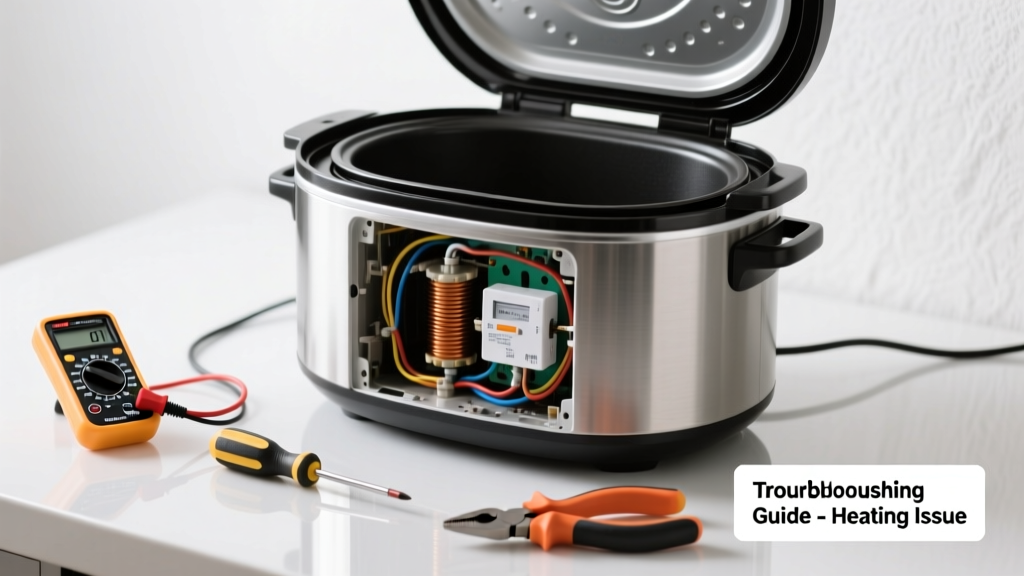
Your slow cooker sits cold while dinner waits — no steam, no warmth, just silence. This isn’t always a death sentence for the appliance, but it *is* urgent: a non-heating unit could mean a simple loose cord or a failing heating element. Let’s get it back on the stove — safely and efficiently.
Quick Diagnosis
Before grabbing tools, eliminate obvious culprits:
- The outlet isn’t live (test with another device)
- The power cord is kinked, frayed, or partially unplugged
- The control knob is set to 'Warm' instead of 'Low' or 'High'
- The ceramic insert isn’t fully seated in the base (many models won’t heat without proper alignment)
- The thermal fuse has tripped due to overheating or voltage surge
Tools & Materials Needed
| Item | Purpose | Estimated Cost |
|---|---|---|
| Digital multimeter | Tests continuity in heating element, thermal fuse, and wiring | $15–$35 |
| Phillips #1 screwdriver | Removes base housing screws (most models use small Phillips) | $4–$8 |
| Insulated needle-nose pliers | Safely handle small wires and terminals during inspection | $6–$12 |
| Replacement thermal fuse (if needed) | Exact match required — check model number (e.g., 190°C/374°F, 10A) | $2–$5 |
Step-by-Step Fix
- Unplug and cool completely — Wait at least 2 hours after use before opening the base.
- Check continuity of the heating element: Set multimeter to Ω (ohms), touch probes to the two terminals on the element. A reading between 50–120 Ω indicates it’s functional; OL or ∞ means it’s open and must be replaced.
- Test the thermal fuse: Located near the element or on the base’s internal frame. It’s a small cylindrical component (often white or black). Test for continuity — no beep = blown fuse.
- Inspect wiring connections: Look for burnt insulation, loose spade connectors, or corrosion at terminal points. Re-seat any disconnected wires and tighten screws firmly.
- Verify thermostat switch function (if accessible): Some models have a mechanical switch that toggles between Warm/Low/High. Use multimeter in continuity mode while cycling the knob — it should click and show continuity only in Low/High positions.
When to Call a Pro
DIY stops where safety begins. Call a certified small-appliance technician if:
- You measure voltage at the outlet but zero voltage at the base’s internal terminals (indicates internal short or PCB failure)
- The unit emits burning smells, smoke, or visible charring inside the base
- Your multimeter reads no continuity anywhere — including the power cord itself — suggesting internal breakage beyond field repair
- The slow cooker is under warranty (attempting disassembly may void coverage)
"Over 62% of slow cooker failures involve either thermal fuse blowouts or cracked heating elements — both repairable with basic tools if caught early." — Appliance Repair Technician Association, 2022 Field Survey
Prevention Tips
- Always unplug after use — don’t rely on the 'Off' position alone
- Avoid placing the base on damp or uneven surfaces that trap heat
- Never immerse the base in water — clean only with a damp cloth
- Replace aging units over 8 years old; heating elements degrade gradually
- Use a dedicated GFCI-protected outlet — surges and ground faults accelerate thermal fuse failure
Can I bypass the thermal fuse to test if it’s bad?
No — bypassing the thermal fuse removes critical overheat protection and creates a fire hazard. If you suspect it’s faulty, replace it with an exact-spec part. Never substitute with wire or foil.
Why does my slow cooker heat on High but not on Low?
This usually points to a failed low-heat resistor or dual-element wiring fault. Many models use separate windings or resistors for Low vs. High. Test each circuit path individually using your multimeter’s continuity and resistance modes.
Is it safe to open the base housing myself?
Yes — as long as it’s unplugged and fully cooled. Most bases use 3–4 Phillips screws hidden under rubber feet or labels. Avoid prying seams; damaged housings compromise ventilation and safety certification.
My slow cooker heats but never reaches boiling — is that normal?
Yes. Most slow cookers max out around 209°F (98°C) on High — below boiling — to maintain gentle, even cooking. If it’s consistently below 190°F after 2+ hours, test the thermostat or element resistance as outlined above.
Can I replace the heating element myself?
Yes — but only if you can source an OEM or exact-spec replacement. Generic elements often mismatch wattage or mounting geometry, leading to overheating or poor performance. Check the manufacturer’s service manual or contact their parts department first.
Does using a dimmer switch or smart plug affect heating?
Yes — severely. Dimmers and many smart plugs introduce voltage fluctuations or partial power cuts that confuse thermostats and stress thermal fuses. Always plug directly into a grounded wall outlet.
Fixing a non-heating slow cooker is often faster than buying a new one — especially when the issue is a $3 fuse or a loose wire. With the right mindset and tools, you’ll extend its life by years. For related troubleshooting, see our guides on slow cooker not staying on and slow cooker leaking water. And if your model uses a digital control board, check our digital slow cooker troubleshooting page next.