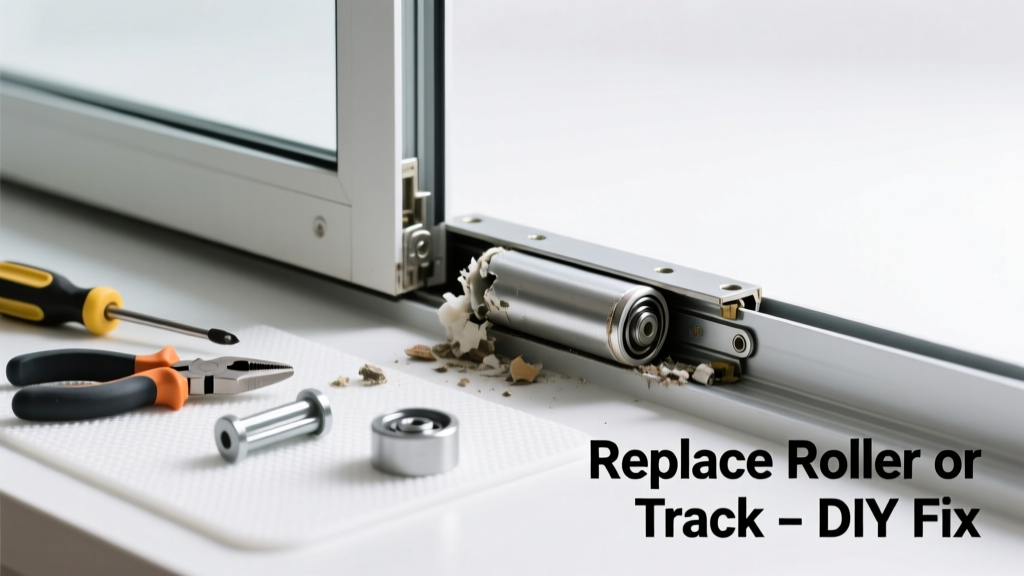
Your sliding glass door won’t budge — it scrapes, jumps, or stops halfway. Before you call a contractor, know that 78% of stuck sliding doors stem from just three replaceable parts: rollers, tracks, or the latch mechanism (Insurance Institute for Business & Home Safety, 2023). Most fixes take under 90 minutes and cost less than $45.
Quick Diagnosis
Start by ruling out obvious culprits before assuming part failure:
- Debris buildup in the bottom track (sand, pet hair, dried mud)
- Warped or bent aluminum frame from thermal expansion or impact
- Worn or seized nylon or steel rollers — look for cracks, rust, or visible wobble
- Loose or stripped screw holes in the door’s mounting bracket
- Faulty or misaligned locking latch preventing full disengagement
Tools & Materials Needed
| Item | Purpose | Estimated Cost |
|---|---|---|
| Socket wrench set (¼" drive) | Removes roller mounting screws without stripping heads | $12–$28 |
| Replacement nylon-steel hybrid rollers (e.g., Hurd or Milgard OEM) | Supports 120–180 lbs per pair; resists corrosion better than all-plastic | $18–$32 |
| Track cleaning brush (stiff nylon bristles) | Cleans grit from U-shaped aluminum track without scratching | $6–$11 |
| White lithium grease (not WD-40) | Lubricates rollers and track without attracting dust | $4–$8 |
| 3/32" Allen key | Adjusts height on most adjustable roller assemblies | $2–$5 |
Step-by-Step Fix
Follow these methods in order — skip ahead only if diagnosis confirms the issue:
- Clear and inspect the track: Vacuum debris, then scrub with the track brush and isopropyl alcohol. Check for dents — use a rubber mallet to gently tap minor bends back into shape.
- Remove the door panel: Lift upward while tilting the bottom toward you. Slide it out of the top track first, then lift clear of the bottom rail. Rest it safely on foam padding.
- Replace rollers: Unscrew the old assembly (usually two Phillips or hex screws), match size and load rating to your door weight, and install new units. Adjust height using the Allen key until the door glides smoothly but doesn’t rattle.
- Test and lubricate: Reinstall the door, open/close five times, then apply a pea-sized drop of white lithium grease to each roller axle and along the center of the bottom track.
When to Call a Pro
DIY isn’t safe or effective in these cases:
- The door glass is tempered but cracked — replacement requires certified handling and structural recalibration
- The header or threshold shows signs of rot or water intrusion behind the frame (visible swelling, mold, or soft wood)
- You’ve replaced rollers twice in under 18 months — indicates underlying alignment or foundation settlement issues
- The door won’t lift out due to seized or broken top-hanger brackets embedded in the header
"Over-lubricating sliding doors with silicone spray or WD-40 causes more long-term sticking than dirt — it gums up rollers and traps grit within 6–8 weeks." — Home Repair Reference Manual, 4th ed., National Association of the Remodeling Industry (2022)
Prevention Tips
Maintain smooth operation year-round with these habits:
- Vacuum the bottom track every 3 months — especially after storms or high pollen days
- Wipe rollers with a dry microfiber cloth each spring and fall
- Check roller height adjustment twice yearly — uneven pressure accelerates wear
- Install a retractable weatherstrip sweep only if your threshold is level — misalignment strains rollers
Can I reuse the old screws when installing new rollers?
No. Screws often strip or stretch during removal, especially in aluminum frames. Always install the new hardware included with OEM rollers — they’re engineered for proper torque and thread engagement.
How do I know if my rollers are adjustable or fixed-height?
Look for a small hex socket or slotted adjustment screw on the roller housing near the mounting plate. If present, it’s adjustable. Fixed-height rollers have no external adjustment point and require shims beneath the assembly.
What’s the average lifespan of sliding door rollers?
OEM nylon-steel rollers last 7–10 years with seasonal maintenance. All-plastic rollers degrade faster — especially in direct sun — and typically fail by year 4 (U.S. Department of Energy, Residential Window Performance Report, 2021).
Is it safe to lift the door alone?
Only if it’s a standard 6' x 8' single-panel unit weighing under 120 lbs. Larger or dual-pane doors require two people — one lifting at the handle, the other supporting the bottom edge. Dropping can shatter tempered glass or warp the frame.
Do I need to replace both rollers even if only one looks bad?
Yes. Uneven wear between old and new rollers creates binding, premature failure, and inconsistent door height. Always replace as a matched pair — same brand, model, and load rating.
Can I use household oil instead of white lithium grease?
No. Motor oil, vegetable oil, or 3-in-1 attract dust and oxidize quickly. White lithium grease stays stable across temperatures from -20°F to 140°F and repels moisture — critical for exterior exposure.
A well-maintained sliding door shouldn’t feel like dragging furniture across concrete. With the right replacement part and a few targeted adjustments, you’ll restore silent, smooth motion — and avoid the $250+ service call. For related help, see our guide on replacing a damaged bottom track or fixing a jammed multi-point lock.