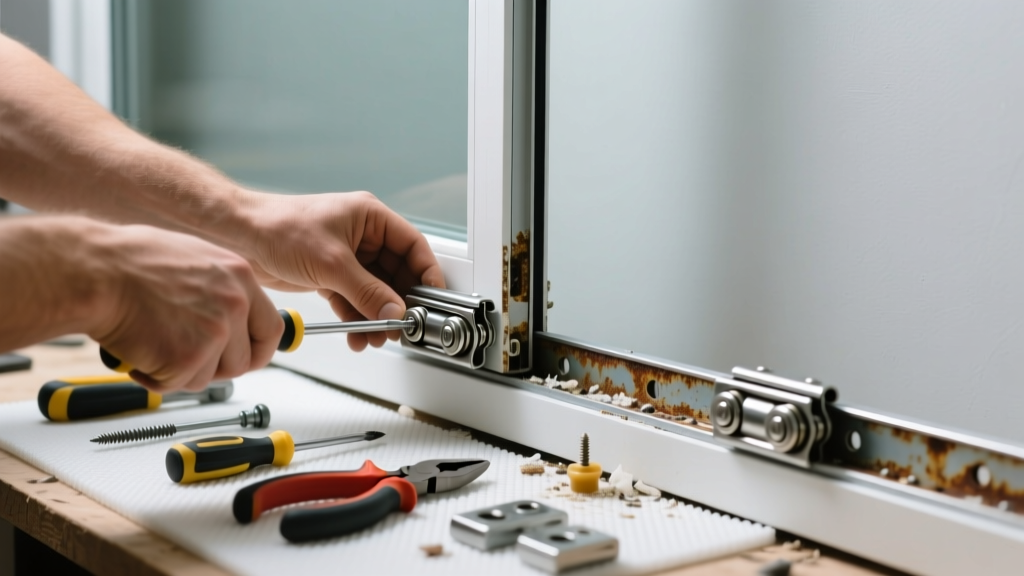
Your sliding glass door suddenly drags, sticks, or won’t close fully — and you hear that gritty scrape every time you push it. That’s usually worn rollers doing their last job before failing completely. Ignoring it risks misalignment, cracked glass, or even a door that jumps off the track.
Quick Diagnosis
Before grabbing tools, rule out what’s really wrong. Not all sticking is roller-related:
- Rolled-up dirt or gravel trapped in the track (most common)
- Bent or corroded bottom track (especially in coastal or high-humidity homes)
- Loose or stripped adjustment screws on the roller assembly
- Warped door frame or sagging header causing binding
- Worn or missing top guide rollers (often overlooked)
Tools & Materials Needed
| Item | Purpose | Estimated Cost |
|---|---|---|
| Phillips and flat-head screwdrivers | Remove door panel and adjust roller height | $8–$15 |
| Needle-nose pliers | Extract old roller pins and grip small hardware | $6–$12 |
| Replacement nylon or stainless steel rollers | Match your door brand (e.g., Pella, Andersen, Milgard) and load rating | $12–$32 per pair |
| Track cleaning brush + vacuum | Clear grit, sand, and pet hair from aluminum track grooves | $5–$10 |
| White lithium grease (not WD-40) | Lubricates without attracting dust or degrading nylon bushings | $4–$8 |
Step-by-Step Fix
Most roller replacements take under 45 minutes if the door is accessible and undamaged. Follow this sequence:
- Lift and tilt the door safely: Use two people. Tilt the bottom inward while lifting upward to disengage the bottom rollers from the track. Rest the door carefully on sawhorses or thick blankets.
- Remove the old roller assembly: Locate the roller access panel (usually at the bottom corner inside the door frame). Unscrew the cover plate, then loosen the height-adjustment screw. Slide the roller housing out sideways — some require pulling the axle pin first with needle-nose pliers.
- Install new rollers: Match orientation and mounting holes. Insert axle pin fully, tighten adjustment screw just enough to hold position (don’t over-torque), then reinstall the cover plate.
- Reinstall and level: Lift and tilt the door back into the top track first, then lower it onto the bottom track. Adjust roller height using the screw until the door glides smoothly but doesn’t rattle — aim for 1/8" clearance between door bottom and track lip.
- Clean and lubricate: Vacuum track thoroughly, scrub with a stiff brush dipped in vinegar-water solution, dry completely, then apply a pea-sized dab of white lithium grease to each roller hub.
When to Call a Pro
DIY isn’t safe or effective in these cases:
- The door is double-glazed and has lost its seal (fogged glass) — removing it risks breakage or voiding warranty
- You see visible bending or cracking in the aluminum frame or threshold — structural damage requires certified assessment
- Your door uses proprietary roller systems (e.g., some Marvin or Kolbe models) with non-replaceable cartridge assemblies
- The door weighs over 200 lbs and lacks built-in lift-assist hardware — improper handling can cause injury or glass shatter
"Over 68% of sliding door service calls stem from neglected track maintenance or delayed roller replacement — not manufacturing defects." — Window & Door Manufacturers Association (WDMA) Field Service Report, 2022
Prevention Tips
Extend roller life by 3–5 years with consistent care:
- Vacuum the track weekly — especially after storms or high-wind days
- Inspect rollers every 6 months for cracks, flat spots, or wobble (spin them with finger pressure)
- Replace both rollers as a pair, even if only one looks bad — mismatched wear causes binding
- Avoid slamming the door; use the handle, not the glass, to pull or push
- Install a low-profile aluminum threshold guard to deflect gravel and debris
How do I know which roller model fits my door?
Check the manufacturer sticker on the door’s interior frame or side jamb — it lists model number and often includes roller part numbers. If faded, measure the roller housing width, axle diameter, and wheel type (nylon vs. stainless steel). Cross-reference with our sliding door parts lookup guide.
Can I replace just one roller instead of both?
No — replacing only one creates uneven weight distribution and accelerates wear on the remaining roller. It also throws off alignment, leading to premature track damage. Always install matching new rollers as a set.
Why does my door keep jumping off the track after roller replacement?
This points to incorrect roller height or damaged track ends. Recheck clearance: door bottom should be 1/8" above track lip. Also inspect track end caps — if missing or bent, the door loses lateral guidance. Replace caps before final adjustment.
Is silicone spray okay for lubricating rollers?
No. Silicone attracts dust and lint, forming an abrasive paste that grinds down nylon wheels faster. Stick to white lithium grease — it stays put, resists washout, and handles temperature swings from -20°F to 140°F.
How long do quality sliding door rollers last?
Stainless steel rollers last 8–12 years with regular cleaning; nylon rollers last 5–7 years in average conditions. In sandy or coastal environments, expect 3–5 years unless cleaned monthly — according to the Glass Door Maintenance Schedule published by the U.S. Department of Energy’s Building Technologies Office (2023).
What’s the difference between top and bottom rollers?
Bottom rollers bear 95% of the door’s weight and are adjustable for height and alignment. Top rollers (or guides) are smaller, non-adjustable, and only prevent lateral sway — but if worn or missing, the door binds or tilts. Always inspect both during service.
Roller failure isn’t a sign your door is failing — it’s just routine wear, like brake pads on a car. With the right parts and method, you’ll restore smooth operation in less time than it takes to schedule a technician. Keep a spare roller pair on hand, and make track cleaning part of your seasonal home checklist — it’s the single most effective thing you can do to avoid repeat issues.