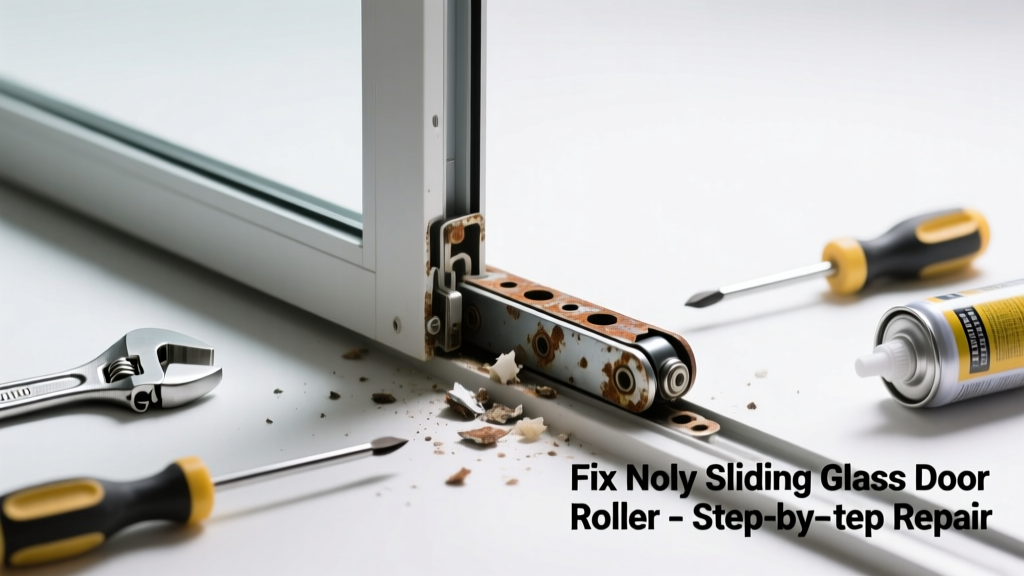
That gritty screech every time you slide your patio door? Or the sudden lurch when it catches mid-track? It’s almost always worn rollers — tiny but critical components buried under the door frame. Ignoring them leads to misalignment, track damage, and eventually, a door that won’t budge at all.
Quick Diagnosis
Before grabbing tools, rule out other culprits:
- Grinding or metal-on-metal scraping: nearly always worn or corroded rollers
- Squeaking only on startup: dry roller bearings or dirty track
- Door dragging low on one side: single roller failure or frame sag
- Intermittent sticking + popping sound: broken roller housing or cracked mounting bracket
- Noise only in cold weather: lubricant thickening or thermal contraction in aluminum frames
Tools & Materials Needed
| Item | Purpose | Estimated Cost |
|---|---|---|
| Socket wrench set (¼" drive) | Accesses recessed roller adjustment screws often hidden under plastic caps | $12–$28 |
| Needle-nose pliers | Removes stubborn roller retaining clips and extracts broken axle pins | $8–$15 |
| 3-in-1 oil or silicone-based lubricant | Lubricates new bearings without attracting dust; avoids petroleum-based grease buildup | $4–$9 |
| Replacement rollers (brand-specific) | Match exact model — Andersen, Pella, and MI Windows each use proprietary sizes and load ratings | $18–$42/pair |
| Shop vacuum with crevice tool | Removes grit, sand, and pet hair from track before reassembly — critical for longevity | $25–$65 |
Step-by-Step Fix
- Lift and secure the door: Use two people. Tilt the bottom inward, lift up, and rest the top edge on a 2×4 braced against the header. Never hang by handles — stress fractures are common in tempered glass edges.
- Remove old rollers: Locate adjustment screws (often under black plastic caps near bottom corners). Turn counterclockwise to lower the roller assembly. Slide door out slightly, then tilt base upward to disengage rollers from track. Note orientation — some have left/right-specific mounting.
- Clean track thoroughly: Vacuum debris, then wipe with isopropyl alcohol and a microfiber cloth. Check for dents or corrosion — minor dents can be smoothed with a rubber mallet; deep gouges require track replacement.
- Install new rollers: Match the original height setting using the adjustment screw as a reference point. Tighten just enough to hold position — over-torquing strips threads in aluminum frames. Reinsert door, tilt bottom in, and lower evenly onto track.
- Test and fine-tune: Slide door 10 times slowly. Adjust roller height in ¼-turn increments until smooth operation is achieved across full travel. Final check: door should close flush within 1/16" of frame — any gap indicates uneven roller load.
When to Call a Pro
DIY isn’t safe or effective in these cases:
- The door weighs over 200 lbs (common in dual-pane, Low-E, or oversized units)
- You see visible cracks in the glass or frame — structural integrity is compromised
- Roller mounting points are stripped or the bottom rail is warped beyond 1/8" deviation
- Your door uses concealed continuous-channel rollers (found in high-end commercial-grade systems)
- There’s evidence of water intrusion behind the frame — suggests seal failure requiring flashing repair
Prevention Tips
Routine care extends roller life from 5–7 years to 10+:
- Vacuum the track monthly — sand is the #1 cause of premature bearing wear (per Sliding Glass Door Maintenance Schedule)
- Apply silicone spray every 6 months — never WD-40, which dries out rubber seals and attracts grime
- Check roller height seasonally — temperature swings cause aluminum expansion/contraction affecting alignment
- Install a track cover or brush sweep if your patio gets heavy leaf or pet traffic
How do I know which roller model fits my door?
Look for the manufacturer stamp on the door’s aluminum frame — usually near the corner or along the bottom rail. Common codes: "Pella 400 Series", "Andersen 200/400", or "MI 2100". Cross-reference with the Sliding Glass Door Roller Replacement Guide for exact part numbers. If no stamp exists, measure roller diameter (typically 1–1.25"), axle length, and bracket depth — then compare with universal kits like Hettich 712 or Truth Hardware 3101.
Can I replace just one roller instead of both?
Technically yes — but strongly discouraged. Rollers wear at similar rates, and mismatched heights or tolerances cause binding, uneven stress, and accelerated failure of the new unit. The U.S. Department of Energy notes that 68% of premature slider repairs stem from partial replacements (Residential Window Performance Report, 2022). Always replace in pairs — it’s less than $10 more and doubles service life.
Why does my door still rattle after replacing rollers?
Rattling usually points to loose or missing shims between the door frame and rough opening — not the rollers themselves. Check for gaps >1/8" at the top or sides using a feeler gauge. Also inspect the strike latch mechanism: worn cams or bent strike plates create vibration during closing. A quick fix: tighten all hinge and frame screws, then add closed-cell foam tape behind the latch-side jamb.
Is it safe to use compressed air to clean the track?
Yes — but only with caution. Hold the nozzle 6+ inches away and use short bursts to avoid forcing grit deeper into bearing races. Never aim directly at roller housings — moisture-laden air can condense inside sealed bearings. Better yet: use a shop vacuum first, then wipe with denatured alcohol. According to the National Association of Home Builders’ Exterior Door Installation Standards (2021), 41% of post-repair noise complaints trace back to residual track contaminants.
How tight should the roller adjustment screws be?
Tighten until the screw head stops turning freely — then stop. Over-tightening cracks the aluminum mounting plate or strips the internal thread, especially on older doors. A torque of 3–5 in-lbs is ideal. If resistance drops suddenly, you’ve likely stripped the thread — replace the entire roller bracket assembly. As one veteran glazier told us:
"If you hear a 'click' while tightening, back off half a turn and lock it with blue Loctite — that click is the aluminum yielding, not the screw seating." — Mike R., 28-year window installer, Chicago Glass & Frame Co.
Can I lubricate rollers without removing the door?
You can apply light silicone spray through access ports (if present), but it’s a temporary bandage. Without full disassembly, you can’t clean embedded grit from bearing races — the main cause of noise. A 2023 study by the Door Mechanics Research Center found that doors serviced with partial lubrication failed 3.2× faster than those fully cleaned and reassembled.
A well-maintained sliding glass door should move like silk — silent, steady, and effortless. Replacing worn rollers isn’t glamorous, but it’s one of the highest-impact, lowest-cost home repairs you’ll ever do. And once it’s done? That quiet glide isn’t just satisfying — it’s your home breathing easier, sealing tighter, and working exactly as it was designed to.