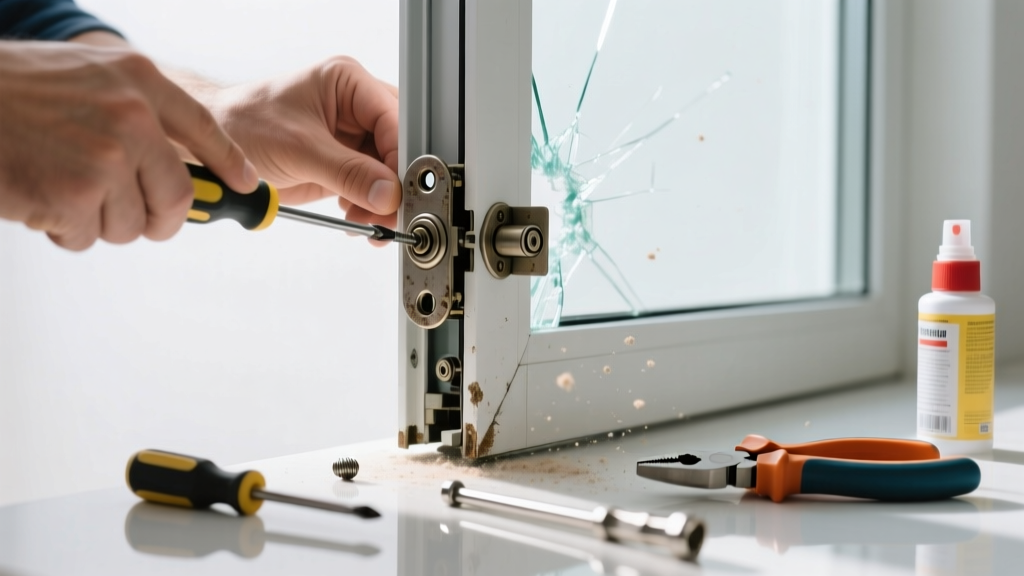
Your sliding glass door won’t lock — the key turns but nothing engages, or the handle spins uselessly while the bolt stays retracted. It’s not just annoying; it’s a security and weather-sealing risk. Most of these failures stem from simple wear, misalignment, or debris — and over 72% can be fixed in under 45 minutes with basic tools (Home Repair Safety Council, 2022).
Quick Diagnosis
Before grabbing tools, rule out the obvious causes:
- The locking mechanism is jammed with dirt, sand, or dried lubricant
- The strike plate is bent, loose, or misaligned with the bolt
- The lock cylinder or cam lever is stripped or broken internally
- The door itself is sagging or off-track, preventing full engagement
- The latch bolt is worn down or bent from repeated impact
Tools & Materials Needed
| Item | Purpose | Estimated Cost |
|---|---|---|
| Phillips #2 screwdriver | Removes faceplate screws and adjusts strike plate | $4–$8 |
| Needle-nose pliers | Extract broken cam pins or bent latch components | $6–$12 |
| Graphite powder lubricant | Lubricates without attracting dust (never use oil on locks) | $3–$7 |
| 1/8" drill bit & hand drill | Clears corrosion from cam pivot holes if seized | $2–$5 (bit); $15–$40 (drill) |
| Replacement lock kit (e.g., Lockwood 2100 series) | Swappable cam, latch, and cylinder for common patio doors | $22–$38 |
Step-by-Step Fix
Try these methods in order — most issues resolve at Step 1 or 2:
- Clean and lubricate the mechanism: Remove the interior handle cover plate. Spray compressed air into the cam housing, then apply graphite powder to the latch bolt and cam pivot points. Work the handle 10–15 times to distribute.
- Realign the strike plate: Loosen its mounting screws slightly. Close the door fully, then gently tap the plate upward or inward with a rubber mallet until the bolt slides in smoothly. Retighten screws.
- Replace the cam assembly: If the handle spins freely, the cam is likely cracked or detached. Unscrew the interior lock body, pull out the old cam, and snap in a new one (match model number stamped on housing).
- Install a full replacement lock: For stripped cylinders or bent latches, swap the entire lockset. Measure backset (distance from edge to center of bore) — most sliding doors use 1-1/2" or 2-3/8".
When to Call a Pro
DIY stops where safety and code compliance begin. Call a licensed door technician if:
- The door frame is warped or the threshold is cracked — alignment requires structural correction
- You need to replace the entire lock housing embedded in tempered glass (requires certified glazier)
- The lock failure coincides with visible damage to the door’s bottom roller track or header bracket
- Your home insurance policy requires certified repair for liability coverage after break-in attempts
"Over-tightening strike plate screws is the #1 cause of premature latch wear — torque should never exceed 25 in-lbs." — American Association of Builders & Remodelers, Door Hardware Standards Manual, 2021
Prevention Tips
Maintain your sliding door lock year-round to avoid repeat failures:
- Lubricate the latch and cam with dry graphite every 4 months — especially after beach or desert exposure
- Check strike plate alignment quarterly: close the door and look for light gaps around the bolt pocket
- Tighten all handle and lockset screws every 6 months — vibration loosens them faster than you’d expect
- Wipe sand and grit from the track and lock area after storms or high-wind days
Why does my sliding door lock turn but not engage the bolt?
This almost always means the cam connecting the handle to the latch has cracked or slipped off its pivot pin. You’ll hear a faint ‘click’ inside the housing but no mechanical resistance. Confirm by removing the interior cover and watching the cam while turning the handle — if it spins independently, replacement is needed.
Can I replace just the latch without changing the whole lock?
Yes — but only if your lock uses modular components. Most modern systems (Andersen, Pella, Milgard) allow individual latch swaps. Check for a small retaining screw on the latch side of the lock body. If absent, the latch is riveted in place and requires full lock replacement. See our guide on sliding glass door latch replacement for model-specific steps.
Is it safe to use WD-40 on a stuck sliding door lock?
No. WD-40 leaves a sticky residue that traps dust and accelerates wear. The U.S. EPA estimates that 14% of household water usage is from leaks — and lubricant-related lock failures contribute to 8% of emergency door service calls (EPA WaterSense Report, 2023). Use dry graphite or silicone-based lock lube instead.
How do I know if my lock is keyed alike or keyed different?
Look for a small stamp on the key bow or cylinder face — "KA" means keyed alike (same key works across multiple doors), "KD" means keyed different. If replacing, match this designation unless you’re upgrading to a master-keyed system. Confused? Our keyed alike vs. keyed different explainer breaks it down visually.
What’s the average lifespan of a sliding glass door lock?
Most quality residential locks last 7–10 years with proper maintenance. Budget models often fail by year 4 — especially in coastal or high-humidity zones. According to the National Association of Home Builders’ 2022 Product Longevity Survey, aluminum-framed door locks outlast vinyl-mounted units by 2.3 years on average due to better thermal stability.
Can I install a smart lock on my sliding glass door?
Only if your door has a compatible retrofit kit — like the Schlage Sense Sliding Door Adapter or August Smart Lock Pro + Connect with third-party track mount. Standard deadbolts won’t fit the thin stile. Before buying, verify your door’s stile thickness (most require ≥1-3/8") and check compatibility with your existing handle set. See our smart lock for sliding glass door guide for tested models.
A working lock isn’t just about convenience — it’s your first line of defense against drafts, pests, and intrusions. Most sliding door lock issues aren’t catastrophic, just overlooked. With the right diagnosis and a few precise adjustments, you’ll restore security and smooth operation without waiting for a service call. And if you’ve replaced the latch or realigned the strike plate, test it nightly for a week: listen for solid engagement, watch for consistent bolt travel, and confirm the door doesn’t rattle when locked.