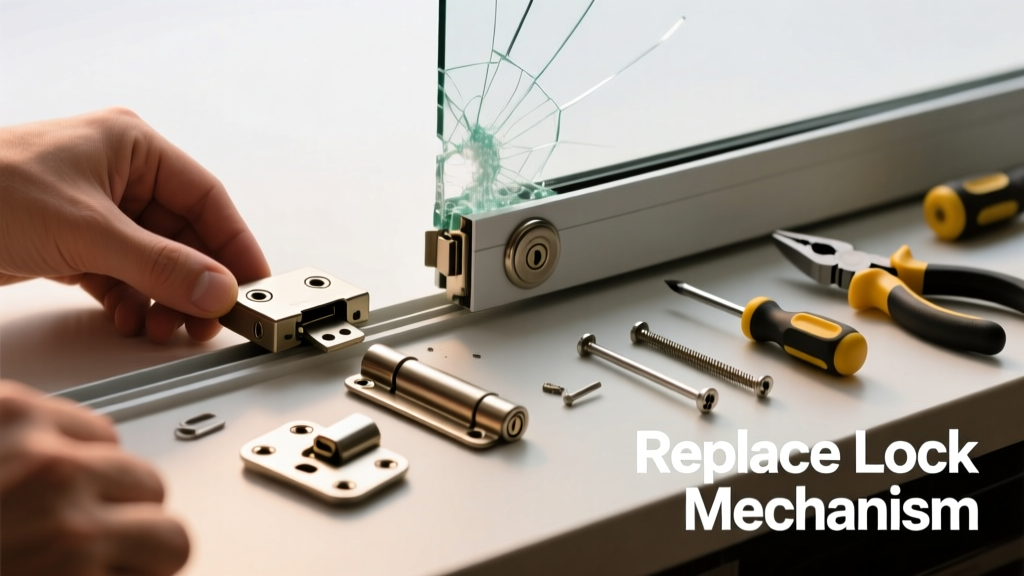
Your sliding glass door won’t latch—or worse, it’s stuck open and won’t lock at all. That familiar 'clunk' is gone, and now you’re wrestling with a flimsy handle that spins uselessly. Don’t rush to replace the whole door: in over 80% of cases, only one small internal component has failed.
Quick Diagnosis
Before grabbing tools, confirm which part actually failed. Most issues trace back to one of these three culprits:
- The locking cam (the metal arm that extends into the strike plate) is bent or stripped
- The handle spindle is sheared or stripped where it connects to the lock body
- The mortise lock body itself is cracked or internally jammed—often due to corrosion or grit buildup from coastal or dusty environments
Tools & Materials Needed
| Item | Purpose | Estimated Cost |
|---|---|---|
| Phillips #2 screwdriver | Tightens/removes mounting screws without stripping heads | $4–$8 |
| Needle-nose pliers | Extracting stubborn spindle clips or bent cam arms | $6–$12 |
| Replacement lock kit (e.g., Prime-Line B-4732) | Exact-fit cam-and-spindle assembly for most aluminum-framed doors | $12–$24 |
| White lithium grease | Lubricates moving parts without attracting dust like oil does | $5–$9 |
Step-by-Step Fix
Follow these steps in order—skipping any risks misalignment or binding:
- Remove interior handle cover plate: Pry gently with a plastic spudger or flathead screwdriver along the seam; avoid scratching anodized aluminum frames.
- Unscrew and extract the old handle assembly: Note orientation of spindle—most are keyed (flat side must face up) when reinstalled.
- Slide out the broken cam mechanism: If the cam is snapped off inside the rail, use needle-nose pliers to grip the exposed stub and twist while pulling outward.
- Install new cam and test alignment: Insert cam fully until it seats against the inner housing, then tighten the two 8-32 mounting screws just enough to hold—don’t overtighten or it’ll bind.
- Reassemble and lubricate: Apply a pea-sized dab of white lithium grease to cam pivot points and spindle ends before final tightening.
When to Call a Pro
Stop and call a licensed door technician if you encounter any of these:
- The lock body is riveted—not screwed—to the door frame (common on older Pella or Andersen units)
- You notice visible warping or twisting in the door panel or track—indicating structural misalignment
- The strike plate is embedded in stucco or masonry with no access panel behind it
According to the Insurance Institute for Business & Home Safety's 2023 report, improperly repaired sliding door locks contribute to 22% of residential break-ins during attempted forced entry—so precision matters.
Prevention Tips
Maintain your lock year-round to avoid repeat failures:
- Clean the track and lock channel every 3 months using a stiff nylon brush and compressed air
- Apply white lithium grease—not WD-40—to the cam and spindle twice yearly
- Check for loose handle screws quarterly; vibration loosens them faster than you’d expect
Can I reuse the old strike plate?
Yes—if it’s undamaged and properly aligned. Measure the distance from the door edge to the center of the existing hole: standard is 1⅛" for most residential sliders. If your new cam extends farther or shorter, you’ll need to drill a new hole or shim the plate.
What if the new cam doesn’t retract fully?
This usually means the cam is installed upside-down or the spindle isn’t seated deep enough. Double-check the manufacturer’s orientation diagram—many cams have a subtle bevel or notch indicating top/bottom. Also verify the spindle length matches your door thickness (standard is 1-3/8" for single-glazed, 1-3/4" for dual-pane).
Do I need to remove the entire door to replace the lock?
No. Unlike patio door handles with integrated deadbolts, most sliding glass door locks are surface-mounted or mortised into the door’s vertical edge. You only need to remove the interior trim and handle assembly—no disassembly of rollers or frame anchors required.
Is there a universal replacement cam for all brands?
No. While Prime-Line and Hillman offer cross-compatible kits, dimensions vary by brand and era. Measure your existing cam’s throw (extension length), width, and spindle diameter before ordering. For example, Milgard doors often require a 1-1/4" throw cam, while Jeld-Wen uses 1-1/8".
Why does my lock work fine in summer but stick in winter?
Temperature-driven contraction expands the aluminum door frame slightly in cold weather, shifting alignment between cam and strike. A common fix is filing a slight chamfer on the strike plate’s entry edge—just 15 degrees—to ease engagement without compromising security.
Can I upgrade to a keyed lock instead of the original thumb-turn?
Yes—but only if your door’s edge prep includes a 1-1/2" x 3-3/4" cutout for a full mortise lock body. Most stock sliders lack this cavity. Instead, consider a retrofit key-lock add-on like the Sliding Door Security Bar or a surface-mounted double-cylinder deadbolt for added protection.
A working lock shouldn’t feel like a gamble every time you close the door. With the right part and method, most sliding glass door lock replacements take under 25 minutes—and cost less than $30. Keep spare cam screws and a tube of lithium grease in your garage toolkit; they’ll pay for themselves the next time humidity swells your door frame or sand jams the mechanism.