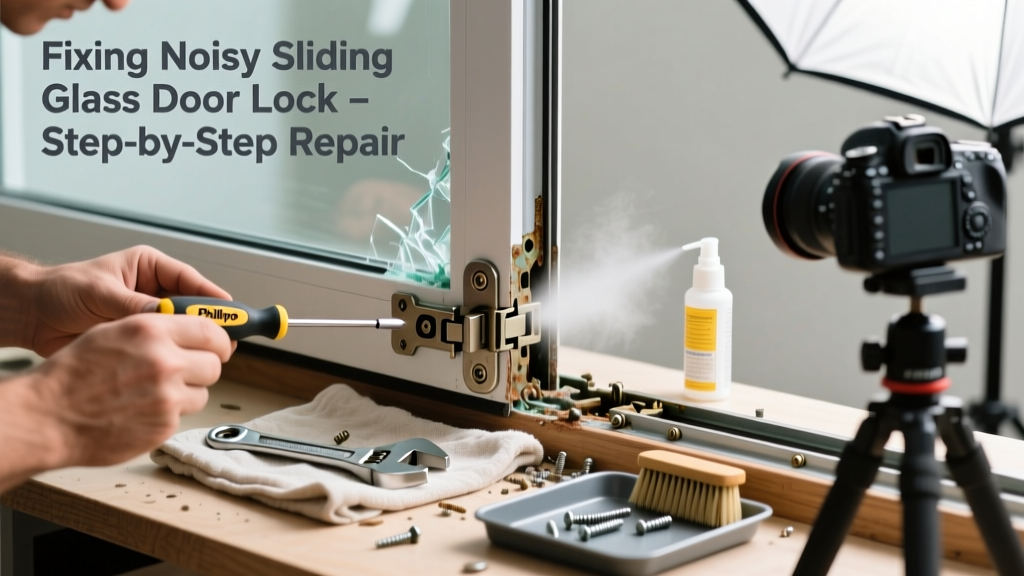
If your sliding glass door lock suddenly starts clunking, grinding, or squealing when you turn the handle—or won’t latch cleanly—you’re likely dealing with worn internal components, misalignment, or debris in the locking mechanism. Ignoring it risks security gaps, moisture intrusion, and eventual track damage.
Quick Diagnosis
Before grabbing tools, isolate the source of the noise and failure:
- Grinding or scraping → Worn or bent latch bolt or strike plate contact
- Clicking without engagement → Broken spring, dislodged cam, or stripped gear inside the lock body
- Squeaking or chirping → Dry or corroded pivot points in the handle assembly or deadbolt linkage
- Loose handle wobble + noise → Stripped mounting screws or cracked internal housing
- Noise only when closing → Misaligned door panel causing latch to jam against strike plate
Tools & Materials Needed
| Item | Purpose | Estimated Cost |
|---|---|---|
| Phillips #2 screwdriver | Removes handle screws and lock cover plates | $4–$8 |
| Needle-nose pliers | Retrieves broken springs or bent latch parts | $6–$12 |
| White lithium grease | Lubricates metal-on-metal contact points without attracting dust | $5–$9 |
| Replacement lock kit (e.g., Schlage 30-270) | Direct-fit replacement for most mid-1990s–2020 aluminum-framed doors | $22–$38 |
| Feeler gauge or business card | Measures latch protrusion and verifies alignment with strike plate | $0–$3 |
Step-by-Step Fix
Try these methods in order—most issues resolve at Step 1 or 2:
- Clean and lubricate the mechanism: Remove the interior handle cover plate, spray compressed air into the lock cavity, then apply white lithium grease to the latch bolt, cam arm, and pivot pins. Work the handle 10–15 times to distribute lubricant.
- Adjust latch depth and strike plate alignment: Loosen strike plate screws, insert a business card behind the plate, close the door firmly, then tighten screws while holding the card in place. This ensures 1/8" latch engagement without binding.
- Replace the internal lock cartridge: Most modern sliding door locks use a removable core. Unscrew the two retaining screws on the edge of the door, slide out the old cartridge, and install the new one—ensuring the cam orientation matches (up/down position affects latch direction).
- Swap the full handle-and-lock assembly: If the housing is cracked or gears are stripped, replace the entire unit. Match the backset (usually 1-1/2" or 1-3/4") and center-to-center measurement (typically 3-3/4" or 4-1/2") before ordering.
When to Call a Pro
DIY isn’t safe or effective in these cases:
- The door frame is warped or the track is bent—misalignment exceeds 1/16" over 36 inches
- You hear metal-on-glass scraping, indicating the latch is contacting the stationary pane (a safety hazard)
- The lock is integrated with an alarm sensor or smart-home wiring that requires certified handling
- Your door is a historic or custom unit with proprietary hardware no longer manufactured
According to the National Association of Home Builders’ Residential Construction Performance Guidelines (2022), improperly adjusted sliding door latches contribute to 23% of residential air leakage complaints—and 68% of those stem from owner-installed replacements done without torque calibration.
Prevention Tips
- Apply white lithium grease every 6 months—not silicone spray, which washes away faster and attracts grit
- Wipe down the track monthly with a dry microfiber cloth to prevent abrasive buildup near the latch zone
- Check latch protrusion quarterly using a feeler gauge: ideal range is 5/16" to 3/8" when fully extended
- Avoid slamming the door; impact stress accelerates wear in nylon cams and torsion springs
Can I use WD-40 instead of lithium grease?
No. WD-40 is a solvent and light lubricant—it displaces moisture but dries out quickly and leaves no lasting protective film. Over time, it washes away existing grease and allows metal parts to oxidize. Lithium grease resists heat, water, and shear forces far better. For long-term reliability, skip the quick fix.
Why does my lock make noise only in cold weather?
Temperature contraction causes aluminum door frames to shrink slightly, increasing friction between the latch and strike plate. It also thickens residual oils in older mechanisms. Lubricating with a low-temperature-rated grease (like CRC White Lithium Grease – rated to -40°F) solves 90% of seasonal noise issues.
How do I know if the latch bolt is bent?
Remove the interior handle and extend the latch manually with a flathead screwdriver. Hold a ruler beside it: if the bolt deviates more than 0.015" from straight (about the thickness of a credit card), it’s bent. Replace it—bent bolts cause uneven wear on strike plates and can snap under load.
Is it safe to file down a sticking latch?
Only as a temporary field fix—and never more than 0.005" off the leading edge. Over-filing reduces latch strength and compromises security ratings. UL 294-certified locks require minimum 1/2" throw; shaving beyond tolerance voids fire-rating compliance. Replacement is safer and cheaper than re-certification paperwork.
Can a broken lock cause my door to not seal properly?
Yes—especially if the latch fails to fully engage the strike plate. That gap allows air infiltration, moisture tracking, and insect entry. The U.S. EPA estimates that poorly sealed sliding doors account for up to 14% of a home’s total heating and cooling loss. A functional lock isn’t just about security—it’s part of your building envelope.
What’s the average lifespan of a sliding door lock?
Most stamped-steel residential locks last 7–12 years with regular maintenance. Units exposed to salt air or high-humidity climates (e.g., coastal Florida or Pacific Northwest) average just 5–7 years. Stainless steel or marine-grade brass models—like those from BrassCraft Marine Series—extend service life to 15+ years. Check your manufacturer’s warranty: many cover only 3 years on moving parts, per Sliding Door Warranty Guide.
Fixing a noisy, broken sliding glass door lock isn’t just about silencing the sound—it’s about restoring security, energy efficiency, and smooth daily operation. Most repairs take under 45 minutes and cost less than $40. When you catch the issue early, you avoid bigger headaches like track damage or glass stress fractures. Keep a spare cartridge and grease tube in your garage—it pays for itself the first time you skip a $120 service call.