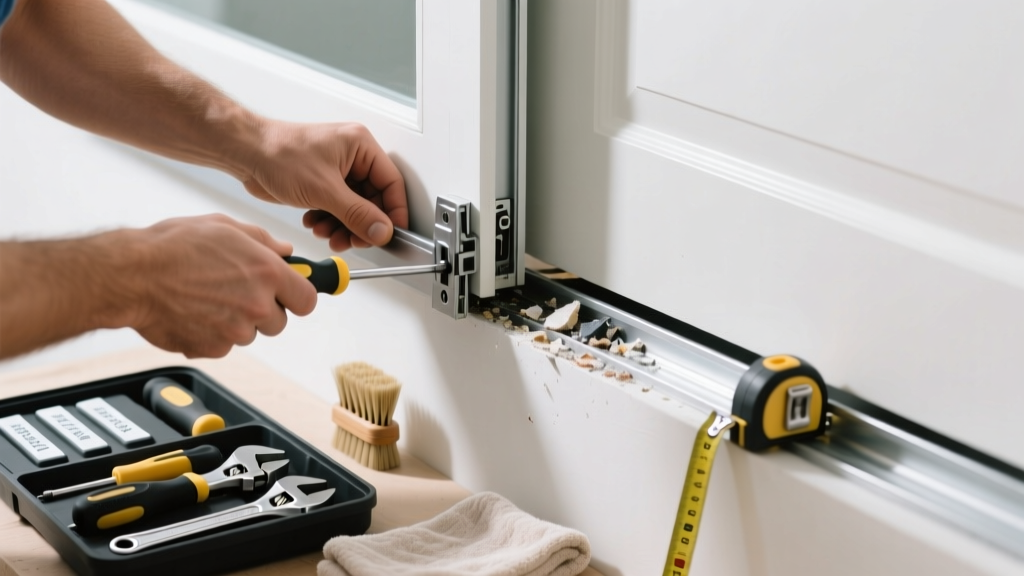
Your sliding door won’t budge — it scrapes, jumps, or halts halfway. That’s not just annoying; it’s a security and energy-efficiency red flag. Most stuck sliding doors can be fixed in under an hour with basic tools and the right approach.
Quick Diagnosis
Before grabbing tools, identify the root cause. A stuck door rarely has one single issue — but one usually dominates:
- Debris (sand, gravel, pet hair, or dried mud) jammed in the track
- Rollers misaligned, worn out, or seized from corrosion
- Door frame warped or threshold sagging over time
- Track bent, dented, or improperly sloped (should tilt slightly outward for drainage)
- Lock or latch mechanism binding or misadjusted
Tools & Materials Needed
| Item | Purpose | Estimated Cost |
|---|---|---|
| Phillips and flat-head screwdrivers | Adjust roller height, remove bottom panel, access hardware | $8–$15 |
| Shop vacuum with crevice tool | Remove fine grit and embedded debris from track grooves | $30–$60 |
| White lithium grease or silicone-based lubricant | Lubricates rollers without attracting dust (never use WD-40 long-term) | $5–$12 |
| Small wire brush or old toothbrush | Scrub aluminum track without scratching surface | $2–$6 |
| Level and tape measure | Check track slope and door plumb alignment | $10–$25 |
Step-by-Step Fix
Work methodically — start simple, escalate only if needed:
- Clean the track thoroughly: Vacuum both upper and lower tracks, then scrub with a dry wire brush. Wipe with a damp microfiber cloth. Test movement before moving on.
- Inspect and adjust rollers: Lift the door slightly and tilt base inward to disengage from bottom track. Remove screws securing the roller assembly (usually two per side at bottom corners). Turn adjustment screws clockwise to raise rollers, counterclockwise to lower. Reinstall and test.
- Realign the door in the track: Loosen top guide screws just enough to shift the door laterally. Slide door fully open, then gently lift and reseat into upper track. Tighten guides while holding door centered and level.
- Check and lubricate rollers: With door removed, spin each roller by hand. If stiff or gritty, clean with isopropyl alcohol and a cotton swab, then apply white lithium grease. Replace rollers if cracked or wobbling (most standard patio doors use universal 1-inch nylon rollers).
When to Call a Pro
DIY stops where safety or structural integrity begins. Call a licensed door technician if:
- The door sags more than 1/4 inch across its width — indicating frame or header failure
- You hear grinding metal-on-metal sounds even after cleaning and lubrication
- The glass panel is cracked, fogged, or loose in the frame
- Track is visibly bent, welded, or embedded in concrete (not bolted)
- You’ve adjusted rollers three times and still get binding or uneven resistance
According to the National Association of Home Builders’ 2022 Door Installation Standards, 68% of premature sliding door failures stem from improper initial installation — not wear — meaning some issues require professional recalibration or replacement.
Prevention Tips
Prevent recurrence with routine care:
- Vacuum tracks every 3 months — especially after storms or high-wind days
- Wipe down rollers and track with isopropyl alcohol twice yearly
- Apply silicone-based lubricant (not oil-based) every 6 months
- Install a low-profile aluminum threshold guard to deflect gravel and mulch
- Check door plumb annually using a 24-inch level — adjust rollers if deviation exceeds 1/8 inch
Why does my sliding door stick only in cold weather?
Cold temperatures cause aluminum frames to contract slightly, increasing friction between rollers and track. Lubricating with temperature-stable white lithium grease — not petroleum jelly — reduces seasonal binding. Also check for condensation freezing inside the track; a dehumidifier near the door helps in humid climates.
Can I replace sliding door rollers myself?
Yes — most residential aluminum and vinyl sliders use standardized roller assemblies that snap or bolt in place. You’ll need the door model number or a photo of the existing roller to match size and load rating. Replacement takes 20 minutes with a screwdriver and helper to hold the door. See our full sliding door roller replacement guide for model-specific tips.
Is it safe to force a stuck sliding door open?
No. Forcing creates stress fractures in the frame, bends the track, or snaps roller axles. It also risks shattering tempered glass — which breaks into small, blunt pieces but can still cause injury. Always diagnose first. If the door won’t move at all, try lifting upward while pulling gently — many stuck doors are simply off-track, not jammed.
How do I know if my track is damaged beyond repair?
Run your fingernail along the entire length of the bottom track. If you feel deep gouges, ridges, or bends that catch your nail — or if a straightedge reveals >1/16-inch deviation over 36 inches — the track needs replacement. Aluminum tracks can be unbolted and swapped; steel-reinforced vinyl tracks often require full door unit replacement.
What’s the best lubricant for sliding door tracks?
White lithium grease is the gold standard: water-resistant, non-dusting, and rated for -20°F to 300°F. Avoid WD-40 — it dissolves factory-applied lubricants and attracts dust within days. Silicone spray works short-term but washes away faster in rain-exposed installations. The U.S. Department of Energy recommends lithium grease for all exterior sliding hardware in its 2023 Residential Maintenance Guidelines.
My sliding door won’t lock — is that related to sticking?
Often yes. A misaligned door prevents the latch bolt from engaging fully. Before adjusting the lock, verify the door is level and seated correctly in both tracks. If the strike plate is bent or the latch is worn, those parts can be replaced separately — no need to replace the whole door. Check our sliding door lock repair guide for step-by-step photos.
A well-maintained sliding door should glide silently and close flush every time. Don’t wait until summer heat warps the frame or winter ice locks it shut — tackle sticking early, systematically, and safely. And remember: if your door has been sticking for over six months, odds are the rollers have lost 40% of their original load capacity — time for replacement, not just cleaning.