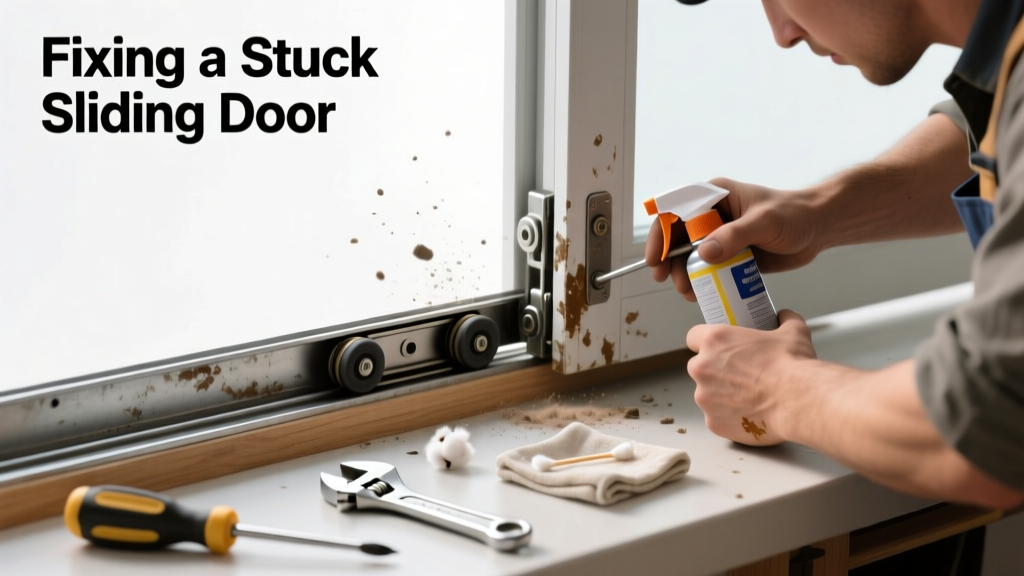
Your sliding door grinds like gravel, squeals like a rusty hinge, or jams mid-track—and now you’re stuck choosing between ignoring it or wrestling with it daily. These noises aren’t just annoying; they’re early warnings of misalignment, worn parts, or debris buildup that can worsen fast.
Quick Diagnosis
Before grabbing tools, identify the symptom pattern:
- Grinding or scraping — usually dirty or damaged track, bent rollers, or metal-on-metal contact
- Squeaking or high-pitched whine — dried-out roller bearings or lack of lubrication
- Sticking only at one point — warped frame, sagging panel, or localized track dent
- Door jumps or lifts off track — loose or broken roller assembly or missing stopper screws
- Thumping when closing — worn or cracked bottom guide or misaligned latch mechanism
Tools & Materials Needed
| Item | Purpose | Estimated Cost |
|---|---|---|
| Phillips and flathead screwdrivers | Adjust roller height, remove trim, secure hardware | $8–$15 |
| Soft-bristle brush + vacuum with crevice tool | Remove grit, pet hair, and sand from track without scratching | $12–$25 |
| White lithium grease (not WD-40) | Lubricates rollers and track without attracting dust | $6–$10 |
| Replacement nylon or steel rollers (if needed) | Match your door brand—Pella, Andersen, or generic aluminum models | $18–$32 |
| Level and 6-in. straightedge | Check for frame sag or track warping | $10–$22 |
Step-by-Step Fix
Work methodically—start simple and escalate only if needed:
- Clean the track thoroughly: Vacuum debris, then scrub with a dry brush. Wipe with isopropyl alcohol on a lint-free cloth to dissolve old grease and grime. Let dry fully before proceeding.
- Inspect and adjust rollers: Lift the door slightly and tilt the bottom inward to disengage from the track. Remove the lower cover plate (usually two screws). Check for cracked housings, seized bearings, or visible rust. Use a Phillips driver to turn the adjustment screw—clockwise raises the door, counterclockwise lowers it. Aim for 1/8" clearance between bottom edge and track.
- Lubricate properly: Apply white lithium grease—not silicone spray or WD-40—to roller axles and the entire upper and lower track. Wipe excess to prevent dust buildup. Test operation slowly 5–6 times.
- Check and reseat the bottom guide: If the door wobbles or catches near the latch end, unscrew the plastic or metal guide embedded in the floor track. Clean its slot, realign it flush with the track edge, and resecure with stainless steel screws.
When to Call a Pro
Stop and call a licensed door technician if:
- The door sags more than 1/4" across the width (measured with level), indicating structural frame failure
- You hear loud metallic clanging *inside* the header—suggesting broken overhead carrier wheels or damaged track mounting brackets
- The glass panel is tempered but shows hairline cracks near the edge or corner (safety risk)
- Your door is part of a hurricane-rated system or has integrated security sensors—you risk voiding warranty or disabling alarms
According to the National Association of Home Builders’ 2023 Residential Construction Performance Guidelines, misaligned sliding doors account for 22% of post-installation service calls—and over half involve improper roller adjustment or track contamination.
Prevention Tips
Maintain smooth operation year-round with these habits:
- Vacuum the track every 3 months—especially after storms or high pollen seasons
- Re-lubricate rollers and track with white lithium grease every 6 months (not silicone or oil-based lubes)
- Wipe down the weatherstripping monthly with mild soap and water to prevent UV cracking
- Check roller height seasonally—wood and vinyl frames expand/contract with humidity shifts
Can I use WD-40 on my sliding door rollers?
No. WD-40 is a solvent and light lubricant—not a long-term lubricant. It washes away factory grease, attracts dust, and dries out rubber seals. The U.S. Department of Energy’s Home Energy Saver Guide (2022) explicitly warns against using it on sliding door mechanisms due to accelerated wear.
Why does my sliding door only stick in winter?
Cold temperatures cause vinyl and wood frames to contract, tightening gaps around rollers and jamming alignment. Aluminum expands less, but thermal contraction still shifts roller position. Always check roller height in late fall and early spring—many homeowners overlook this seasonal drift.
How do I know if my rollers are bad?
Rollers should spin freely with finger pressure. If they grind, feel gritty, or don’t rotate smoothly—or if the roller housing is cracked, discolored, or missing nylon caps—they’re compromised. Replace both rollers as a pair, even if only one looks faulty.
Can I replace just the track instead of the whole door?
Yes—if the frame and glass are intact and the track is aluminum or stainless steel (not integral to the jamb). But match the profile exactly: measure width, depth, and flange angle. Generic tracks rarely fit Pella or Marvin systems. For reference, sliding door track replacement requires precise milling tolerances—off-by-0.5mm causes binding.
Is it safe to lift a heavy sliding glass door alone?
No. Most residential sliding glass doors weigh 120–200 lbs. Lifting improperly risks back injury or dropping the unit onto your foot or tile. Always use a helper—and consider renting a door dolly with padded straps. See our how to safely remove sliding glass door guide for step-by-step lifting protocol.
What’s the average lifespan of sliding door rollers?
With proper maintenance, quality nylon or sealed-ball-bearing rollers last 10–15 years. Cheaper stamped-steel rollers often fail by year 7, especially in coastal or dusty environments. The American Architectural Manufacturers Association (AAMA) reports 68% of premature roller failures stem from inadequate cleaning—not material defects.
A well-maintained sliding door shouldn’t sound like a construction site. Once you’ve cleaned, aligned, and lubricated, test it daily for a week—listen for consistency, not silence. If the noise returns within days, revisit the track alignment or suspect hidden damage in the header assembly. And remember: small fixes now prevent costly replacements later—especially since sliding door repair costs jump 300% once glass or frame integrity is compromised.