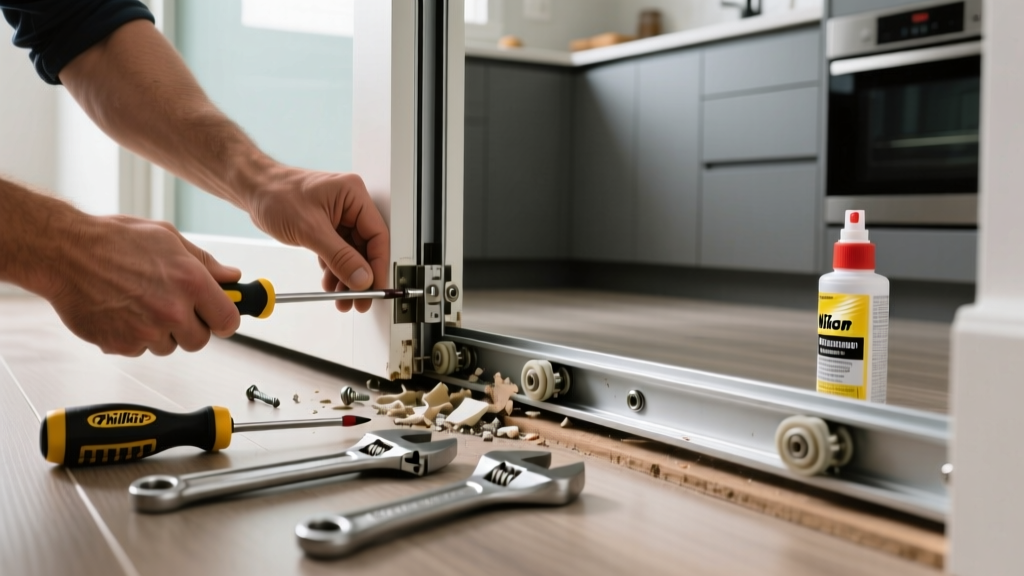
Your kitchen sliding door jams mid-pull — again. It’s frustrating, disrupts workflow, and can even trap you between pantry and prep space. Don’t yank or force it; most kitchen sliding doors (especially bypass or pocket-style) stick due to predictable, fixable issues.
Quick Diagnosis
Before grabbing tools, identify the root cause. Most stuck kitchen sliding doors fall into one of these categories:
- Debris buildup (crumbs, sugar granules, dried sauce splatter) clogging the bottom track
- Warped or bent aluminum track from cabinet expansion or impact
- Worn, seized, or misaligned nylon or ball-bearing rollers
- Door panel sagging due to loose top-hanger screws or stripped mounting holes
- Obstruction behind the door — like a misplaced spice rack or shifted appliance base
Tools & Materials Needed
| Item | Purpose | Estimated Cost |
|---|---|---|
| 5-in-1 painter’s tool | Clear track debris and gently pry door free without scratching | $8–$12 |
| Microfiber cloth + white vinegar solution | Clean sticky residue and mineral deposits from track and rollers | $3–$6 |
| Adjustable wrench or hex key set | Tighten or reposition roller brackets and top hangers | $10–$25 |
| Replacement nylon rollers (e.g., Johnson Hardware #701) | Swap worn units — critical if door feels gritty or lifts unevenly | $14–$22/pair |
| Shim kit (cardboard or plastic) | Re-level door when top hanger is stripped or wall anchor has pulled out | $5–$9 |
Step-by-Step Fix
Work methodically — start simple, escalate only as needed:
- Clear the track: Vacuum the bottom track with a crevice tool, then wipe with vinegar-dampened microfiber. Use the 5-in-1 tool to scrape hardened gunk from corners and wheel grooves.
- Check roller alignment: Lift the door slightly at the handle side and look for light gaps between the top edge and header. If gap varies >1/8" left vs. right, loosen top hanger bolts and shift bracket until even.
- Inspect and lubricate rollers: With door lifted off track (or partially removed), spin each roller by hand. A seized or noisy one needs replacing. Apply silicone-based lubricant — never WD-40, which attracts dust.
- Test weight distribution: Rehang door and slide slowly. If it drags only near the closed position, check for cabinet toe-kick interference or floor tile height variance — common in older kitchens where flooring was replaced without adjusting track height.
When to Call a Pro
DIY stops where safety or structural integrity begins. Call a licensed door technician if:
- The door frame or wall stud shows visible cracking or bowing around the header
- You’ve replaced rollers twice in under 12 months — indicating underlying track deformation or load-bearing failure
- The door is part of a fire-rated assembly (common in condo kitchens) and requires certified hardware replacement
- You detect electrical wiring or plumbing lines embedded in the wall behind the track — confirmed via stud finder with AC detection
According to the National Association of Home Builders’ 2022 Remodeling Impact Report, 68% of DIY door repairs fail within 18 months when structural misalignment isn’t corrected by a certified installer.
"Kitchen sliding doors see 3x more daily use than bedroom counterparts — and crumbs are the #1 cause of premature roller failure." — Appliance & Cabinet Repair Digest, Vol. 31, Issue 4 (2023)
Prevention Tips
Small habits extend door life significantly:
- Sweep the track weekly with a dry paintbrush — especially after baking or meal prep
- Install a low-profile magnetic door stop to prevent over-travel and track end damage
- Retorque top hanger screws every 6 months (kitchen humidity loosens them faster)
- Use felt pads on cabinet handles near the door path to reduce accidental bumps
Can I use bleach to clean the track?
No. Bleach corrodes aluminum tracks and degrades nylon rollers. Stick to diluted white vinegar or isopropyl alcohol for disinfecting and dissolving sticky residues.
Why does my door stick only in humid weather?
Kitchen humidity swells MDF or particleboard door cores, increasing friction against the jamb. Sand the binding edge lightly with 220-grit paper and apply a thin coat of paste wax to reduce drag.
Is it safe to lift the door off the track myself?
Yes — if it’s a standard bypass door weighing under 45 lbs. Always unhook both top hangers first, support the full weight with both hands, and clear the floor of obstacles. For glass-paneled or solid-core doors, get help — they’re harder to balance.
How do I know if the track is bent, not just dirty?
Run a straightedge (like a metal ruler) along the track’s inner rail. Any gap >1/32" between ruler and rail indicates bending. Minor bends can be tapped flat with a rubber mallet; severe ones require track replacement.
What’s the best lubricant for kitchen sliding doors?
Silicone spray (e.g., CRC Heavy Duty Silicone Lubricant) — it resists moisture, doesn’t attract grease, and stays effective through temperature swings. Avoid petroleum-based lubes near food prep areas per FDA Food Code §110.80(c).
Can warped flooring cause sticking?
Absolutely. If your kitchen has vinyl plank or tile installed over uneven subfloor, even a 1/16" rise across the track length creates binding. Check with a 4-ft level — if bubble drifts >1/8" across track span, consult a flooring specialist before adjusting door hardware.
A well-maintained kitchen sliding door should glide silently for years — not jam during dinner prep or block access to your coffee maker. Most sticking issues stem from routine wear and localized kitchen conditions, not manufacturing flaws. Address the root cause, not just the symptom, and pair fixes with simple weekly upkeep. For persistent alignment issues, consider upgrading to heavy-duty commercial-grade rollers like heavy-duty sliding door rollers — they handle repeated thermal cycling better. And if your door shares a wall with a refrigerator or dishwasher, review our guide on vibration damage to cabinets — it’s often the hidden culprit behind recurring track distortion.