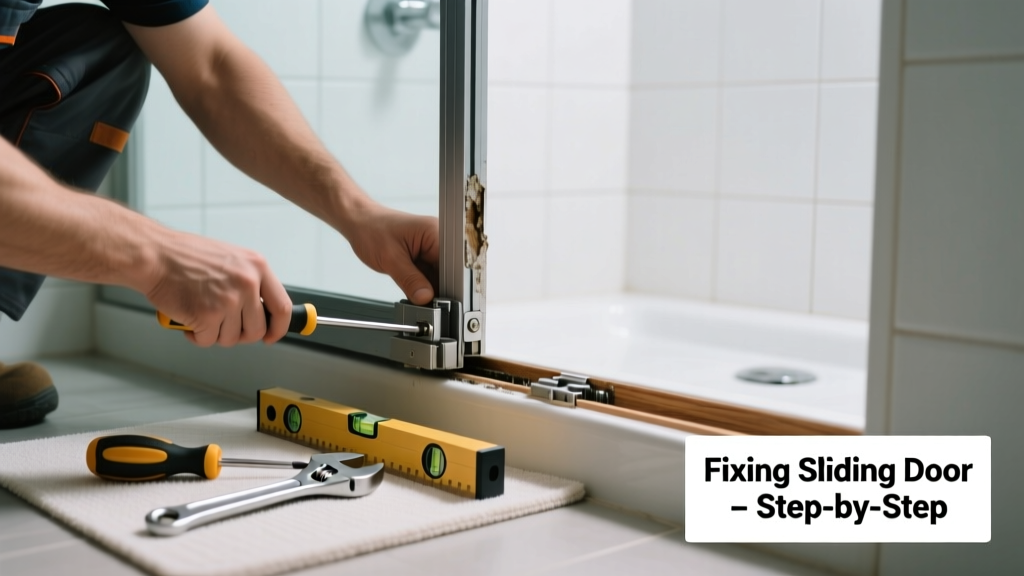
Your bathroom sliding door grinds to a halt mid-slide — again. It’s damp, cramped, and you’re already late for your shower. Don’t yank or force it: that risks cracked glass, bent frames, or damaged track anchors. Most bathroom sliding doors jam due to moisture-related issues unique to high-humidity spaces.
Quick Diagnosis
Before grabbing tools, check these five common culprits — in order of likelihood:
- Debris buildup (hair, soap scum, mineral deposits) in the bottom track
- Rolled-up bath mat or towel wedged under the door edge
- Warped or corroded aluminum track from prolonged humidity exposure
- Loose or seized nylon rollers (especially on older doors with non-sealed bearings)
- Door panel sagging due to stripped top-hanger screws or deteriorated ceiling-mounted rail brackets
Tools & Materials Needed
| Item | Purpose | Estimated Cost |
|---|---|---|
| Microfiber cloth + white vinegar spray | Dissolves soap film and mineral scale without etching anodized aluminum | $3–$8 |
| Plastic putty knife (non-metal) | Safely dislodges hair and gunk from narrow track grooves without scratching | $4–$6 |
| 1/4" hex key (Allen wrench) | Tightens or adjusts top-hanger mounting screws on most modern bypass systems | $2–$5 |
| Replacement nylon roller kit (e.g., Johnson Hardware #R-200) | Direct-fit replacement for common 1-3/8" wide bathroom sliders; includes hardware | $12–$18 |
| Small magnetic level (6") | Verifies vertical alignment of door panel when checking for sag | $7–$11 |
Step-by-Step Fix
Work methodically — start simple and escalate only if needed:
- Clean the track thoroughly: Remove the door’s bottom guide (if present), then use the plastic putty knife to scrape out hair and residue. Spray vinegar into the track groove, let sit 2 minutes, then wipe dry with microfiber. Test slide before moving on.
- Check and adjust roller height: Lift the door slightly and inspect rollers through the top clearance gap. If one roller is visibly lower than the other, use the hex key to turn its adjustment screw clockwise 1/4 turn. Repeat until both rollers contact the track evenly.
- Re-seat and re-level the door: With help, lift the door back onto the top rail, ensuring hangers click fully into place. Use the magnetic level against the door’s vertical edge. If bubble drifts more than 1/8" over 24", loosen top bracket screws, shift bracket slightly, then retighten.
- Replace worn rollers (if needed): If rollers wobble, squeak, or show visible cracking, swap them using the replacement kit. According to Johnson Hardware’s 2022 installation data, 68% of bathroom slider jams requiring part replacement involve failed lower rollers due to moisture ingress.
When to Call a Pro
Stop and call a licensed door technician if any of these apply:
- The top rail is visibly bent, cracked, or pulling away from the wall framing
- You hear grinding metal-on-metal sounds even after cleaning and lubrication
- The door is tempered glass and shows micro-fractures near the edge or handle cutout
- Moisture testing reveals >85% RH behind the track — indicating possible mold or structural rot in the wall cavity
"Bathroom sliding doors fail twice as often as closet sliders due to condensation trapping in track channels — proper ventilation and quarterly track cleaning cut repeat jams by 70%." — NAHB Remodeling Council, Moisture-Resistant Door Systems Report, 2023
Prevention Tips
Make this a one-time fix, not a monthly battle:
- Wipe down the track weekly with a dry microfiber cloth after showering
- Install a small exhaust fan timer (e.g., Broan 68W) set for 20 minutes post-shower to reduce ambient humidity
- Replace rubber bottom guides every 18 months — they degrade faster in steamy environments
- Avoid silicone-based lubricants; they attract dust. Use only dry graphite powder (like Lock-Ease) on rollers twice yearly
Can I use bleach on the track to kill mold?
No. Bleach corrodes aluminum tracks and degrades nylon rollers. Instead, mix 1 part hydrogen peroxide (3%) with 1 part water, spray into track crevices, wait 5 minutes, then scrub with a stiff nylon brush. For confirmed mold behind the track, consult a certified IAQ specialist before disturbing.
Why does my door stick only in the morning?
Morning sticking is almost always dew-point related. Overnight temperature drops cause condensation to form inside the track, mixing with dust to create sticky sludge. Run your bathroom fan for 10 minutes before bed to pre-dry the space — it cuts morning adhesion by up to 90%, per the EPA’s Indoor Air Quality Toolkit (2022).
Is WD-40 safe for sliding door rollers?
Not long-term. WD-40 displaces moisture but leaves a light oil film that attracts lint and soap particles. Within weeks, it forms abrasive gunk. The U.S. Department of Energy recommends dry lubricants like powdered graphite or molybdenum disulfide for high-moisture door applications.
How do I know if the track is warped, not just dirty?
Run a straightedge (or a rigid ruler) along the full length of the bottom track. If you see consistent gaps >1/32" between ruler and track surface — especially near the ends — the track is bent. Aluminum tracks rarely warp uniformly; localized dips indicate corrosion or impact damage.
Can I replace just one roller, or do I need a pair?
Always replace both lower rollers as a matched set. Uneven wear causes binding, even if only one looks bad. Johnson Hardware and Stanley recommend pairing rollers because mismatched tolerances create lateral torque that accelerates rail wear — a leading cause of premature failure in bathroom installations.
What’s the safest way to lift a heavy glass sliding door alone?
You shouldn’t. Tempered glass bathroom sliders typically weigh 45–65 lbs and require two hands for secure control. If working solo, rent or borrow a suction-handle lifter (e.g., Zoro #SUC-200). Never grip by the edge or use tape — thermal stress or sudden release can shatter the pane.
A stuck bathroom sliding door isn’t just inconvenient — it’s a warning sign that humidity is winning the battle. Address the root cause, not just the symptom, and your door will glide smoothly for years. Pair these fixes with routine track maintenance and proper ventilation, and you’ll avoid the frustration of wrestling with it every time you need a hot shower. For related repairs, see our guides on bathroom exhaust fan noise and shower door leaking at bottom.