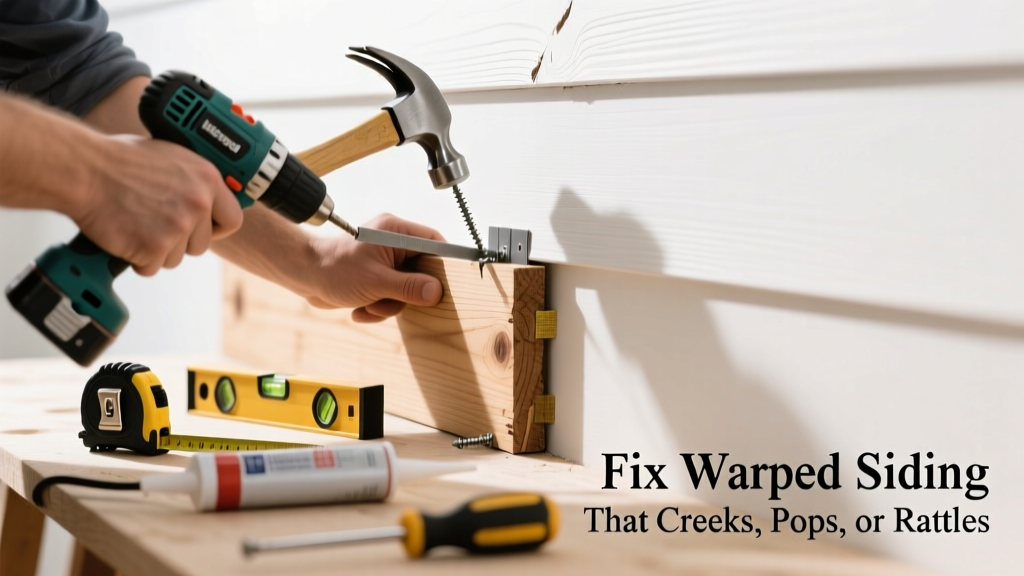
If your siding groans when the wind picks up or pops loudly on hot afternoons, you’re not imagining things — warped panels are flexing beyond their design limits. This isn’t just annoying; it’s a red flag for moisture intrusion, fastener failure, or improper installation. Left unaddressed, it can lead to water damage behind the wall or premature system failure.
Quick Diagnosis
Start here before grabbing tools. These are the five most common culprits behind noisy warped siding:
- Thermal expansion/contraction in vinyl or aluminum siding during rapid temperature swings
- Loose or missing nails or screws — especially near panel ends or corners
- Moisture trapped behind siding causing wood or OSB sheathing to swell
- Improper nailing: overdriven, underdriven, or too-tight fasteners restricting movement
- Structural framing movement due to foundation settling or truss uplift
Tools & Materials Needed
| Item | Purpose | Estimated Cost |
|---|---|---|
| 16d galvanized ring-shank nails | Secure warped panels without splitting wood or pulling out | $8–$12 |
| Drill with Phillips bit & siding screwdriver bit | Drive screws precisely without stripping heads or damaging panels | $25–$45 |
| 3-ft level & chalk line | Verify panel alignment and mark straight reference lines | $12–$20 |
| Utility knife & pry bar (3-in) | Cut caulk/sealant and gently lift warped sections for re-securing | $7–$15 |
| Butyl rubber tape (1/4-in thick) | Fill gaps between panel and furring strip to reduce vibration noise | $14–$22 |
Step-by-Step Fix
Apply these methods in order — start simple, escalate only if needed:
- Re-fasten loose panels: Locate each warped section, inspect for missing or popped fasteners within 1 in. of the edge. Replace with color-matched siding screws (not nails) spaced no more than 12 in. apart along the top nail flange.
- Relieve thermal stress: On vinyl siding, use a heat gun (set to <200°F) to gently warm the bowed area for 30 seconds, then press back into place while cooling. Do not overheat — warping accelerates above 220°F (Vinyl Siding Institute, 2022).
- Add backing support: For large bulges (>1/2 in. deflection), install a 1x2 furring strip horizontally behind the panel using construction adhesive and masonry anchors (if over brick) or framing screws (if over studs). Seal edges with butyl tape before reattaching.
- Replace damaged panels: If cracking, brittleness, or UV fading is present, cut out the affected piece with tin snips and snap in a new one — match grain direction and overlap correctly per manufacturer specs.
When to Call a Pro
Don’t risk injury or further damage in these scenarios:
- Warped siding covers more than three full courses (horizontal rows) on any wall face
- You find wet, spongy, or moldy sheathing underneath during inspection
- Fasteners pull out repeatedly in the same location — indicates rotted framing or inadequate stud spacing
- The house was built before 1978 and you suspect asbestos-cement siding (testing required before removal)
According to the Insurance Institute for Business & Home Safety’s 2023 report, improperly repaired siding contributes to 22% of weather-related insurance claims involving exterior envelope failure — especially where DIYers skip moisture barrier checks.
Prevention Tips
Extend your siding’s quiet service life with these proven habits:
- Inspect all fasteners annually — tighten or replace corroded ones before spring temperature swings
- Keep gutters clean and downspouts directed >5 ft from foundation to reduce splash-back moisture
- Never caulk the bottom edge of vinyl or aluminum panels — it traps condensation and accelerates warping
- Use furring strips with 1/8-in air gap behind all new installations to allow drainage and thermal movement
Can I use bleach on this?
No — bleach degrades vinyl polymer chains and weakens aluminum oxide layers. It also damages nearby landscaping and concrete. Use a mild detergent-and-water solution with a soft brush instead. For mold behind panels, address the moisture source first; surface cleaning won’t solve the root issue.
How long does a proper repair last?
A well-executed re-fastening or backing repair typically lasts 7–12 years, depending on climate exposure and material type. Replaced panels carry the original warranty — usually 20–50 years for premium vinyl, though labor coverage rarely exceeds 5 years. Check your manufacturer’s documentation at siding warranty checklist.
Will painting stop the noise?
No — paint adds minimal mass and zero structural support. In fact, dark-colored paint on vinyl increases surface temperature by up to 40°F in direct sun (U.S. Department of Energy, 2021), worsening thermal expansion noise. Stick to factory-finished or approved low-VOC acrylic coatings rated for your siding type.
Is this a sign of foundation problems?
Sometimes — but not always. Isolated warped panels usually point to localized issues like poor nailing or moisture. However, if you see diagonal cracks in stucco or brick veneer above the warped area, sticking windows/doors on the same wall, or consistent warping across multiple walls, schedule a foundation inspection. A certified structural engineer can assess movement via laser-level surveys and crack mapping.
Can I fix this in winter?
Yes — but with caveats. Vinyl becomes brittle below 40°F and may crack during manipulation. Wait for a sunny day above 45°F, or warm panels with a heat gun set to ≤180°F before adjusting. Aluminum remains workable down to 20°F, but avoid driving cold screws — they’re more likely to strip or bend.
Do I need to remove insulation behind the siding?
Only if it’s wet, compressed, or moldy. Intact fiberglass or rigid foam insulation doesn’t need replacement. But if you discover soaked batts or discolored foam board, remove and replace it — damp insulation loses up to 40% of its R-value (ASHRAE Handbook, 2022). Always wear an N95 mask and gloves when handling insulation debris. Learn more about safe removal at insulation safety guide.
Warped, noisy siding is rarely an emergency — but it’s rarely just cosmetic either. Addressing it promptly preserves both your home’s appearance and its weather-resistance layer. Most repairs take under half a day per wall section, and the peace that comes from silence on a windy evening? That’s worth every minute spent leveling a panel or tightening a screw.