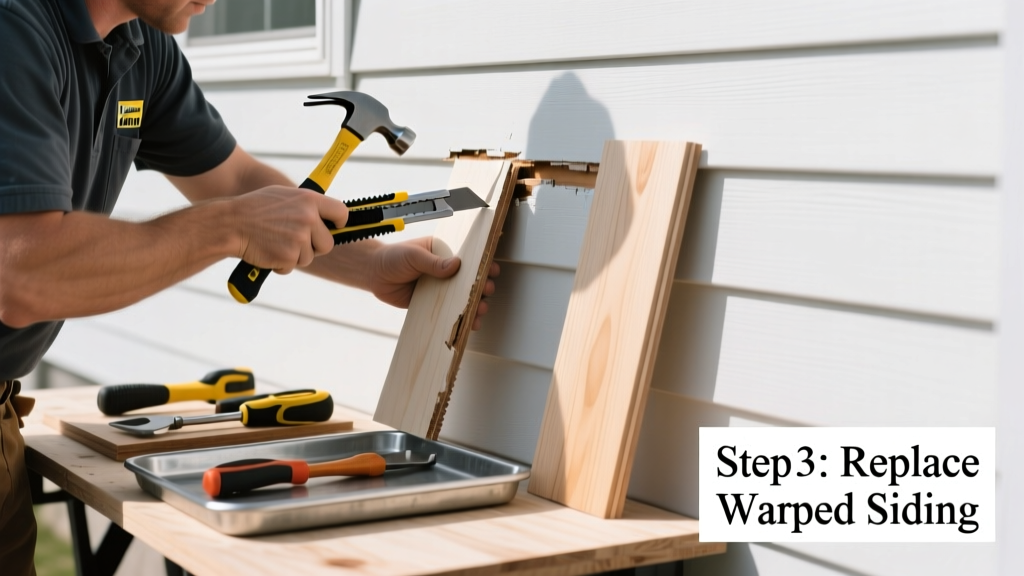
Warped siding isn’t just an eyesore—it’s a red flag for moisture intrusion, poor installation, or material fatigue. Left unaddressed, it can lead to rot, insect entry, and energy loss through gaps in your home’s thermal envelope. Most minor warping is fixable in a weekend, but knowing when to stop and call in help keeps you safe and saves money long-term.
Quick Diagnosis
Before grabbing tools, identify the root cause. Warping rarely happens in isolation—it’s usually a symptom. Here are the most common triggers:
- Moisture trapped behind siding (especially under vinyl or fiber cement)
- Improper nailing—too tight, too loose, or driven flush instead of leaving 1/32" clearance
- Direct sun exposure on dark-colored siding without proper ventilation or furring strips
- Foundation settling causing wall movement or framing distortion
- Aging or low-grade materials (e.g., early-2000s vinyl with inadequate UV inhibitors)
Tools & Materials Needed
| Item | Purpose | Estimated Cost |
|---|---|---|
| Flat pry bar (6") | Lifts warped panels without cracking adjacent pieces | $12–$18 |
| Utility knife with snap-off blades | Cuts caulk, removes old fasteners, scores backing paper | $8–$15 |
| Drill with #2 Phillips bit | Removes/replaces screws or nails quickly and cleanly | $45–$95 |
| Replacement siding panel (same profile & color) | Required if panel is cracked, brittle, or beyond reshaping | $25–$75 per 12' piece |
| Stainless steel siding nails (1-1/4") | Corrosion-resistant; allow for thermal expansion | $8–$12 per box of 1,000 |
Step-by-Step Fix
Choose the method that matches your siding type and severity. Always inspect behind the panel first—if sheathing is soft or moldy, stop and address moisture before proceeding.
- Assess flexibility: Press gently on the warped area. If it springs back slightly, it may be repositioned. If it cracks or feels brittle, replace it.
- Remove fasteners: Use the drill to carefully extract nails or screws from the warped section—start at the top edge, then work down. Don’t force bent nails; cut them with diagonal cutters if needed.
- Realign and resecure: Slide the panel back into its locking channel. Leave 1/32" gap at each nail location to allow for expansion. Nail only at the top edge and center—never at the bottom (which restricts movement).
- For severe bowing (over 1/4" deviation): Cut out the damaged section using a utility knife and straightedge, then install a new panel with matching butt joints and seam tape underneath.
When to Call a Pro
Some warping signals deeper issues no DIYer should tackle alone. Call a licensed exterior contractor if you see any of these:
- More than three consecutive panels warped across multiple walls
- Visible sagging or bulging in wall framing (check with a level or plumb line)
- Mold, mildew, or musty odor behind the siding
- Warping coincides with recent foundation repairs or soil erosion near the home’s perimeter
- Siding is part of a rainscreen system—reassembly requires precise air-gap calibration
"Over 68% of premature vinyl siding failures stem from improper fastening—not material defects," according to the Vinyl Siding Institute's 2022 Field Performance Report.
Prevention Tips
Fixing warped siding once is smart. Preventing recurrence is smarter. These steps reduce risk over time:
- Install furring strips (1x3s) over existing sheathing before new siding—creates airflow behind panels
- Use only manufacturer-approved fasteners, spaced per spec (typically 12" on center for horizontal runs)
- Trim trees and shrubs within 18" of walls to improve drying and reduce moisture retention
- Inspect and clean weep holes at panel bottoms annually—clogged openings trap water
- Choose Light Reflective Value (LRV) 55+ for vinyl in hot climates—reduces surface temps by up to 40°F (U.S. Department of Energy, 2021)
Can I use heat guns to reshape warped vinyl siding?
No—applying direct heat risks melting, discoloration, or weakening structural integrity. Vinyl expands ~1/4" per 10 feet with 50°F temperature swing; intentional heating introduces unpredictable stress points. Replacement is safer and more durable.
Will painting warped wood siding hide the problem?
Painting masks visual flaws but accelerates deterioration. Trapped moisture swells wood from within, and paint seals the surface—creating ideal conditions for rot. Sanding and priming won’t fix underlying movement. Address moisture first, then refinish.
How long does repaired siding last after fixing warping?
Properly reinstalled vinyl or fiber cement lasts 20–40 years post-repair—assuming correct nailing, drainage, and no hidden moisture. Wood siding, even after repair, typically needs refinishing every 5–7 years and replacement after 15–25 years depending on species and exposure.
Does insurance cover warped siding repair?
Rarely. Most standard homeowners policies exclude wear-and-tear, gradual deterioration, or improper installation. Exceptions exist for sudden, accidental damage (e.g., hail impact causing immediate warping), but claims require documentation and adjuster verification. Review your policy’s 'dwelling coverage' section for exclusions.
Can warped siding affect my home’s energy efficiency?
Yes—gaps from warping create convective air loops behind the cladding, reducing effective R-value by up to 30%. A study by the Oak Ridge National Laboratory (2020) found homes with compromised siding had measurable increases in HVAC runtime during shoulder seasons.
Is pressure washing safe for warped siding?
Not recommended—high-pressure streams force water behind panels, worsening moisture issues. Use a garden hose with soft-bristle brush and oxygen-based cleaner instead. For stubborn algae, apply a 1:3 mix of oxygen bleach and water, let dwell 15 minutes, then rinse gently at low pressure.
Warped siding is rarely a crisis—but it’s never harmless. The best repairs combine mechanical correction with moisture management and smart material choices. Whether you’re resetting a single panel or upgrading your entire south-facing wall, treat the symptom *and* the cause. For more on related fixes, see our guides on cracked siding repair and siding gaps and drafts.