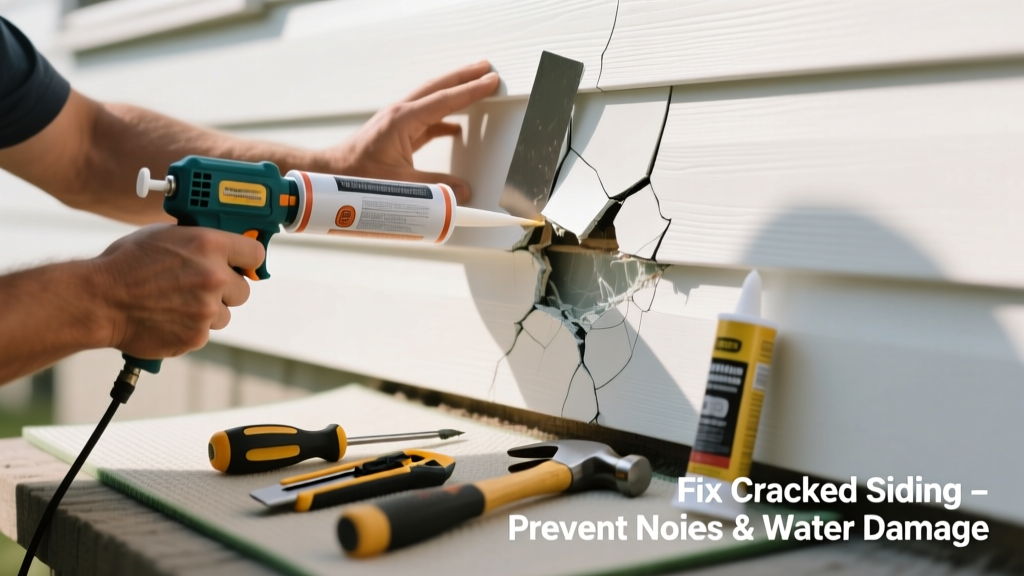
If your siding cracks and makes strange noises—like sharp pops, rhythmic creaks, or fluttering flaps—it’s not just annoying. It’s often a warning sign of moisture intrusion, fastener failure, or thermal stress that could worsen in weeks. Ignoring it risks rot, mold, and structural compromise behind the panels.
Quick Diagnosis
Start by inspecting during temperature swings (early morning or late afternoon), when materials expand and contract most. Listen closely while walking the perimeter. Then check for:
- Visible cracks, splits, or warping—especially near corners, windows, or soffits
- Loose or missing nails, screws, or clips beneath panels
- Gaps wider than 1/8 inch between panels or at seams
- Moisture stains, black mold, or soft wood underneath near the crack
- Wind-driven flapping—common with vinyl or fiber cement installed without proper expansion gaps
Tools & Materials Needed
| Item | Purpose | Estimated Cost |
|---|---|---|
| 10-in flexible putty knife | Slides behind panels to assess backing and loosen debris without damaging surface | $8–$14 |
| Corrosion-resistant screws (1-1/4" stainless steel) | Re-secures loose panels; won’t rust like standard deck screws | $12–$18 per box of 50 |
| High-quality acrylic-latex caulk (e.g., DAP Dynaflex Ultra) | Seals small cracks without restricting thermal movement | $5–$9 per tube |
| Utility knife with snap-off blades | Cuts away damaged vinyl or trim cleanly before patching | $6–$11 |
| Drill/driver with Phillips #2 bit | Drives screws precisely without stripping heads or cracking panels | $45–$120 (if you don’t own one) |
Step-by-Step Fix
Choose the method based on crack size, material, and noise type:
- For hairline cracks (<1/16") making faint ticking: Clean with mild detergent, dry thoroughly, then apply a thin bead of acrylic-latex caulk. Smooth with a damp finger—don’t overfill. Let cure 24 hours before wetting.
- For loose panels flapping or popping in wind: Locate the nearest secure fastener. Drill pilot holes 1/8" above and below the crack, then install two stainless steel screws into solid sheathing—not just furring strips. Countersink slightly but don’t compress the panel.
- For warped or buckled fiber cement: Remove the affected panel using a zip tool and pry bar. Check for rotted OSB or missing housewrap. Replace panel with 1/8" gap at all edges (per James Hardie’s 2022 Installation Guide). Use corrosion-resistant ring-shank nails.
- For recurring creaks at seams: Insert a 1/32" shim (thin plastic or cedar) between panels where they rub—never force panels together. This relieves friction without blocking expansion.
When to Call a Pro
DIY stops being safe or effective in these cases:
- Cracks longer than 12 inches with visible sagging or bowing—could indicate compromised wall framing
- Noise accompanied by interior water stains, musty odors, or peeling paint inside adjacent walls
- Siding installed directly over foam insulation without drainage plane—requires expert moisture mapping
- You’re working above second-story height without fall protection or scaffolding
According to the Insurance Institute for Business & Home Safety's 2023 report, improperly repaired siding accounts for 27% of post-storm water intrusion claims—many stemming from rushed DIY attempts that sealed moisture in rather than redirecting it.
Prevention Tips
Extend your siding’s quiet service life with these habits:
- Inspect twice yearly—spring and fall—with a focus on south- and west-facing walls (greatest UV and thermal stress)
- Keep gutters clean and downspouts directed at least 5 feet from the foundation to reduce splash-back moisture
- Trim tree branches within 3 feet of walls to prevent abrasion and trap less humidity
- Never pressure-wash vinyl or fiber cement above 1,200 PSI—high pressure forces water behind panels and loosens fasteners
Can I use regular caulk instead of acrylic-latex?
No. Silicone or polyurethane caulk creates a rigid bond that restricts thermal movement—causing new cracks or pulling fasteners loose. Acrylic-latex remains flexible across -20°F to 140°F, matching siding’s natural expansion. Per the Vinyl Siding Institute’s 2021 Technical Bulletin, only ASTM C920–rated sealants are approved for exterior siding joints.
Why does my siding only creak at dawn?
That’s classic thermal contraction. Overnight cooling causes panels to shrink slightly, tightening against fasteners or adjacent pieces. As the sun hits the wall, rapid warming triggers sudden micro-shifts—creating audible ‘pops.’ If it happens daily in the same spot, the fastener is likely bottomed out or corroded.
Will painting over cracked vinyl fix the noise?
No—and it can make it worse. Paint traps heat, increasing surface temperatures up to 30°F (U.S. Department of Energy, 2022), accelerating expansion stress. Worse, paint fills expansion gaps and hides underlying moisture damage. Never paint vinyl unless specifically rated for it—and never over cracks.
How long should a proper repair last?
A correctly executed screw-and-seal repair on vinyl or fiber cement typically lasts 7–12 years, assuming no underlying moisture issues. But if the crack reappears within 18 months, investigate hidden water infiltration behind the panel—check for missing flashing at windows or failed drip edges. See our guide on moisture behind siding signs.
Can I replace just one cracked board without matching color issues?
Yes—but only if your siding is under 5 years old and you have the original lot number. Fading varies by exposure: south-facing panels lose 20–30% color intensity in 3 years (Certified Fiber Cement Council, 2023). For older installations, consider replacing an entire course—or consult a supplier about factory-matched recuts. See siding color matching tips for blending techniques.
Is the noise dangerous, or just annoying?
It depends on context. A single pop during extreme temperature change is usually benign. But rhythmic creaking during wind, combined with visible gaps or bulging, suggests mounting lateral pressure—a precursor to panel ejection in high winds. The U.S. EPA estimates that 14% of household water usage is from leaks—including those masked by noisy, failing siding.
Fixing noisy, cracked siding isn’t just about silence—it’s about catching small failures before they cascade into costly repairs. Most fixes take under two hours and cost less than $40 in materials. But if you hear a deep groan followed by a ‘snap’ when stepping near the wall, stop and call a certified exterior wall inspector. That sound could mean sheathing separation—not just a loose nail.