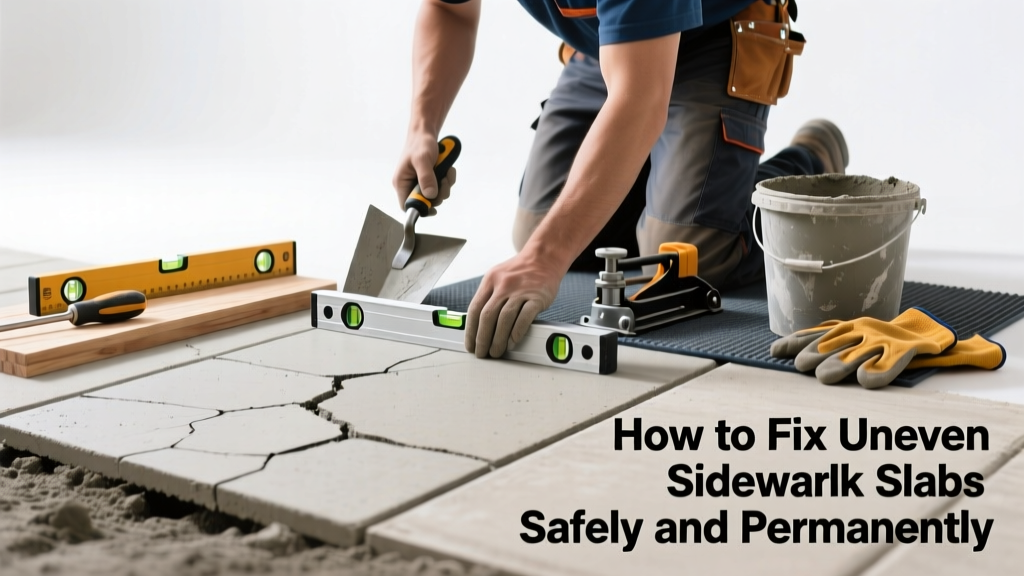
That one sunken or raised sidewalk slab near your front walk? It’s more than an eyesore—it’s a liability. Trips on uneven concrete cause over 30,000 emergency room visits annually, according to the U.S. Consumer Product Safety Commission’s 2022 injury data. Fixing it early saves money, prevents injuries, and keeps your property compliant with local codes.
Quick Diagnosis
Before grabbing tools, identify the root cause. Most uneven sidewalks stem from one (or more) of these:
- Soil erosion beneath the slab—especially after heavy rain or poor grading
- Tree root uplift—common with mature maples, oaks, or silver birches within 6 feet of the slab
- Frost heave in cold climates where freeze-thaw cycles lift edges
- Settling of poorly compacted fill dirt during original installation
- Broken or missing expansion joints allowing lateral movement
Tools & Materials Needed
| Item | Purpose | Estimated Cost |
|---|---|---|
| Concrete leveling compound (e.g., Sakrete Level Mix) | Fills voids under slabs without full replacement | $12–$18 per 50-lb bag |
| Rotary hammer drill with 3/8" masonry bit | Drills injection holes through concrete for foam or grout | $85–$140 (rental: $35/day) |
| Self-leveling polyurethane foam kit | Lifts settled slabs by expanding beneath them | $220–$350 per kit (covers ~10–15 sq ft) |
| Chalk line & 4-ft level | Measures height variance and marks correction zones | $8–$15 |
| Shop vacuum with drywall filter | Cleans debris from voids before injecting material | $60–$110 |
Step-by-Step Fix
Choose the method based on slab movement, budget, and equipment access. For slabs that are cracked but stable, use mudjacking or foam lifting. For minor dips (<1/2"), consider surface patching. Never attempt to pry up a severely tilted slab with a crowbar—it risks shattering the concrete.
- Mark and measure: Use chalk and a 4-ft level to identify high/low points. Note any cracks wider than 1/8"—those require structural assessment first.
- Clean and prep: Remove vegetation, dirt, and loose debris. Vacuum all voids under the slab using a shop vac. Seal surface cracks >1/16" with polyurea crack filler.
- Inject leveling material: Drill 5/8" holes every 12–18" along low side. Inject polyurethane foam slowly until slab lifts visibly (stop at 1/8" over level to allow settling). Let cure 15 minutes.
- Seal and finish: Fill injection holes with non-shrink grout. Apply a thin skim coat of polymer-modified topping mix over patched areas. Cure 72 hours before foot traffic.
When to Call a Pro
DIY works for single-slab shifts under 1.5 inches and no adjacent cracking. But call a licensed concrete contractor if:
- The slab is cracked into three or more pieces
- Adjacent slabs are also shifting or separating
- You spot efflorescence plus crumbling edges—signs of long-term water damage
- Your municipality requires permits for sidewalk repairs (e.g., Portland, OR mandates inspection for any lift >1")
- The unevenness occurs near a utility box, sewer cleanout, or gas line marker
"Over 68% of sidewalk repair callbacks occur when homeowners skip soil stabilization before lifting—always compact subgrade or install geotextile fabric beneath new fill," says Gary Lin, P.E., Concrete Repair Association Field Guide (2023).
Prevention Tips
Long-term stability starts underground. Redirect downspouts at least 5 feet from walkways. Install French drains alongside walkways in clay-heavy soils. Trim tree roots every 3 years using an air spade—not a saw—to avoid damaging vascular tissue. When replacing slabs, specify 4,000 psi concrete with fiber reinforcement and 6" gravel base compacted to 95% Proctor density.
How long does polyurethane foam leveling last?
Properly injected polyurethane foam lasts 25+ years in residential applications, per the American Concrete Institute’s Guide to Concrete Repair (ACI 562-23). Its closed-cell structure resists water absorption and won’t degrade like older cementitious mudjacking slurries.
Can I just pour new concrete over the old slab?
No—overlaying adds weight without addressing underlying voids or movement, accelerating failure. The U.S. Department of Transportation’s 2021 Pavement Rehabilitation Manual explicitly warns against overlays on slabs with >3/8" differential settlement.
Will homeowner’s insurance cover sidewalk repair?
Rarely. Most policies exclude routine wear, settling, or tree-root damage. However, if a guest trips and sues, liability coverage may apply—but only if you’ve documented prior repair attempts. Check your policy’s “earth movement” exclusion clause.
Is pressure washing safe before repair?
Yes—if done at ≤1,500 PSI and held 12+ inches from the surface. Higher pressure or close range erodes mortar joints and exposes aggregate, weakening bond strength for patching materials. Always let the slab dry 48 hours before injecting.
Do I need a permit for sidewalk leveling?
It depends on your city. In Chicago, no permit is required for cosmetic leveling under 1" lift. In Seattle, any work within 3 feet of a public right-of-way requires a Right-of-Way Use Permit—even for foam injection. Check your local public works department website or call before drilling.
Can I rent the foam injection kit instead of buying?
Some tool rental centers (like Sunbelt Rentals) offer limited foam kits—but most require certified applicator training. DIY kits sold online (e.g., Geolift, FoamJack) include video support and come with calibrated pumps. Renting often costs more due to delivery fees and minimum-day requirements.
A well-leveled sidewalk doesn’t just look better—it protects your family, avoids code violations, and preserves curb appeal. If you’ve tackled small lifts successfully, consider adding a concrete crack repair to seal stress points, or explore root barrier installation to stop future uplift. And remember: when in doubt about load-bearing integrity, a $150 inspection beats a $3,000 liability claim.