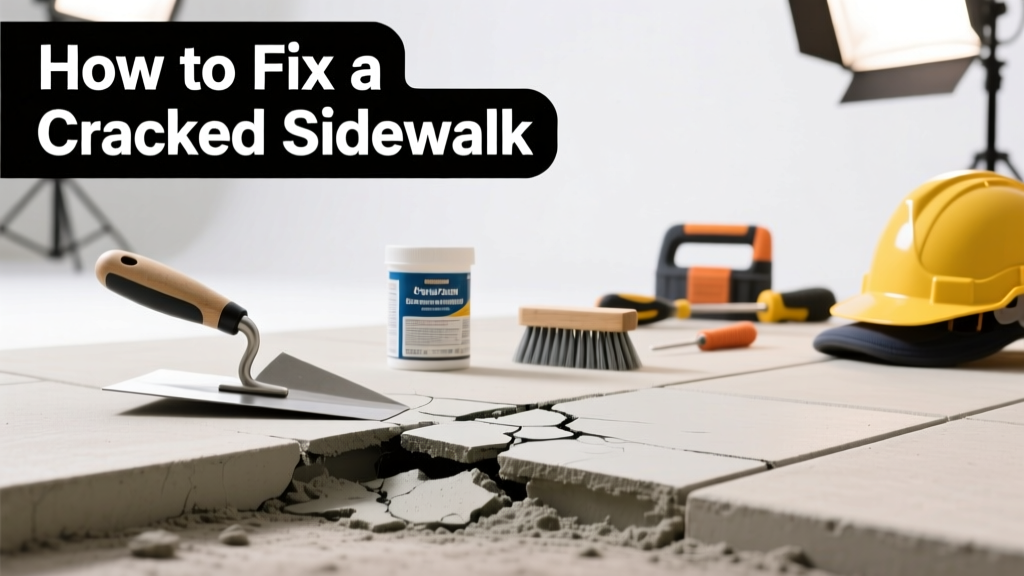
A cracked sidewalk isn’t just an eyesore—it’s a liability. Trips, falls, and worsening damage cost U.S. homeowners over $30 billion annually in slip-and-fall claims (National Safety Council, 2022). The good news? Most hairline to ¼-inch cracks can be repaired in under two hours with basic tools and under $40.
Quick Diagnosis
Before grabbing tools, identify the cause—it dictates your fix:
- Tree root pressure (often lifts one slab edge)
- Frost heave in cold climates (cracks follow soil movement)
- Poor subbase compaction during original pour
- Settling from buried organic matter or erosion
- Heavy vehicle traffic on residential walks (e.g., delivery trucks, dumpsters)
Tools & Materials Needed
| Item | Purpose | Estimated Cost |
|---|---|---|
| Wire brush & stiff broom | Cleans debris and dust from crack for proper sealant adhesion | $8–$15 |
| Chisel & masonry hammer | Removes loose concrete and widens crack for V-grooving (critical for lasting repair) | $12–$22 |
| Concrete crack filler (polyurethane or epoxy-based) | Flexible, weather-resistant sealant that bonds to old concrete and accommodates minor movement | $18–$32 per tube |
| Backer rod (closed-cell foam) | Provides depth control and prevents overfilling; essential for cracks >¼ inch wide | $6–$10 per 25-ft roll |
| Utility knife & caulk gun | Preps backer rod and applies filler smoothly and evenly | $5–$12 |
Step-by-Step Fix
Choose the method based on crack width and location:
- Hairline cracks (<1/16"): Clean with wire brush, dampen lightly, apply acrylic latex concrete sealer with a foam brush. Let cure 24 hrs before walking.
- Moderate cracks (1/16"–¼"): Chisel into a V-groove (wider at surface, ~¼" deep), remove dust, insert backer rod, then tool polyurethane filler flush with surface using a putty knife.
- Widened cracks (>¼") with spalling edges: Remove all loose material down to sound concrete, prime with bonding agent, fill with fast-setting hydraulic cement (e.g., QUIKRETE® FastSet™), and trowel smooth.
- Crack separating slabs with vertical displacement >⅛": Not a filler job—grind high side level first with angle grinder + diamond cup wheel, then fill as in step 2.
When to Call a Pro
DIY stops where safety and structural integrity begin. Call a licensed concrete contractor if:
- The crack is wider than ½ inch and growing month-to-month
- Adjacent slabs are tilting inward (indicating subsidence or sinkhole risk)
- Cracks form a spiderweb pattern across more than 3 square feet
- You see standing water pooling near the crack after rain (sign of failed drainage or pipe leak)
- Your sidewalk borders a city-maintained right-of-way—many municipalities require permits for repairs
Prevention Tips
Stop new cracks before they start:
- Install root barriers (HDPE sheeting) 24" deep along tree-lined walks
- Ensure positive slope (¼" per foot) away from foundations to prevent freeze-thaw saturation
- Seal entire sidewalk every 3 years with silane/siloxane penetrating sealer—not film-forming acrylics
- Avoid de-icing salts containing ammonium nitrate or magnesium chloride; use calcium chloride or sand instead
Can I use regular caulk instead of concrete crack filler?
No. Standard silicone or latex caulk lacks compressive strength and UV resistance. It will shrink, pull away, and fail within months. According to the American Concrete Institute’s Guidelines for Repair of Concrete Surfaces (ACI 546R-19), only elastomeric sealants rated for horizontal concrete exposure should be used outdoors.
How long does concrete crack filler last?
Quality polyurethane fillers last 5–7 years in shaded areas and 3–5 years in full sun. Epoxy-based options last longer but become brittle in freezing temps—so avoid them in zones with frequent sub-freezing cycles.
Do I need to replace the whole slab if it’s cracked?
Not unless the crack is accompanied by significant settling, crumbling edges, or multiple intersecting fractures. A 2021 study by the Portland Cement Association found that 82% of isolated cracks under 3/8" wide were successfully repaired without replacement.
Will sealing stop water from getting under the slab?
It helps—but only if the sealant fully penetrates and you’ve corrected grading and drainage first. The U.S. EPA estimates that 14% of household water usage is from leaks, many starting as unsealed cracks that channel runoff beneath slabs.
Can I paint over the filled crack?
Yes—but only after 72 hours of full cure and only with concrete-specific paint (e.g., masonry acrylic). Never use oil-based or standard exterior house paint; it’ll peel at the filler interface.
Is pressure washing safe before repair?
Use low-pressure (under 1,500 PSI) and keep nozzle >12 inches from surface. High-pressure washing erodes weakened edges and pushes moisture deeper—delaying drying and compromising adhesion. As veteran concrete restorer Mark Delaney advises:
“If you hear gravel popping out or see white dust flying, you’re doing more harm than cleaning.” — Mark Delaney, 32-year concrete restoration specialist, Concrete Repair Digest, 2020
Fixing a cracked sidewalk isn’t glamorous—but it’s one of the highest-ROI home repairs you’ll ever do. A clean, level walkway adds curb appeal, reduces insurance risk, and keeps kids and elders safe. Start small: tackle one 3-foot crack this weekend, then assess whether adjacent sections need attention. And if roots or settling keep returning? That’s not a repair job—it’s a sign to inspect your home’s foundation and evaluate nearby trees.