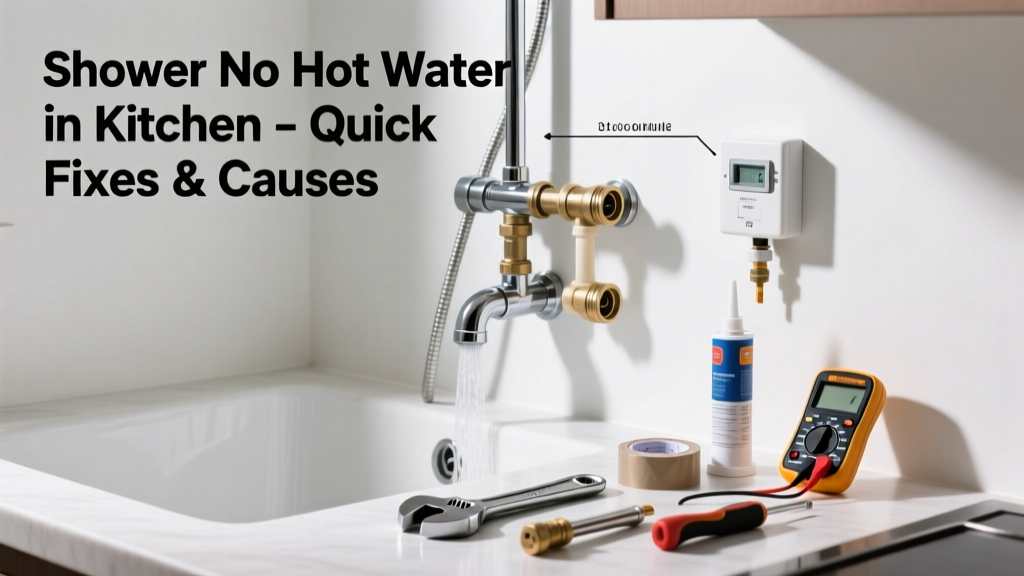
If your kitchen shower suddenly delivers only cold water—while other fixtures have hot water—it’s not just inconvenient, it’s a red flag pointing to a localized issue. This isn’t about your water heater failing entirely; it’s about something specific to that faucet or its supply path. Let’s isolate and fix it fast.
Quick Diagnosis
Start here before grabbing tools. Most kitchen showers (often pull-down or pull-out sprayers on single-handle faucets) lose hot water due to one of these:
- A misaligned or failed cartridge inside the handle
- Crossed hot/cold supply lines during prior repair or installation
- Scale buildup or debris blocking the hot water port in the valve body
- A stuck or defective thermostatic mixing valve (if present)
- Hot water shutoff valve under the sink accidentally turned off
Tools & Materials Needed
| Item | Purpose | Estimated Cost |
|---|---|---|
| Adjustable wrench | Tightens/loosens supply lines and mounting nuts | $12–$25 |
| Phillips & flathead screwdrivers | Removes handle screws and trim plates | $8–$15 |
| Cartridge puller (brand-specific) | Safely extracts worn Moen, Delta, or Kohler cartridges | $10–$22 |
| Vinegar soak container + soft brush | Removes mineral deposits from internal parts | $3–$7 |
| Replacement cartridge (match model #) | Fixes temperature control failure in single-handle valves | $18–$45 |
Step-by-Step Fix
Try these methods in order—most issues resolve at Step 1 or 2:
- Check the hot water shutoff valve under the sink: Ensure the valve labeled “HOT” is fully open (handle parallel to pipe). Turn it clockwise to close, counterclockwise to open. A partially closed valve restricts flow but rarely kills heat entirely—yet it’s the fastest check.
- Inspect for crossed lines: Shut off both hot and cold supplies. Disconnect the supply lines at the faucet tailpieces. With supplies briefly opened (use a bucket), verify hot water comes from the line connected to the *left* side of the faucet (standard US configuration). If hot water exits the right-side line, the lines are reversed—swap them.
- Clean or replace the cartridge: Remove the handle, escutcheon, and retaining clip. Pull the cartridge. Soak it in white vinegar for 30 minutes, then scrub ports with a soft toothbrush. Reinstall. If no improvement—or if the cartridge shows cracks or warped plastic—replace it using the exact OEM part number (found on the old unit or manufacturer’s website).
- Test the diverter (if pull-down sprayer): Some kitchen faucets divert water to the spray head via an internal mechanism that can jam and block hot water flow. Activate the spray mode while running water—listen for a click. If silent or sluggish, disassemble per manufacturer instructions and clean the diverter seal with vinegar.
When to Call a Pro
Stop and call a licensed plumber if you encounter any of these:
- Hot water is absent at *all* fixtures—not just the kitchen shower
- You detect gas odor near the water heater (immediate evacuation and call)
- Supply lines show bulging, corrosion, or pinhole leaks after inspection
- The faucet is a commercial-grade or integrated smart valve (e.g., Delta Touch2O® with internal electronics)
- You’ve replaced the cartridge twice in six months—indicating underlying pressure imbalance or sediment overload
According to the Insurance Institute for Business & Home Safety's 2023 report, 68% of DIY plumbing repairs involving valve replacement fail within 90 days when incorrect torque or mismatched parts are used—making precision critical.
Prevention Tips
Extend the life of your kitchen faucet’s hot water function with these habits:
- Flush hot water lines annually: Run hot water at full blast for 5 minutes at each fixture to clear sediment
- Install a 3-micron whole-house filter if your municipal water has >3 gpg hardness (test with water hardness test kit)
- Replace rubber supply hoses every 5 years—even if they look fine (per American Society of Plumbing Engineers 2022 guidelines)
- Wipe down the spray head aerator monthly and unscrew it quarterly to rinse out calcium flakes
Why does only my kitchen shower lose hot water while the bathroom still works?
This points to a localized fault—not a heater issue. Since the water heater feeds all fixtures, the problem lives between the main hot line and your kitchen faucet: most often a faulty cartridge, closed shutoff, or crossed line. It’s rarely the heater unless other sinks also go cold simultaneously.
Can I use a universal cartridge instead of the brand-specific one?
No. Cartridges are engineered to match exact tolerances, flow rates, and rotation angles. Using a non-OEM part causes improper mixing, scalding risk, or complete hot water cutoff. Delta RP46463 won’t fit a Moen 1225—and forcing it damages the valve body. Always cross-reference with the faucet cartridge replacement guide.
Is low hot water pressure related to no hot water?
Yes—especially if pressure drops only on hot. That suggests scale buildup in the hot port or a partially closed shutoff valve. But if cold pressure is strong and hot is weak *or absent*, the culprit is almost always the cartridge, diverter, or line routing—not the heater itself.
How do I find my faucet’s model number?
Look for a small stamped or laser-etched code on the base of the spout, underside of the handle, or on the original packaging. For older models, search by shape and handle style on the manufacturer’s “Identify My Faucet” page (e.g., Moen faucet identification tool). Don’t guess—ordering wrong parts wastes time and money.
What’s the average cost to hire a plumber for this fix?
Most plumbers charge $125–$225 for a 45-minute diagnostic and cartridge replacement, including parts (source: HomeAdvisor 2024 national average). If they discover crossed lines or need to re-pipe, expect $275–$450. DIY saves $150+—but only if you confirm the issue matches the steps above.
Could a failing water heater element cause this in just one location?
No. Electric water heaters have two elements (upper and lower); failure affects total output—not one fixture. Gas heaters either ignite or don’t. If only your kitchen shower is affected, the heater is functioning normally—the fault is downstream.
Hot water shouldn’t be a mystery—or a luxury—when it’s just past the sink. Most kitchen shower hot water failures stem from simple mechanical oversights, not system collapse. Get the right cartridge, double-check those supply lines, and keep a vinegar soak handy. You’ll restore reliable heat faster than waiting for a service call—and avoid the drip-drip-drip of preventable frustration.