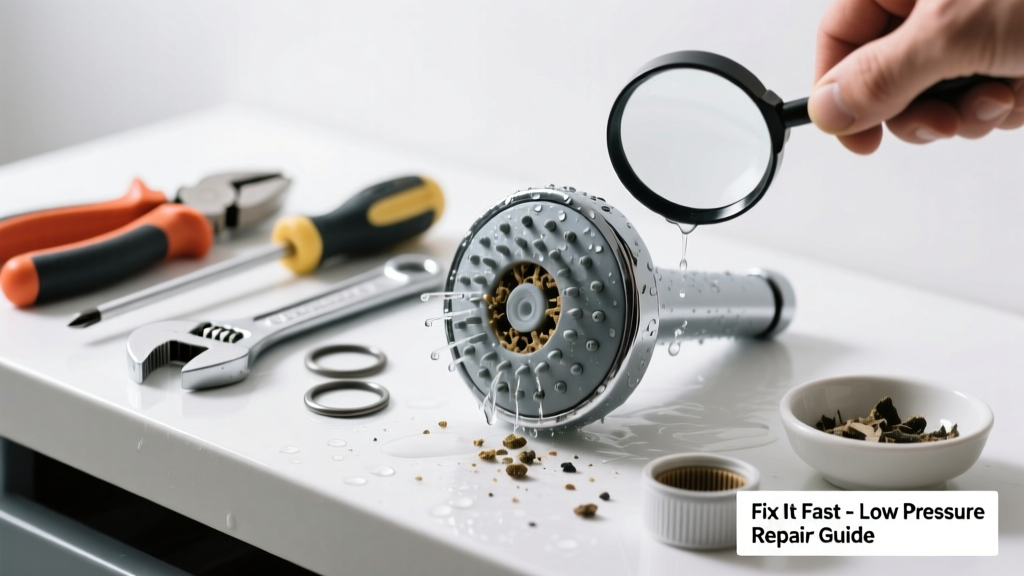
Nothing kills a relaxing morning like stepping into a lukewarm, dribbling shower. If your shower pressure has dropped noticeably—especially if it’s sudden or affects only one fixture—you’re likely dealing with a clog, valve issue, or water supply problem, not just bad luck.
Quick Diagnosis
Before grabbing tools, rule out the obvious:
- Is the low pressure isolated to one shower, or do other faucets have weak flow too?
- Does pressure improve when you turn off other water-using appliances (dishwasher, washing machine)?
- Is the showerhead brand-new—or over 5 years old without cleaning?
- Do you hear knocking, hissing, or gurgling behind walls when the shower runs?
- Has your home recently had plumbing work, water heater replacement, or municipal water main repairs?
Tools & Materials Needed
| Item | Purpose | Estimated Cost |
|---|---|---|
| Adjustable wrench | Tightens or loosens shower arm and valve connections without stripping threads | $12–$25 |
| White vinegar (1 quart) | Dissolves mineral deposits in aerators and showerheads | $3–$6 |
| Small wire brush or toothbrush | Cleans tiny orifice holes and internal channels | $2–$5 |
| Plumber’s tape (Teflon tape) | Seals threaded joints to prevent leaks after reassembly | $2–$4 |
| Replacement cartridge (brand-specific) | Fixes faulty pressure-balancing or thermostatic valves | $18–$65 |
Step-by-Step Fix
Work methodically—from easiest to most involved:
- Remove and soak the showerhead: Unscrew it by hand or with pliers (wrap jaws in cloth to avoid scratches). Soak overnight in undiluted white vinegar. Scrub nozzles with a soft brush. Reinstall and test.
- Check the flow restrictor: Many modern showerheads have a plastic disc inside limiting flow to 2.0 GPM. Remove it carefully with needle-nose pliers—this often doubles pressure (but may violate local water codes; check your municipality’s regulations).
- Inspect the shower valve cartridge: Turn off water at the shut-off valve (or main). Remove handle, escutcheon, and retaining clip. Pull out cartridge. Look for cracked rubber seals, mineral-crusted ports, or warped plastic. Replace with OEM part—never substitute generic cartridges.
- Test for pipe scale buildup: If pressure is fine at sinks but weak at the shower, cut a small access panel near the shower valve (if accessible) and inspect copper or PEX supply lines for greenish-white crust. This points to hard water scaling upstream—common in homes over 15 years old with well or unsoftened municipal water.
When to Call a Pro
Stop and call a licensed plumber if:
- You detect wet drywall, mold odor, or bulging tiles near the shower valve—signs of a hidden leak behind tile or sheetrock.
- Pressure drops only when hot water runs elsewhere—indicating a failing water heater dip tube or sediment-clogged tank outlet.
- Your home uses galvanized steel pipes built before 1975; internal corrosion can’t be cleaned—it requires pipe replacement.
- Water pressure at all fixtures is below 40 PSI (test with a $15 pressure gauge on an outdoor spigot), suggesting municipal supply issues or main shutoff valve problems.
"Over 60% of low-shower-pressure complaints in homes older than 10 years trace back to failed thermostatic mixing valves—not clogged heads," says plumbing engineer Maria Chen in the American Society of Plumbing Engineers Journal (2022).
Prevention Tips
Extend your system’s life with simple habits:
- Soak showerheads in vinegar every 6 months—even if flow seems fine.
- Install a whole-house water softener if your water hardness exceeds 7 grains per gallon (test with a $10 hardness strip kit).
- Replace rubber washers and O-rings in handles every 3 years—dry rot causes slow valve leakage that starves pressure.
- After any plumbing work, flush all lines by opening cold and hot taps fully for 90 seconds to clear debris.
Can I use bleach instead of vinegar to clean the showerhead?
No. Bleach corrodes brass, chrome plating, and rubber seals—especially when heated. It also reacts dangerously with residual minerals to produce chlorine gas. Stick to white vinegar or citric acid solutions. For stubborn biofilm, add 1 tsp baking soda to warm vinegar for a gentle effervescent lift.
Why does my shower pressure drop only when the washing machine runs?
This signals undersized supply piping (often ½-inch instead of required ¾-inch) or a partially closed main shutoff valve. The washing machine demands ~3.5 GPM—enough to starve a ½-inch line feeding multiple fixtures. Check valve position and consider upgrading branch lines if remodeling.
Will replacing my showerhead fix low pressure permanently?
Only if the root cause is the head itself—like a clogged restrictor or worn internal seal. A new high-flow model won’t help if your valve cartridge is failing or pipes are scaled. Always diagnose first: compare flow rates between your old and new head using a 1-gallon bucket and stopwatch.
How do I know if my pressure-balancing valve is failing?
Symptoms include sudden temperature swings (scalding or icy bursts), inconsistent pressure when flushing toilets, or a faint clicking sound from the wall when adjusting the handle. These indicate worn internal pistons or spring fatigue—replace the entire cartridge, not just seals.
Can hard water damage my shower valve permanently?
Yes. Calcium and magnesium deposits accumulate inside ceramic disc valves and thermostatic elements, causing sticking, reduced flow, and eventual failure. The U.S. EPA estimates that homes with >12 GPG hardness see valve lifespan drop by 40% without softening or regular descaling.
What’s the minimum safe water pressure for a shower?
Most manufacturers require 40–80 PSI for optimal performance. Below 40 PSI, flow-sensitive features (like rain heads or body sprays) underperform. Use a pressure gauge on an outdoor faucet—if readings are consistently under 40 PSI, contact your water utility or install a booster pump—especially common with well systems.
Low shower pressure rarely means your entire plumbing system is failing—it’s usually a localized, fixable issue hiding in plain sight. Most cases resolve in under an hour with vinegar, a wrench, and 10 minutes of inspection. But don’t ignore recurring symptoms: what starts as a weak stream can become a leaking valve or hidden pipe corrosion if left unchecked. Stay proactive, keep records of past fixes, and treat your shower like the high-use appliance it is—because it is.