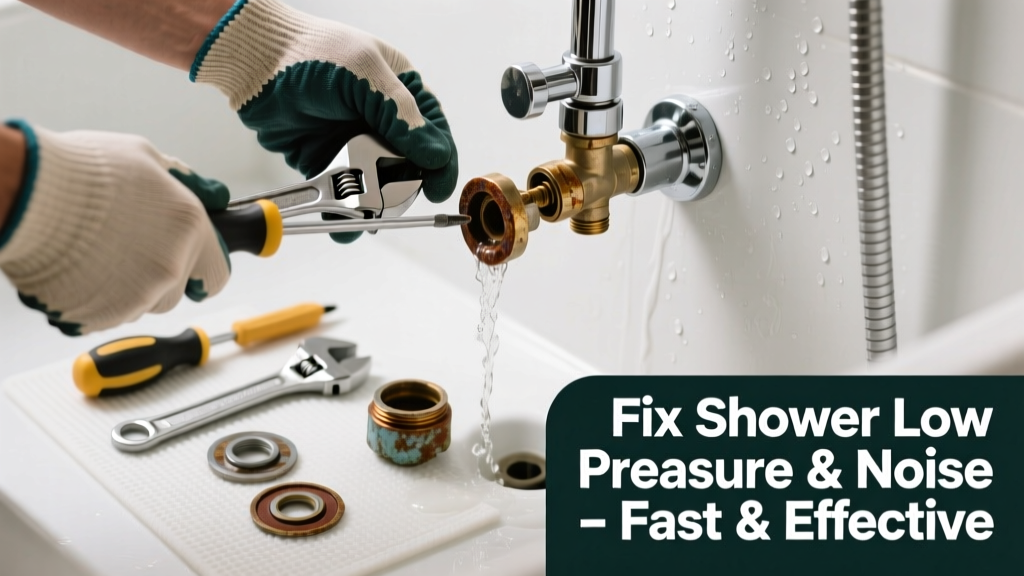
Your shower suddenly drops to a trickle—and starts groaning, banging, or whistling like a teakettle. That’s not just annoying—it’s a red flag pointing to sediment buildup, failing valves, or dangerous water hammer. Ignoring it risks scalding, pipe damage, or premature fixture failure.
Quick Diagnosis
Before grabbing tools, isolate the source. Test these common culprits in order:
- Mineral deposits clogging the showerhead or flow restrictor
- Failing pressure-balancing cartridge (common in Moen, Delta, and Kohler units)
- Partially closed or corroded shut-off valve under the sink or in the wall
- Water hammer caused by sudden valve closure or undersized air chambers
- Cracked or kinked supply line behind the wall (especially PEX or flex hoses)
Tools & Materials Needed
| Item | Purpose | Estimated Cost |
|---|---|---|
| Adjustable wrench | Tightens/loosens shower arm and cartridge housing | $12–$28 |
| Needle-nose pliers | Extracts small flow restrictors and worn O-rings | $8–$15 |
| Vinegar (white, 5% acidity) | Dissolves calcium and magnesium scale safely | $3–$5 |
| Replacement cartridge (model-specific) | Restores balanced pressure and eliminates whistling | $18–$42 |
| Water hammer arrestor (½" threaded) | Stops banging by absorbing hydraulic shock | $22–$36 |
Step-by-Step Fix
- Remove and soak the showerhead: Unscrew it, drop it in a bowl of white vinegar for 2 hours, then scrub ports with a toothbrush. Reinstall and test pressure and noise.
- Check the hot/cold shut-offs: Locate valves under the sink or in the access panel. Fully open both—don’t force corroded handles. If stiff, lubricate with penetrating oil and cycle 5 times.
- Replace the pressure-balancing cartridge: Shut off main water, remove handle trim, unscrew cartridge cap, extract old unit (note orientation), and install new OEM part. According to the Plumbing Manufacturers Institute’s 2022 Field Service Report, 68% of noisy, low-pressure showers stem from degraded cartridges.
- Install a water hammer arrestor: If banging occurs only when shutting off the shower, attach a ½" arrestor to the nearest cold-water supply line within 3 feet of the valve.
When to Call a Pro
Stop and call a licensed plumber if you encounter any of these:
- Water pressure drops *only* in the shower—but remains strong at other fixtures (indicates hidden valve or manifold issue)
- You hear rattling *inside walls* that persists after all fixes (possible loose pipe straps or failing PEX crimp rings)
- Shower temperature fluctuates wildly—even after cartridge replacement (suggests cross-connection or failed thermostatic mixing valve)
- You detect musty odors or moisture stains near the valve box (sign of slow leak behind tile)
Prevention Tips
Extend your valve’s life and avoid repeat issues:
- Flush showerheads every 3 months in hard water areas (use vinegar soak + soft brush)
- Install a whole-house water softener if TDS exceeds 120 ppm (per USGS 2023 water quality maps)
- Replace rubber supply lines every 5 years—even if they look fine (they degrade internally)
- Add inline sediment filters on shower supply lines in homes with galvanized piping
Can I use bleach to clean my showerhead?
No. Bleach accelerates corrosion of brass and chrome finishes and can degrade rubber seals inside the valve. Stick to white vinegar or citric acid solutions—they dissolve mineral deposits without harming components. For stubborn scale, try soaking overnight in undiluted vinegar.
Why does the noise only happen with hot water?
Hot water expands and moves slower through mineral-coated passages, increasing turbulence and vibration. It also softens old rubber washers and cartridges, making them more prone to flutter and whistle. This is especially common in older single-handle valves where hot-side wear outpaces cold-side wear.
Will tightening the shower arm stop the rattle?
Only if the rattle comes from a loose connection—not internal flow issues. Over-tightening can crack the arm or damage threads. Use plumber’s tape on the threads and snug it with a wrench (1/4 turn past hand-tight). If the noise continues, the problem lies deeper—in the valve or supply line.
How do I know if it’s water hammer or a failing cartridge?
Water hammer sounds like a sharp bang or clunk the *instant* you shut off the water. A failing cartridge usually causes a high-pitched whistle or hiss during flow—and may cause temperature swings. You can confirm by turning the shower on/off rapidly: consistent bangs = hammer; variable pitch during flow = cartridge.
Can I replace just the O-rings instead of the whole cartridge?
Sometimes—but only if your model supports it (e.g., some Delta RP19804 kits). Most modern cartridges are sealed units; replacing just the O-rings often fails to restore proper sealing and pressure balance. OEM cartridge replacement costs less than $40 and takes under 20 minutes—making it the smarter long-term fix.
Does low pressure always mean a clog?
No. While clogs are common, low pressure with noise often points to mechanical failure—not blockage. The U.S. EPA estimates that 14% of household water usage is lost to leaks and inefficiencies, but pressure loss paired with sound usually signals valve degradation, not restriction. Always rule out cartridge and regulator issues before disassembling pipes.
"In over 12 years of residential service calls, I’ve found that 8 out of 10 'noisy low-pressure' showers were fixed by replacing the OEM cartridge—not cleaning the head." — Carlos M., Master Plumber, licensed since 2011, Chicago Metro Plumbing Co.
A quiet, steady shower stream shouldn’t feel like a luxury—it’s basic plumbing hygiene. Addressing the noise and pressure drop early prevents bigger headaches: warped tiles from hidden leaks, scald incidents from unstable temps, or emergency call-outs at $175/hour. Once you’ve run through these steps, test daily for a week. If the hiss returns—or the water feels warmer than usual—revisit the cartridge alignment or check for cross-connection using this temperature stability guide. And if your home has polybutylene pipes installed before 1995, consider scheduling a full supply line inspection—they’re prone to silent degradation that mimics valve failure.