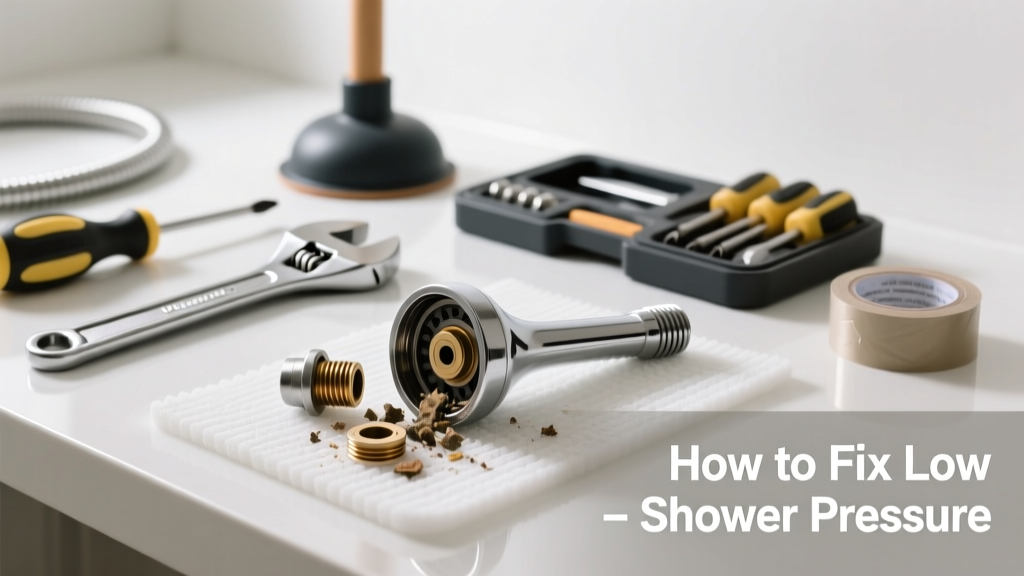
Waking up to a weak, sputtering shower stream is frustrating — especially when you’re already running late. Low water pressure isn’t always a sign of major plumbing failure; often, it’s a simple clog or valve issue you can resolve in under an hour. Let’s get that satisfying spray back without calling a plumber first.
Quick Diagnosis
Before grabbing tools, rule out the obvious causes. Low pressure may be isolated to one fixture or affect multiple outlets — that distinction matters.
- Showerhead clogged with mineral deposits (most common in hard water areas)
- Partially closed or corroded shut-off valve behind the wall or at the water heater
- Crushed, kinked, or aged supply line (especially braided stainless steel lines older than 5 years)
- Failed pressure-balancing cartridge inside the valve body (common in Moen, Delta, and Kohler units)
- Whole-house pressure drop — check other faucets and toilets for similar issues
Tools & Materials Needed
| Item | Purpose | Estimated Cost |
|---|---|---|
| Adjustable wrench | Tightens or loosens shower arm and supply nuts without stripping threads | $12–$25 |
| White vinegar & small container | Dissolves calcium and magnesium buildup in showerhead nozzles | $3–$6 |
| Small wire brush or toothbrush | Cleans fine debris from faceplate and internal passages | $2–$5 |
| Replacement cartridge (model-specific) | Fixes inconsistent flow or temperature shifts caused by worn internal parts | $18–$45 |
| Thread seal tape (PTFE) | Prevents leaks when reinstalling showerhead or supply lines | $2–$4 |
Step-by-Step Fix
Start with the easiest, lowest-cost solutions first — most cases resolve before touching the valve body.
- Soak the showerhead in vinegar: Unscrew it (use a cloth to protect finish), submerge in undiluted white vinegar for 2–4 hours, then scrub nozzles with a wire brush. Reinstall and test.
- Check the shut-off valves: Locate the two inline shutoffs near the shower rough-in (often behind an access panel). Ensure both handles are fully counterclockwise (open). If stiff or leaking, replace them — they’re $8–$12 each.
- Inspect the supply line: Look for kinks, bulges, or corrosion on the flexible line between valve and showerhead. Replace if older than 5 years — braided stainless lines fail silently.
- Test the cartridge: If pressure drops only after hot water runs or fluctuates with temperature, the cartridge is likely failing. Remove trim plate, extract cartridge using manufacturer’s tool (or needle-nose pliers), and compare to replacement guides by brand.
When to Call a Pro
DIY stops where safety, code, or structural access begins. Don’t risk scalding, flooding, or voiding warranties.
- You hear banging or groaning pipes when water turns on — indicates water hammer or pressure regulator failure
- Low pressure affects all fixtures on the same floor or entire house — points to main line, pressure regulator, or municipal supply issue
- No access panel behind the shower valve, requiring drywall removal or tile cutting
- Your home has polybutylene piping (installed 1978–1995) — these degrade unpredictably and require full replacement
"Over 60% of shower pressure complaints stem from neglected showerhead maintenance — not pipe or valve failure." — Plumbing Manufacturers Institute, 2022 Residential Repair Survey
Prevention Tips
Extend your system’s life and avoid repeat issues with consistent care.
- Soak your showerhead in vinegar every 6 months if your water hardness exceeds 7 grains per gallon
- Install a whole-house water softener if hardness is above 10 gpg — reduces scale buildup by 90% (U.S. Geological Survey, 2021)
- Replace flexible supply lines every 5 years — even if they look fine — as internal linings degrade
- Set your water heater to 120°F maximum to slow mineral precipitation in hot lines
Can I use bleach to clean my showerhead?
No. Bleach corrodes brass, chrome plating, and rubber washers. It also reacts dangerously with mineral deposits, releasing chlorine gas. Stick to white vinegar or citric acid solutions — both dissolve scale safely and leave no residue.
Why does pressure drop only when I turn on hot water?
This usually signals a failing thermostatic or pressure-balancing cartridge. Hot water expands slightly and moves slower through restricted passages; a worn cartridge can’t regulate flow evenly. It’s rarely the water heater itself unless sediment has built up in the tank — but that would also reduce hot water volume and duration.
Will a water-saving showerhead make low pressure worse?
Not necessarily — many high-efficiency models (like Waterpik EcoFlow or High Sierra) maintain strong spray at 1.5 GPM by optimizing nozzle design and air infusion. Avoid ultra-low-flow heads under 1.2 GPM unless your home’s static pressure exceeds 60 PSI.
Can a clogged aerator cause low shower pressure?
No — showers don’t use aerators like sink faucets do. The restriction happens in the showerhead’s internal flow restrictor or nozzle array. Some models have removable plastic discs behind the faceplate — those are the real culprits, not aerators.
What’s the minimum safe water pressure for a shower?
The International Plumbing Code requires a minimum of 20 PSI at fixture outlets under flow. Most modern shower systems perform best between 40–80 PSI. Below 30 PSI, you’ll notice sluggish response and poor spray pattern — and may need a booster pump if municipal supply is consistently low.
Do I need to shut off the main water supply to replace the cartridge?
Yes — always. Even if you close the local shut-offs, residual pressure remains in the lines. Shut off the main, open the lowest faucet in the house to relieve pressure, then proceed. Skipping this risks sudden water bursts and damaged valve seats.
A steady, powerful shower stream shouldn’t feel like a luxury — it’s basic functionality you’re entitled to. Most low-pressure issues respond well to methodical cleaning and inspection, saving you $150+ in service calls. But know your limits: when walls must be opened or pressure readings fall below 25 PSI, bring in someone with a license and liability insurance. Your morning routine will thank you.