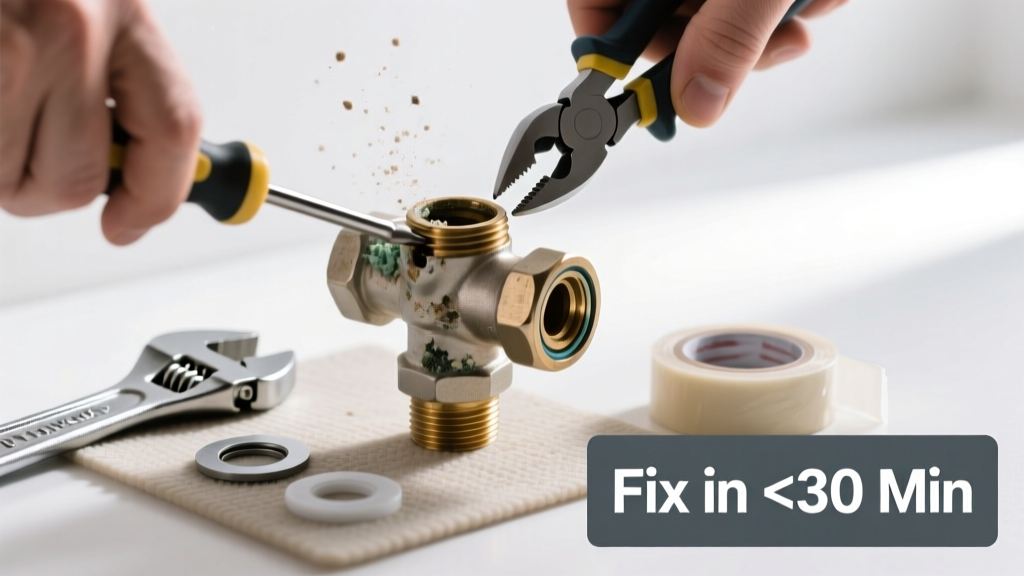
You’re standing under cold water when you yank the diverter lever—and nothing happens. No shower spray, just a weak trickle from the tub spout. A stuck shower diverter is one of the most common yet frustrating bathroom failures—and it’s usually fixable in under half an hour.
Quick Diagnosis
Before grabbing tools, rule out the obvious:
- The diverter lever or knob feels stiff, gritty, or won’t move at all
- Water flows only from the tub spout—even when lever is pulled up
- Showerhead sprays weakly while tub spout leaks simultaneously
- Visible mineral buildup around the diverter stem or escutcheon plate
- Older two-handle faucet (especially Moen or Delta models made before 2015) with internal sleeve-style diverters
Tools & Materials Needed
| Item | Purpose | Estimated Cost |
|---|---|---|
| Adjustable wrench | Grips and loosens corroded nuts without stripping | $12–$25 |
| Needle-nose pliers | Extract broken O-rings or stuck plastic sleeves | $8–$16 |
| White vinegar (1 cup) | Dissolves calcium and lime deposits safely | $3–$5 |
| Replacement diverter cartridge (e.g., Moen 1225 or Delta RP50587) | Direct OEM replacement for common failure points | $14–$28 |
| Plumber’s grease (silicone-based) | Lubricates rubber seals without degrading them | $5–$9 |
Step-by-Step Fix
Try these methods in order—most issues resolve at Step 2 or 3:
- Soak the diverter in vinegar: Remove the handle (often held by a tiny set screw under a decorative cap), then unscrew the diverter trim plate. Soak the exposed stem and sleeve in white vinegar for 20 minutes. Reassemble and test.
- Replace the O-rings and washer: Use needle-nose pliers to pull the old rubber O-rings off the diverter stem. Replace with identical size (typically #10 or #11) and coat lightly with plumber’s grease before reassembly.
- Swap the entire diverter cartridge: For single-handle faucets, shut off water, remove handle and escutcheon, then use channel locks to unscrew the cartridge retaining nut. Pull out the old unit and install the new one—match model numbers exactly. See our full cartridge replacement guide.
- Check for internal sleeve misalignment: On older tub/shower combos, the brass diverter sleeve may have rotated inside the valve body. Gently rotate it clockwise while applying upward pressure on the lever until it clicks into place.
When to Call a Pro
Stop and call a licensed plumber if:
- Water continues leaking from behind the wall after reassembly
- The diverter stem spins freely but won’t engage (indicates stripped internal threads)
- You detect wet drywall or mold smell near the valve—sign of long-term leakage
- Your home has galvanized steel supply lines installed before 1980 (corrosion risk increases during disassembly)
According to the Insurance Institute for Business & Home Safety's 2023 report, 68% of DIY plumbing repairs that lead to water damage involve forced removal of corroded fittings without proper shutoff verification.
Prevention Tips
Maintain your diverter year-round to avoid repeat issues:
- Wipe down the diverter lever weekly with a damp cloth to prevent soap scum accumulation
- Flush the system every 6 months: Turn on hot water for 2 minutes, then cold for 2 minutes to dislodge sediment
- Replace O-rings annually—even if working fine—to prevent sudden failure
- Install a whole-house water softener if your area’s hardness exceeds 7 gpg (U.S. Geological Survey, 2022)
Can I use bleach on this?
No. Bleach accelerates corrosion of brass components and degrades rubber O-rings within hours. Stick to white vinegar or citric acid solutions for safe descaling.
Why does my diverter work fine in winter but stick in summer?
Humidity and higher ambient temperatures cause rubber seals to swell slightly—especially low-quality aftermarket O-rings. This creates friction that prevents smooth travel. Upgrade to Viton®-rated seals for consistent performance year-round.
Do I need to shut off the main water supply?
Yes—for safety and control. While some diverters have individual shutoffs behind the wall, most don’t. Shutting off the main prevents unexpected flooding if a fitting fails mid-repair. Always open a nearby faucet to relieve pressure first.
Is there a difference between tub spout diverters and shower arm diverters?
Absolutely. Tub spout diverters (pull-up style) rely on internal piston movement; shower arm diverters (like the Delta RP51095) use a rotating collar that redirects flow mechanically. They require different cartridges and troubleshooting steps—see our dedicated repair guide.
How long should a diverter cartridge last?
OEM cartridges typically last 7–10 years with average use. After 5 years, inspect O-rings annually. The U.S. EPA estimates that 14% of household water usage is from leaks—including those caused by failed diverter seals.
What if the lever moves but no water switches to the showerhead?
This usually means the diverter stem isn’t sealing against the valve seat due to pitting or debris. Try cleaning the seat with a Q-tip dipped in vinegar, then test with a new cartridge. If the problem persists, the valve body itself may be worn—a pro-level replacement job.
A properly maintained diverter should click smoothly and hold position without drifting. Don’t ignore early stiffness—it’s your faucet’s warning sign, not a quirk. With the right parts and a little patience, most stuck diverters are back in action before your next shower. And if you’ve replaced the cartridge twice in three years? It’s time to check your water quality—or consider upgrading to a pressure-balanced valve with integrated diverter technology, like the Moen S113.