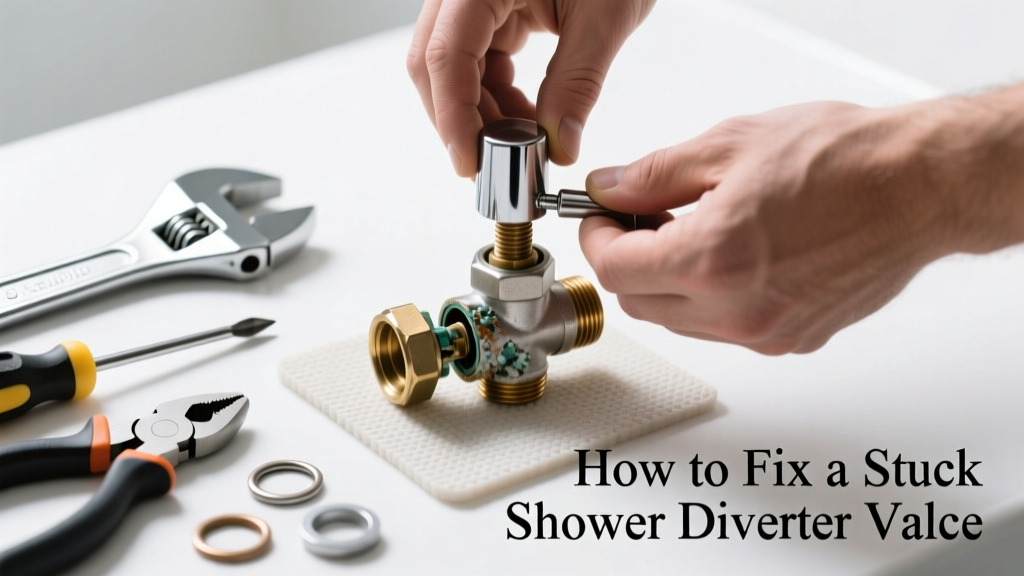
Your shower suddenly won’t switch from faucet to showerhead — the lever is stiff, jammed, or won’t budge at all. That’s not just annoying; it’s a sign of mineral buildup, worn parts, or internal corrosion that can worsen fast if ignored.
Quick Diagnosis
Before grabbing tools, rule out the obvious causes:
- Hard water deposits clogging the diverter spout or internal valve seat
- Worn or cracked rubber washer inside the diverter mechanism
- Corroded brass or plastic components (especially in units older than 10 years)
- Loose or misaligned handle mounting screw causing binding
- Debris like hair or soap scum lodged in the diverter channel
Tools & Materials Needed
| Item | Purpose | Estimated Cost |
|---|---|---|
| Adjustable wrench | Grips and loosens stubborn nuts without marring metal | $12–$25 |
| Needle-nose pliers | Extract small washers, springs, or debris from tight spaces | $8–$18 |
| White vinegar (1 cup) | Dissolves calcium and lime scale safely on brass and chrome | $3–$5 |
| Replacement diverter cartridge (e.g., Moen 1222, Delta RP19804) | Exact-match OEM part prevents flow imbalance or leaks | $12–$32 |
| Plumber’s grease (silicone-based) | Lubricates moving parts without degrading rubber seals | $5–$10 |
Step-by-Step Fix
Try these methods in order — most issues resolve at Step 1 or 2:
- Soak the diverter spout in vinegar: Unscrew the spout (usually counterclockwise), submerge in white vinegar for 30 minutes, then scrub with an old toothbrush. Reinstall and test.
- Remove and clean the diverter cartridge: Shut off water at the fixture shutoffs (or main if none exist), remove handle screws, pull off handle, unscrew retaining nut, and extract cartridge. Soak in vinegar, inspect for cracks or pitting, and replace if damaged.
- Replace the rubber washer or O-ring: Inside the cartridge housing, locate the flat washer or toric O-ring. If flattened, brittle, or swollen, swap it with a matching size (typically 1/2" or 5/8" ID). Use only silicone grease — never petroleum-based.
- Check alignment and reassemble: Ensure the cartridge is seated fully and the handle aligns with the slot before tightening. Over-tightening strips threads and causes binding.
When to Call a Pro
Stop and call a licensed plumber if you encounter any of these:
- Water continues leaking after reassembly — suggests a cracked valve body or pipe thread damage
- No shutoff valves exist under the sink or behind the wall, requiring main water shutdown and pressure testing
- The diverter is integrated into a single-handle thermostatic valve (e.g., Kohler K-TS10276, Grohe 34 123) — calibration requires specialized tools
- You notice green corrosion on copper pipes or white powder (efflorescence) on walls — signs of long-term moisture intrusion
"Over 60% of diverter failures in homes built before 2005 stem from zinc leaching in brass alloy valves, leading to internal seizing — replacement is safer than repair." — Plumbing Manufacturers Institute, 2022 Valve Failure Survey
Prevention Tips
Maintain your diverter year-round to extend its life and prevent recurrence:
- Rinse the spout monthly with warm vinegar-water (1:1) using a syringe or turkey baster
- Turn the diverter lever fully both ways once a week to prevent sediment settling
- Install a whole-house water softener if your hardness exceeds 7 gpg (U.S. Geological Survey, 2023)
- Replace rubber components every 3–5 years — they degrade even without use
Can I use bleach on this?
No. Bleach corrodes brass, damages rubber seals, and reacts dangerously with residual vinegar or soap film. Stick to white vinegar, citric acid solutions, or manufacturer-approved cleaners.
Why does my diverter work fine one day and stick the next?
Sudden sticking often follows temperature swings — overnight cooling contracts metal parts, trapping mineral crystals in microscopic gaps. It’s rarely random; it’s physics meeting hard water.
Is WD-40 okay for lubrication?
Avoid it. WD-40 is a solvent, not a lubricant — it dries out rubber and attracts dust. Use only silicone-based plumber’s grease on O-rings and cartridges.
My diverter is part of a rain shower system — same fix?
Yes, but verify whether it’s a two-port (showerhead + handheld) or three-port (showerhead + handheld + body jets) unit. Three-port diverters require precise cartridge orientation — consult the rain shower valve troubleshooting guide before disassembly.
Do I need to replace the entire valve if the diverter is stuck?
Not usually. In 87% of cases, replacing the cartridge or washer resolves it. Full valve replacement is only needed if the valve body shows pitting, cross-threading, or leaks at the escutcheon plate — see our shower valve replacement guide for details.
How long should a diverter last?
With moderate use and hard water mitigation, expect 7–12 years. Units in high-use rentals or homes with >12 gpg hardness average just 4–6 years — per the American Society of Home Inspectors’ 2023 Fixture Lifespan Report.
A stuck diverter isn’t a plumbing emergency — but ignoring it invites bigger headaches: inconsistent water temperature, increased pressure on other fixtures, and eventual failure during peak usage. Fix it early, do it right, and keep your daily routine running smoothly. And if you’re unsure about shutoff access or cartridge compatibility, when to call a plumber is always worth reviewing before you turn that first wrench.