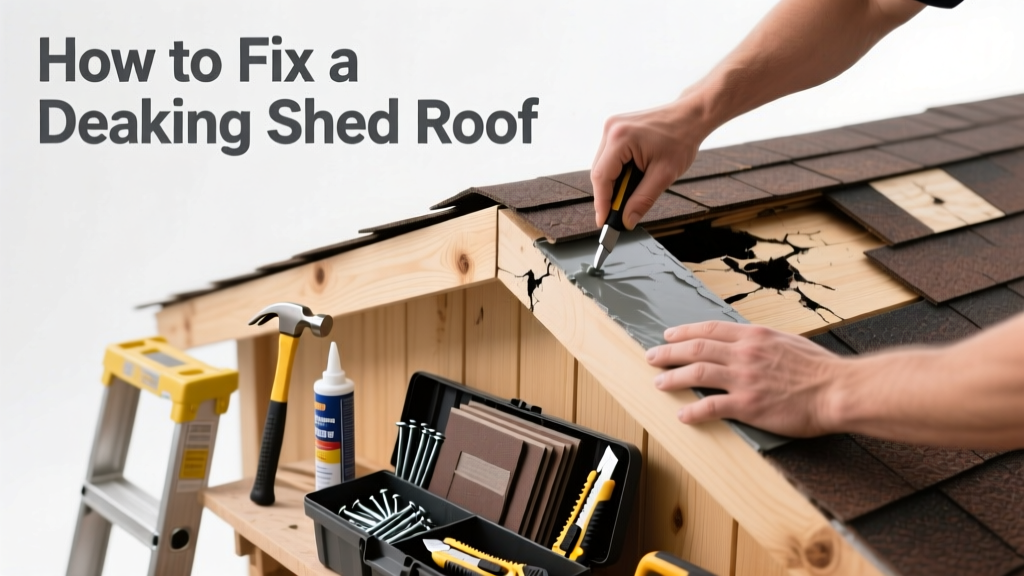
A leaky shed roof isn’t just annoying—it’s actively rotting your structure from the inside out. Even a small drip can saturate insulation, warp plywood sheathing, and invite mold within weeks. Catch it early, and you’ll likely spend under $30 and an hour on the fix.
Quick Diagnosis
Before grabbing tools, identify the source. Most leaks trace back to one of these culprits:
- Cracked or missing asphalt shingle tabs (especially near ridges or valleys)
- Failed sealant around roof vents, skylights, or plumbing boots
- Rusted or loose screws in corrugated metal roofs
- Gutter overflow backing water into soffit or fascia gaps
- Decayed wood at eaves or around flashing where roof meets wall
Tools & Materials Needed
| Item | Purpose | Estimated Cost |
|---|---|---|
| Roofing cement (trowel-grade) | Seals cracks and secures flashing repairs | $8–$12 |
| 100% silicone roof sealant (UV-resistant) | Flexible, long-lasting seal for metal seams and penetrations | $10–$15 |
| Replacement shingles or metal roofing screws (with neoprene washers) | Direct replacement for damaged sections | $5–$20 |
| Stiff-bristle brush & mineral spirits | Cleans old tar, debris, and oxidation before sealing | $6–$9 |
| Roofing nail puller & claw hammer | Safely removes damaged nails without splitting wood | $12–$18 |
Step-by-Step Fix
Choose the method that matches your roof type and damage severity:
- Shingle repair: Lift the damaged shingle with a flat bar, scrape off old adhesive, apply roofing cement underneath, press down firmly, and seal edges with silicone.
- Metal roof seam leak: Clean seam with mineral spirits, dry thoroughly, then run a continuous ¼" bead of silicone along the entire seam—press seam together while wet.
- Flashing gap (e.g., around vent pipe): Remove old caulk, clean metal and roof surface, embed new flashing tape (like Grace Ice & Water Shield) under upper course, then top-seal with silicone.
- Gutter-related leak: Clear clogs, check slope (should drop ¼" per 10 feet), and install leaf guards if overhanging branches cause frequent debris buildup.
When to Call a Pro
Don’t risk your safety—or your shed’s structural integrity—on these scenarios:
- More than 30% of shingles are curled, brittle, or missing granules (sign of full roof age-out)
- Water stains extend into rafters or ceiling joists (indicates prolonged saturation)
- Roof pitch is steeper than 6:12 and lacks secure anchor points for fall protection
- You spot daylight through the roof deck from inside—this means sheathing failure, not just surface damage
According to the Insurance Institute for Business & Home Safety's 2023 report, improperly repaired roof leaks contribute to 62% of secondary moisture damage claims on accessory structures like sheds.
Prevention Tips
Extend your roof’s life with consistent, low-effort habits:
- Inspect roof twice yearly—spring after winter storms and fall before heavy rains
- Trim overhanging branches to within 3 feet of the roof edge
- Reapply silicone sealant around penetrations every 2 years (UV degrades it faster than asphalt)
- Install zinc or copper strips near ridge caps—they inhibit algae and moss growth that trap moisture
Can I use bleach on this?
No. Bleach corrodes metal roofs, degrades asphalt shingle binders, and kills beneficial lichens that actually protect underlying surfaces. Use a 50/50 mix of oxygen bleach (sodium percarbonate) and water instead—it breaks down organic growth without harming materials. See our safe roof moss removal guide for application details.
Will roof patch tape hold up in winter?
Only if applied above 40°F and on a completely dry, clean surface. Most peel-and-stick membranes (like EPDM or butyl rubber tape) lose adhesion below freezing—and condensation trapped underneath causes premature failure. For cold-weather emergencies, use roofing cement warmed in warm water first, then cover with a scrap shingle secured with galvanized nails.
How long does roofing cement last?
Typical trowel-grade roofing cement lasts 3–5 years on vertical surfaces and 5–7 years on horizontal ones, assuming proper prep and UV exposure is limited. It’s not a permanent fix—think of it as a high-quality bandage. For lasting results, replace damaged components entirely. Compare repair vs. replacement costs here.
Do I need underlayment under new shingles?
Yes—even on sheds. Modern synthetic underlayment (like GAF Tiger Paw) adds critical secondary waterproofing and reduces thermal bridging. Skip it, and you’re gambling on wind-driven rain breaching shingle laps. The U.S. EPA estimates that 14% of household water usage is from leaks—including those in unconditioned outbuildings—so proper underlayment pays for itself in moisture prevention alone.
Can I walk on my shed roof safely?
Only if it’s framed with 2×6 rafters spaced 16" on center and covered with ½" OSB or plywood. Most budget sheds use 2×4 rafters at 24" spacing—stepping between them risks collapse. Always crawl on knees, distribute weight across rafters (not sheathing), and wear soft-soled shoes. If unsure, use a ladder and extension pole for inspection instead.
What’s the best sealant for metal-to-wood flashing?
Use polyurethane-based sealant (e.g., Sikaflex-221 or OSI Quad Max). Unlike silicone, it bonds aggressively to both substrates, remains flexible down to -40°F, and won’t shrink or crack over time. Avoid acrylic or latex caulk—it dries brittle and fails within 12 months on exterior joints. Our full flashing sealant comparison chart breaks down performance by material pair.
A well-maintained shed roof should outlive the structure itself—but only if you treat leaks as urgent, not inconvenient. Most fixes take less time than loading the dishwasher, and catching a drip early prevents $200 in rot repair later. Keep a small kit in your garage: roofing cement, silicone, and a stiff brush. You’ll thank yourself the next time spring rain finds its way in.