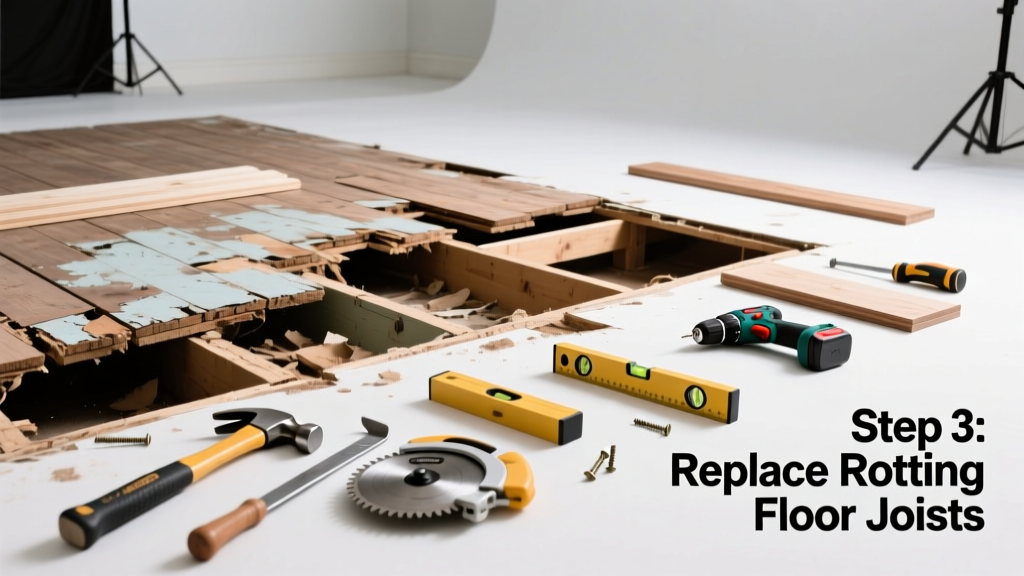
If you’ve noticed spongy spots, discoloration, or musty odors under your shed floor—or worse, a board that gives way when stepped on—you’re dealing with active wood rot. Left untreated, this decay compromises the entire structure and invites pests, mold, and moisture damage into your yard storage space.
Quick Diagnosis
Rotten shed floors rarely appear overnight. Most cases stem from one or more of these root causes:
- Poor ground drainage—soil slopes toward the shed instead of away
- Lack of airflow underneath—no ventilation gaps or crushed stone base
- Direct wood-to-soil contact—floor joists or subfloor resting on bare dirt or concrete without moisture barrier
- Unsealed or untreated lumber—especially pressure-treated wood with cut ends left uncoated
- Leaking roof or siding directing water onto floor edges
Tools & Materials Needed
| Item | Purpose | Estimated Cost |
|---|---|---|
| Cordless drill with screwdriver bits | Removes old screws and fastens new subfloor securely | $80–$150 |
| 36″ level and 4-ft straightedge | Verifies joist flatness and identifies sagging sections | $12–$25 |
| 10-gauge galvanized joist hangers | Reinforces compromised joists without full replacement | $2.50–$4.00 each |
| 1/2″ CDX plywood (treated) | Replacement subfloor material rated for ground contact | $22–$30 per sheet |
| Wood preservative (copper naphthenate) | Penetrates and halts fungal growth in adjacent sound wood | $18–$28 per quart |
Step-by-Step Fix
Most shed floor repairs fall into three tiers—choose the method that matches your damage level:
- Surface-level rot (under 1/4″ deep): Sand affected area, apply copper naphthenate preservative, then seal with exterior-grade polyurethane. Monitor monthly.
- Localized board replacement: Cut out rotted section using a circular saw set to depth; remove damaged joist if compromised; sister new 2×6 pressure-treated joist alongside using 3″ structural screws; install new 1/2″ treated plywood, staggering seams.
- Full subfloor rebuild: Lift shed temporarily with hydraulic jacks (never cinder blocks); remove all flooring and inspect joists; replace any joist with >20% cross-sectional loss; add 4″ crushed gravel + landscape fabric beneath; reframe with 16″ OC spacing and proper ledger flashing.
When to Call a Pro
DIY repair crosses into unsafe or code-violating territory in these scenarios:
- The shed is leaning more than 1/2″ per 8 feet of height—indicating foundation or load-bearing failure
- Rot extends into the bottom plate of the wall framing or sill plate attached to concrete
- You discover termite galleries, carpenter ant frass, or widespread fungal fruiting bodies (e.g., shelf-like conks)
- Your local building department requires permits for structural floor replacements—and you lack stamped plans
According to the Insurance Institute for Business & Home Safety's 2023 report, 68% of small structure failures begin with undetected floor rot that spreads upward into walls within 18 months.
Prevention Tips
Stop future rot before it starts with these field-tested habits:
- Elevate the shed at least 4″ above grade using concrete piers—not soil or wood skids
- Install 1/4″ insect screening over all ventilation openings to block moisture-trapping debris
- Apply end-grain sealer to every cut end of pressure-treated lumber before installation
- Inspect floor corners and perimeter twice yearly—especially after heavy spring rains
- Keep shrubs, mulch, and stored firewood at least 18″ away from all shed walls
Can I use bleach on this?
No. Household bleach kills surface mold but doesn’t penetrate wood or stop fungi feeding deeper in the grain. It also degrades wood fibers over time. Use a borate-based wood preservative or copper naphthenate instead—they diffuse into damp wood and inhibit enzyme activity in rot spores.
How long does pressure-treated wood last in a shed floor?
In ideal conditions—elevated, ventilated, and sealed—it lasts 25–40 years. But the U.S. Forest Service notes that ground-contact-rated lumber installed directly on soil averages just 7–12 years before significant decay sets in.
Do I need to replace the entire floor if only one board is rotten?
Not necessarily—but always check adjacent boards and joists with an awl. If the awl sinks deeper than 1/8″ into neighboring wood, that section needs removal too. Rot spreads laterally along moisture paths, especially where fasteners create micro-channels.
Can I lay new plywood over the old floor?
Only if the existing subfloor is solid, dry, and level—and you add 1/2″ sleepers first to create an air gap. Otherwise, you’re trapping moisture between layers. That’s how many DIYers accidentally double their rot problem within two seasons.
What’s the best wood preservative for outdoor sheds?
Copper naphthenate (e.g., Cuprinol Wood Preserver) is EPA-registered for ground contact and penetrates wet wood better than borates. Apply with a brush or low-pressure sprayer, then let dry 48 hours before sealing. Avoid creosote—it’s restricted for residential use and toxic to plants.
Is rot always caused by rain or leaks?
No. Condensation is a major culprit—especially in insulated sheds with poor ventilation. Warm, humid air hitting cold floor framing creates dew points inside the joist cavity. That’s why the shed ventilation guide recommends at least two soffit vents plus one gable vent for structures over 64 sq ft.
A properly repaired shed floor should feel solid, smell clean—not earthy or sour—and remain dry even after weeks of rain. Pair your fix with regular checks and smart site prep, and you’ll extend your shed’s life by a decade or more. For related help, see our guides on shed foundation repair and shed roof leak detection.