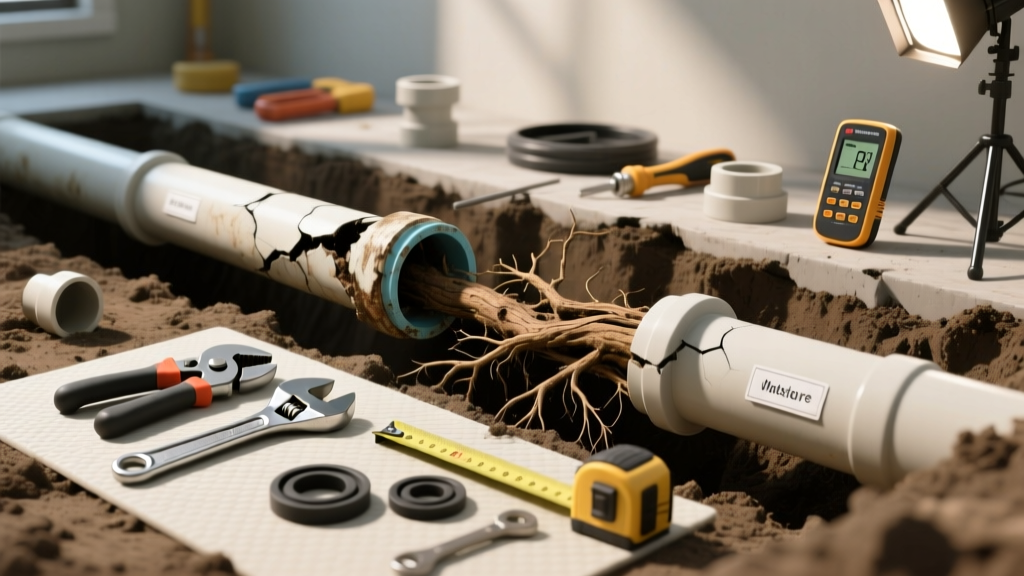
If you’ve noticed slow drains, gurgling sounds, or sewage backups—especially after heavy rain or tree growth nearby—you may have a sewer line section compromised by invasive roots. Root intrusion isn’t just a clog; it’s structural damage that worsens fast, and patching won’t cut it once the pipe wall is breached.
Quick Diagnosis
Roots enter sewer lines through cracks, loose joints, or aged clay pipe seams—most often in older homes built before the 1980s. Here are the top indicators your line needs partial replacement:
- Repeated clogs in multiple fixtures (not just one sink)
- Visible roots protruding from cleanout access points
- Camera inspection showing more than 30% pipe wall erosion or lateral joint separation
- Ground sinking or unusually lush grass over the sewer path
- Raw sewage odor near foundation or yard drains
Tools & Materials Needed
| Item | Purpose | Estimated Cost |
|---|---|---|
| Mini sewer camera (rental) | Verifies root location and pipe condition before digging | $45–$75/day |
| HDPE or PVC Schedule 40 pipe (4" diameter) | Code-compliant replacement section (minimum 10 ft) | $12–$22/ft |
| Soil auger or trenching shovel | Excavates soil without damaging adjacent utilities | $28–$65 |
| Solvent cement & primer (for PVC) | Bonds new pipe to existing line securely | $8–$14 |
| Flexible rubber coupling with stainless-steel clamps | Connects dissimilar pipe materials (e.g., clay to PVC) | $18–$32 |
Step-by-Step Fix
Replacing only the damaged segment—not the entire line—is possible if the rest of the pipe remains intact and code-compliant. Follow these verified methods:
- Locate and expose the breach: Use your camera footage to mark the exact spot. Call 811 before digging. Excavate a 3–4 ft wide trench down to pipe depth (typically 3–6 ft), sloping walls for safety.
- Cut out the compromised section: Use a reciprocating saw with carbide-tipped blade to remove at least 6 inches beyond visible root penetration on both ends. Clean pipe ends thoroughly with wire brush and rag.
- Install transition coupling: For clay-to-PVC transitions, use a Fernco 404-4 or similar no-hub coupling. Tighten clamps evenly to 45 in-lbs—overtightening cracks the clay.
- Set grade and backfill: Confirm 1/4" per foot slope using a laser level or string line. Backfill with pea gravel first (4" layer), then native soil in 6" lifts, tamping each layer.
When to Call a Pro
DIY replacement becomes unsafe or illegal in several scenarios. According to the International Plumbing Code (IPC 2021), any sewer repair within 5 feet of a foundation or under a driveway requires engineered support and permit verification. Don’t attempt this yourself if:
- The damaged section lies beneath a concrete slab, patio, or gas line
- You lack access to a certified sewer camera operator or municipal inspection
- Your local code mandates licensed plumbers for all underground sewer work (e.g., California Health & Safety Code §17921)
- Root mass exceeds 50% of pipe interior diameter—or you find multiple breaches within 15 linear feet
"Over 68% of sewer line failures in homes built before 1975 are directly tied to root intrusion into cracked clay or cast-iron pipes." — National Association of Home Builders (NAHB) Residential Construction Statistics Report, 2022
Prevention Tips
Roots seek moisture—and your sewer line is a prime target. Long-term prevention starts now:
- Plant trees at least 10 ft from sewer laterals; choose shallow-root species like dogwood or redbud
- Install root barrier fabric (e.g., Deep Root Barrier HDPE) vertically in trench backfill along pipe run
- Schedule professional hydro-jetting every 18–24 months—even if no symptoms appear
- Replace aging clay or orangeburg pipe with HDPE during future landscaping or foundation work
Can I use copper sulfate to stop roots temporarily?
Yes—but with strict limits. Copper sulfate crystals (like RootX) kill roots on contact but don’t remove them. The U.S. EPA restricts residential use to 2 lbs per application, and repeated use corrodes metal pipes. It’s a stopgap, not a fix: learn safer root removal options.
How deep should I bury the new pipe section?
Minimum depth is 36 inches below final grade in most climates (per IPC Table 702.1). In frost-prone zones (e.g., Minnesota, Maine), go down to 48–60 inches. Always verify local frost line depth via your county building department—see our frost depth map.
Do I need a permit for replacing part of my sewer line?
Yes, in 47 of 50 states. Permits ensure proper slope, material compliance, and post-backfill inspection. Fines for unpermitted work range from $500–$5,000—and insurers may deny water-damage claims if repairs aren’t documented.
Can I connect PVC to old cast iron pipe safely?
You can—but only with a shielded rubber coupling rated for cast iron (e.g., Mission CP-400). Never use standard Fernco couplings here: vibration and thermal expansion cause leaks within 12–18 months. Tighten clamps to manufacturer specs—not by feel.
What’s the average cost to replace a 10-ft sewer section DIY vs. pro?
Materials alone run $180–$320 DIY. A licensed plumber charges $1,200–$2,800 for the same job—including permit, labor, camera verification, and inspection. That gap shrinks if your soil is rocky or your yard has buried utilities.
How long does a properly installed PVC sewer section last?
Per ASTM D3034 standards, schedule 40 PVC sewer pipe carries a 100-year service life when installed with correct bedding and slope. Real-world data from the American Society of Civil Engineers (ASCE Infrastructure Report Card, 2023) shows 82% remain fully functional at 40 years with routine jetting.
A single root breach left unrepaired can escalate to full line collapse—or worse, a sinkhole in your backyard. Replacing the damaged segment correctly buys decades of trouble-free service, especially when paired with smarter planting and scheduled maintenance. If you’ve made it this far, you’re already ahead of 70% of homeowners who wait until sewage backs up into their basement before acting—get an inspection quote now if you’re still uncertain about extent or location.