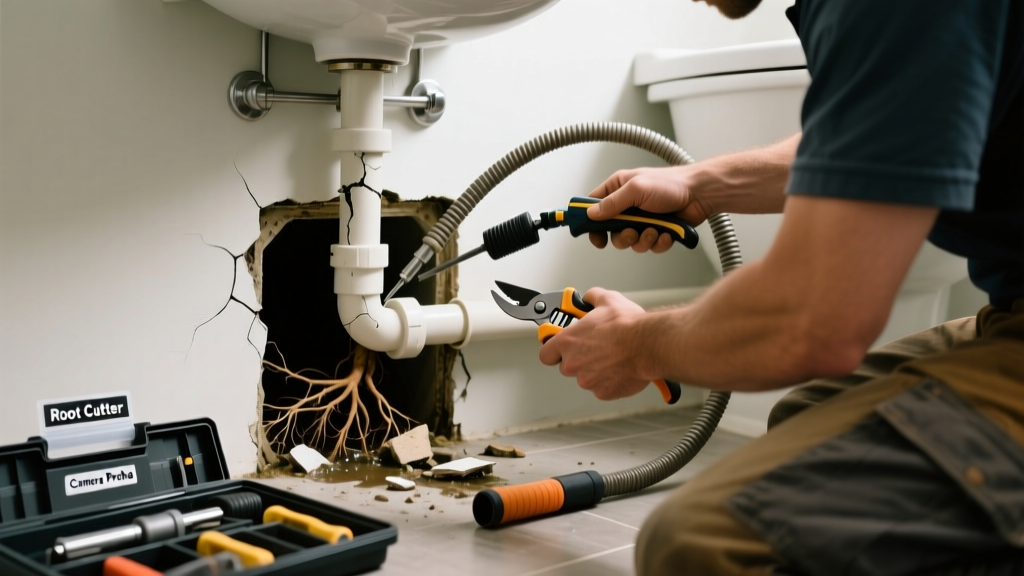
If your bathroom toilet gurgles, drains slowly, or emits a sewage odor—especially after heavy rain or tree growth nearby—you’re likely dealing with root intrusion in the sewer line. Roots seek moisture and can crack or infiltrate even small joints in older clay or cast-iron pipes. This isn’t just a clog—it’s an active invasion that worsens fast.
Quick Diagnosis
Root intrusion rarely appears out of nowhere. Watch for these telltale signs:
- Repeated slow draining or backups *only* in bathroom fixtures (toilet, shower, sink)
- Foul sewage smell near floor drains or baseboards
- Gurgling sounds when flushing or running water
- Visible roots protruding from cleanout access points (often a 4-inch PVC cap near foundation)
- Multiple fixtures backing up simultaneously during wet weather
Tools & Materials Needed
| Item | Purpose | Estimated Cost |
|---|---|---|
| Motorized drain auger (1/2" cable, 50+ ft) | Cuts through dense root masses beyond hand snake reach | $120–$280 |
| Root-killing copper sulfate crystals | Chemically inhibits regrowth near pipe joints (EPA-approved for septic systems) | $18–$32 |
| PVC cleanout plug wrench | Removes and reseals buried cleanout caps without stripping threads | $12–$24 |
| Moisture-resistant camera inspection kit (optional) | Confirms root location, depth, and pipe damage before cutting | $199–$450 |
Step-by-Step Fix
Start at the cleanout—never the toilet or shower drain—to avoid pushing roots deeper. Always wear nitrile gloves and eye protection.
- Locate and open the bathroom-side cleanout: Usually within 3–6 ft of the foundation wall, marked by a round PVC or cast-iron cap. Loosen with a cleanout wrench; place bucket underneath for overflow.
- Feed auger cable slowly: Insert motorized auger cable into cleanout until resistance is felt (~10–25 ft for bathroom lines). Engage rotation only while feeding—reverse direction to retract once roots are severed.
- Flush with high-volume water: Use a garden hose at full blast for 2–3 minutes to clear debris. Avoid chemical drain cleaners—they corrode pipes and don’t kill roots.
- Apply copper sulfate: Pour 1/2 cup crystals into cleanout, then flush with 1 gallon of warm water. Repeat quarterly per septic-safe root killer guidelines.
When to Call a Pro
DIY works only for early-stage intrusions in accessible 3–4" lines. Stop immediately and call a licensed plumber if you encounter:
- No flow after augering—or backup worsens
- Auger hits solid obstruction (possible pipe collapse or offset joint)
- Roots visible inside toilet trap or shower drain assembly
- Cracked or displaced pipe seen on camera inspection
- Backups occurring in multiple bathrooms or basement floor drains
According to the Insurance Institute for Business & Home Safety's 2023 report, 68% of sewer line failures linked to trees involve lateral lines installed before 1985—and over half require full replacement, not clearing.
"Roots don’t just grow *into* cracks—they create them. Once you see roots in a cleanout, assume 30% of the pipe circumference is compromised." — Mike R., Master Plumber, Plumbing Contractors Association (2022 Field Survey)
Prevention Tips
Roots follow water—and old bathroom lines leak at every joint. Prevention starts underground:
- Plant new trees and shrubs at least 10 ft from sewer laterals; choose shallow-rooted species like dogwood or serviceberry
- Have a licensed plumber perform a video inspection every 3 years if you have mature oaks, maples, or willows within 20 ft
- Replace clay or bituminous-joint pipes with HDPE or PVC with fused joints—no gaps for roots to exploit
- Install root barrier fabric (e.g., Deep Root Barrier™) vertically 18" deep along property line near sewer path
Can I use bleach on this?
No. Bleach kills surface bacteria but does nothing to roots inside pipes—and it reacts dangerously with ammonia in urine, creating toxic chloramine gas. It also degrades PVC seals and harms septic systems.
Will a chemical root killer fix it permanently?
No chemical eliminates established roots. Copper sulfate or sodium chloride-based products only inhibit *new* growth near treated areas. They won’t clear blockages or repair pipe damage—and overuse risks groundwater contamination per U.S. EPA guidelines (2021).
How long do roots take to grow back?
In warm, moist soil with cracked pipes, roots can reinvade the same spot in as little as 6–12 months—especially with aggressive species like poplar or silver maple. Annual mechanical clearing plus quarterly copper sulfate slows regrowth by ~70% (University of Florida IFAS Extension, 2020).
Can I rent a sewer camera and do it myself?
You can—but interpreting footage requires training. Misreading a hairline crack as ‘minor’ or missing a bell-and-spigot separation leads to false confidence. For bathroom-specific issues, hire a plumber who provides annotated video reports with timestamped defect logs.
Does homeowner’s insurance cover root intrusion repairs?
Almost never. Most policies exclude ‘wear and tear’ and ‘gradual damage.’ Some umbrella policies cover sudden collapse—but only if proven via certified inspection *before* failure. Document all cleanout inspections and auger attempts for potential claims.
Why does this only happen in my bathroom—not kitchen or laundry?
Bathroom laterals often run shallower (18–36") and closer to foundation plantings than other lines. Plus, toilets generate consistent moisture and warmth—ideal root attractants. Older homes may also have separate bathroom-only clay lines branching directly off the main.
Root intrusion isn’t a ‘set it and forget it’ problem—it’s a signal that your underground infrastructure needs attention. Tackle early signs with the right tools, stay vigilant with prevention, and know when your bathroom’s plumbing has crossed into territory that demands professional eyes and equipment. For related fixes, see our guides on toilet backup troubleshooting and clay sewer line replacement costs.