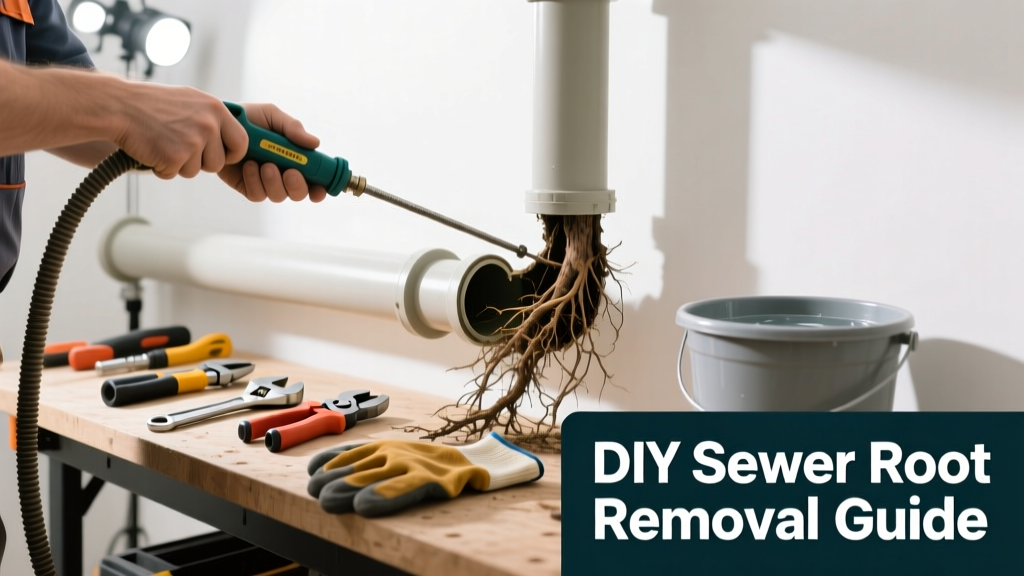
If your toilet gurgles, drains slow despite plunging, or you smell sewage near your yard or basement, roots may have breached your sewer line. Tree roots seek moisture and nutrients — and your aging clay or cast-iron pipe is an easy target. Left untreated, root intrusion can collapse pipes, flood basements, and cost thousands in emergency excavation.
Quick Diagnosis
Root intrusion rarely appears out of nowhere. Watch for these red flags:
- Recurring clogs in multiple fixtures (not just one sink)
- Foul odor near floor drains or outside cleanouts
- Visible cracks or depressions in your yard above the sewer line path
- Wet, unusually lush grass patches over buried pipe runs
- Tree species known for aggressive roots nearby (e.g., willow, poplar, maple, oak)
Tools & Materials Needed
| Item | Purpose | Estimated Cost |
|---|---|---|
| Motorized drain snake (1/4"–3/8" cable, 50+ ft) | Cuts through dense root masses inside pipes; essential for lines deeper than 20 ft | $120–$350 |
| Root-killing copper sulfate crystals or sodium chloride pellets | Chemically inhibits regrowth at pipe joints and cracks; not a substitute for mechanical removal | $15–$30 |
| Pipe inspection camera (rental or purchase) | Confirms root location, severity, and pipe condition before and after cleaning | $75 rental/day or $200–$600 purchase |
| Heavy-duty gloves, safety goggles, N95 mask | Protects against biohazards, sharp debris, and chemical exposure during cleanup | $25–$45 |
| High-pressure water jet attachment (for garden hose or pressure washer) | Flushes loosened roots and residue; prevents re-clogging post-snaking | $40–$95 |
Step-by-Step Fix
Most successful DIY repairs combine mechanical clearing with chemical prevention. Start here — but only if your line is accessible via cleanout and shows no signs of collapse:
- Locate and open the main cleanout: Usually a 4" capped PVC or cast-iron pipe near your foundation or in the yard. Loosen with a wrench; cover opening with a rag to prevent splashback.
- Run a motorized snake into the line: Feed cable slowly until resistance is met (typically 15–40 ft in). Rotate at low speed, advancing 6–12 inches at a time. Stop when you feel the cable “give” — that’s the root mass breaking apart.
- Flush with high-pressure water: Attach jet nozzle to garden hose or pressure washer (max 2,500 PSI). Insert nozzle past the cleaned zone and flush for 2–3 minutes to remove debris and residual roots.
- Inspect with camera: Verify full clearance and check for cracks, offsets, or bellies where roots re-enter. Record video for future reference or contractor consultation.
- Apply root killer: Pour 1 cup copper sulfate crystals down the cleanout or nearest toilet weekly for 4 weeks, then quarterly. Never use in septic systems — it kills beneficial bacteria.
When to Call a Pro
DIY fails fast when structural integrity is compromised. Call a licensed plumber or sewer specialist immediately if:
- You hit solid obstruction within 10 ft of the cleanout — could indicate collapsed pipe or severe offset
- Camera reveals >30% pipe wall loss, cracked bell-and-spigot joints, or tree roots entering through multiple points
- Water backs up into multiple fixtures simultaneously — suggests blockage beyond your reach or lateral line failure
- Your home was built before 1975 and uses clay tile or orangeburg pipe (nearly 80% fail within 50 years, per the National Association of Home Builders’ 2022 Infrastructure Report)
"Over 60% of sewer line repairs in suburban neighborhoods involve root intrusion — and nearly half require full lateral replacement within five years of initial snaking." — American Society of Civil Engineers, 2023 State of U.S. Infrastructure Report
Prevention Tips
Preventing recurrence is cheaper and safer than repeated fixes. Prioritize these long-term strategies:
- Plant trees at least 10 ft from sewer laterals — increase to 20+ ft for willows, silver maples, or poplars
- Install root barriers: 24"-deep HDPE sheets angled outward along pipe path (costs $15–$25/linear ft installed)
- Replace failing sections with PVC or HDPE pipe using trenchless CIPP lining (lasts 50+ years)
- Schedule annual camera inspections — especially if you have mature trees within 30 ft of your line
- Divert downspouts and sump pump discharge away from sewer line zones
Can I use bleach on this?
No. Household bleach does not kill roots inside pipes — it only disinfects surface bacteria and degrades pipe seals over time. It offers zero penetration into root tissue embedded in joints or cracks. According to the U.S. EPA’s 2021 Wastewater Chemical Guidance, chlorine-based cleaners are ineffective against woody plant growth and may corrode older metal fittings.
Will a chemical root killer fix it permanently?
No. Copper sulfate or dichlobenil products inhibit regrowth near treated areas but don’t eliminate existing roots or repair pipe damage. They’re best used after mechanical clearing — never as a standalone solution. The Insurance Institute for Business & Home Safety’s 2023 report found chemical-only treatment failed in 78% of cases within 12 months.
How deep are sewer lines usually buried?
In most residential areas, sewer laterals run 3–6 ft below grade to prevent freezing and accidental damage. Depth varies by climate: 4–7 ft in northern states (per IRC 2021 Table P3005.1), and as shallow as 2 ft in frost-free zones like southern Florida. Always call 811 before digging — even for camera access pits.
Can I rent a sewer snake from Home Depot or Lowe’s?
Yes — both chains rent 1/4"–3/8" electric snakes with 50–75 ft cables for $45–$75/day. Confirm the model includes reverse rotation and torque-limiting clutch (critical for avoiding cable breakage). For frequent issues, consider buying a quality mid-range unit — it pays for itself after two rentals.
Do root killers harm my septic system?
Absolutely. Copper sulfate kills anaerobic bacteria essential for breaking down solids in septic tanks. The National Small Flows Clearinghouse warns that repeated use reduces tank efficiency by up to 40% and increases pumping frequency. If you have a septic system, skip chemical root killers entirely — rely on regular pumping and professional line inspection instead.
How often should I snake my sewer line?
Not on a schedule — only when symptoms appear. Over-snaking wears pipe interiors, especially older clay or cast iron. Instead, get a baseline camera inspection every 3–5 years. If roots reappear within 12 months of clearing, it’s time to replace the affected section — not snake again. As one veteran municipal inspector told us: "Snaking is triage. Replacement is cure."
Root intrusion isn’t just an inconvenience — it’s a warning sign your underground infrastructure is aging. Addressing it early with the right tools and timing keeps repair costs low and protects your home’s value. Whether you tackle the first cleanout yourself or call in a pro for camera-guided trenchless repair, act before standing water appears in your basement or your neighbor’s yard starts sinking. And remember: healthy trees belong in your landscape — not your sewer line.