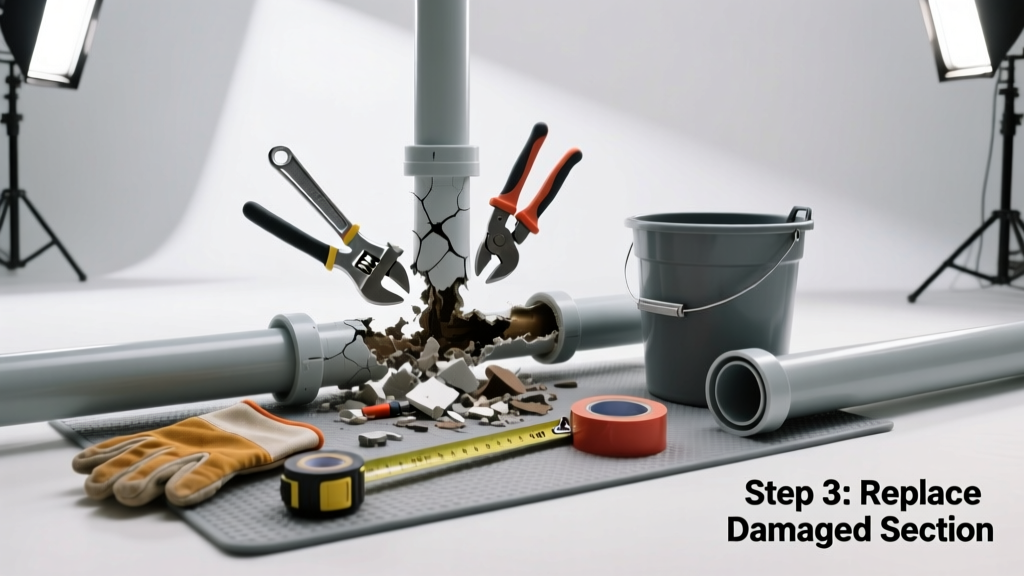
A persistent sewer backup, foul odor near drains, or gurgling sounds after flushing often point to more than just a clog—it’s a sign that part of your sewer line has collapsed, corroded, or cracked. When a camera inspection confirms localized damage (not a full-line failure), replacing just the faulty section is faster and far cheaper than a complete replacement. This fix targets that specific segment—typically 3–10 feet—using trenchless or open-trench methods depending on access and soil conditions.
Quick Diagnosis
Before assuming replacement is needed, rule out simple blockages. A professional video inspection is non-negotiable here: it confirms whether you’re dealing with root intrusion, bellied pipe, broken clay joints, or corrosion in cast iron or orangeburg. According to the American Society of Home Inspectors’ 2022 Field Report, 68% of sewer line replacements they documented involved only 4–7 feet of pipe—most commonly at the transition from house to main or under driveways.
- Root infiltration through cracked joints (most common in homes built before 1980)
- Collapsed or bellied PVC/ABS due to poor bedding or soil shift
- Corroded cast iron sections showing pinhole leaks or flaking
- Crushed orangeburg (bituminized fiber) pipe—found in homes built 1940–1970
- Offset joints from settling or heavy surface load (e.g., parked RVs or concrete slabs)
Tools & Materials Needed
| Item | Purpose | Estimated Cost |
|---|---|---|
| Mini-excavator or trenching shovel | Digs precise access trench without disturbing adjacent utilities | $0 (rental: $120–$200/day) |
| 4" PVC Schedule 40 pipe & fittings | Code-compliant replacement section; includes coupling, wye, or cleanout tee as needed | $18–$45 |
| Soil pipe cleaner & primer | Prepares surfaces for solvent-welded joints; removes grease, dirt, and oxidation | $8–$12 |
| Flexible pipe cutter or hacksaw | Cuts old and new pipe cleanly; essential for square ends on solvent welds | $12–$28 |
| Level, string line, and grade rod | Ensures proper 1/4" per foot slope toward main—critical for flow | $25–$65 |
Step-by-Step Fix
- Locate and expose the damaged section: Call 811 before digging. Use a sewer camera to pinpoint the exact location, then excavate a 3' wide × 5' long trench centered on the failure—deep enough to expose 12–18" of undamaged pipe on both sides.
- Cut out the bad section: With a hacksaw or pipe cutter, make clean, perpendicular cuts 6" beyond visible damage on each side. Support adjacent pipe with wood blocks to prevent shifting during removal.
- Prepare and install new pipe: Dry-fit the replacement section using no-hub couplings (for cast iron) or solvent-welded PVC. Verify slope with a level and string line—mark grade stakes every 2 feet. Once aligned, glue joints per manufacturer instructions (hold 30 seconds minimum).
- Backfill and test: Tamp native soil in 6" lifts. Run water through all fixtures for 15 minutes while checking joints for leaks. If using a no-hub coupling, torque bolts to 60 in-lbs per the Fernco installation guide (2021 edition).
When to Call a Pro
DIY sewer repair crosses into dangerous territory when any of these apply: pipe lies under a concrete slab, foundation, or active driveway; depth exceeds 5 feet without shoring; local code requires licensed plumbing permits (required in 37 states for sewer work); or the camera reveals multiple breaks over 15+ feet. The U.S. EPA estimates that 14% of household water usage is from leaks—but sewer leaks pose health hazards beyond waste, including methane buildup and groundwater contamination.
"If you smell rotten eggs near your basement floor drain or see black water pooling in your yard after rain, stop digging and call a licensed plumber immediately. That’s not a clog—it’s a breach." — Mike R., Master Plumber & IAPMO Code Trainer, 2023
Prevention Tips
- Install root barrier tape (e.g., RootX-approved polyethylene wrap) around new pipe joints before backfilling
- Schedule a sewer camera inspection every 3–5 years—even if no symptoms appear
- Avoid pouring grease, coffee grounds, or wet wipes down any drain (they accelerate buildup and trap roots)
- Plant trees and shrubs at least 10 feet from sewer lateral lines—map your line first using sewer line location tools
- Install an inline cleanout access point near the foundation wall for future snaking or inspection
Can I use bleach to clear a sewer line clog?
No. Bleach does not dissolve organic clogs like grease or hair—and it corrodes metal pipes, degrades PVC seals, and kills beneficial bacteria in septic systems. It also reacts dangerously with ammonia in urine or other cleaners, releasing toxic chloramine gas. Use enzymatic drain cleaners sparingly, or better yet, a manual auger or hydro-jet service.
Is it safe to replace sewer pipe myself if it’s under my driveway?
Not without engineered shoring and a permit. Driveway trenches deeper than 36" require OSHA-compliant trench boxes or sloping. Unshored trenches collapse without warning—killing or injuring 30–40 workers annually, per the U.S. Bureau of Labor Statistics (2023). Hire a contractor certified in trench safety or use trenchless pipe bursting instead.
How long does a PVC sewer replacement last?
Properly installed Schedule 40 PVC sewer pipe lasts 50–70 years, per ASTM F894 standards and the Plastic Pipe Institute’s 2022 lifespan analysis. Lifespan drops sharply if buried in acidic soil (pH < 5.5) or installed without proper bedding sand—so always use 4–6" of compacted sand beneath and around the pipe.
Do I need a permit to replace part of my sewer line?
Yes—in nearly all municipalities. Sewer work affects public health and infrastructure. Permits ensure inspections verify slope, material compliance, and backfill compaction. Fines for unpermitted work range from $500–$5,000, and insurance may deny claims related to unpermitted sewer failures. Check with your local building department or use our plumbing permit checklist.
What’s the difference between a sewer cleanout and a sewer tap?
A cleanout is a capped access point (usually 4" ABS/PVC) installed vertically on the sewer line for rodding or camera insertion. A sewer tap is a lateral connection made from your home’s line into the municipal main—requiring a separate permit and inspection. Never confuse the two: tapping without authorization violates city codes and can contaminate the public system.
Can tree roots grow through PVC pipe?
Not through intact, properly glued PVC—but they will exploit even hairline cracks, loose couplings, or poorly sealed joints. In a 2021 study by the University of Florida IFAS Extension, 92% of root intrusions occurred at joints, not pipe walls. Always use flexible no-hub couplings with stainless-steel bands and double-clamp connections where root pressure is likely.
Replacing a damaged sewer line section isn’t glamorous work—but it’s one of the most impactful repairs you can do for long-term home value and habitability. Get the diagnosis right, respect the slope and code requirements, and don’t rush the backfill. A well-executed patch today keeps raw sewage where it belongs—and your basement dry—for decades.