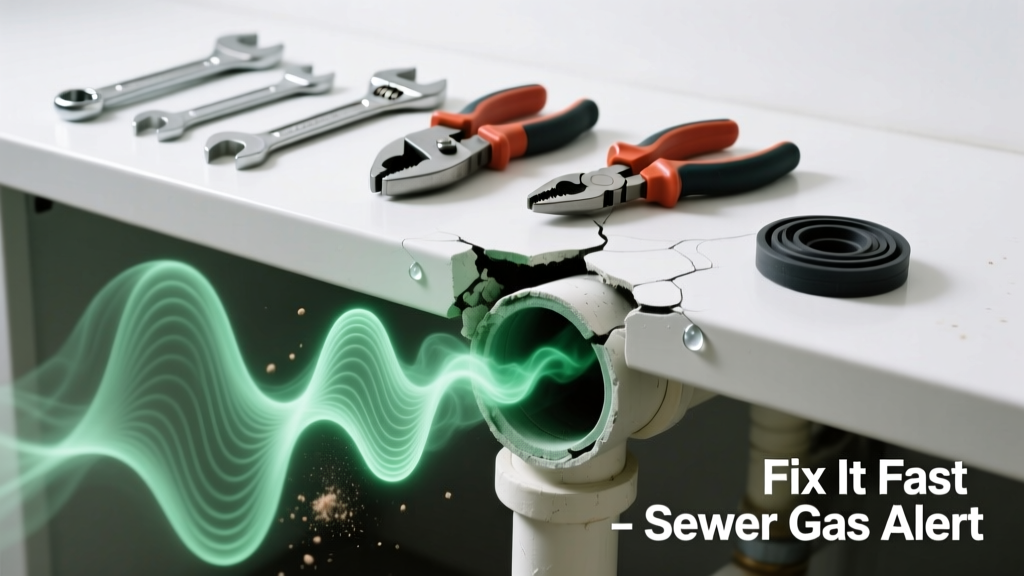
If you smell rotten eggs near a drain—and hear gurgling, bubbling, or high-pitched whistling—it’s not just a stink problem. That noise signals trapped air, pressure imbalances, or failing traps in your drainage system. Left unaddressed, it can expose your household to hydrogen sulfide (H₂S) and methane—both hazardous at elevated levels.
Quick Diagnosis
Start here before grabbing tools. These are the top five culprits behind simultaneous odor and noise:
- Dry P-trap (most common—especially in guest bathrooms or basement sinks used infrequently)
- Clogged vent stack (blocks airflow, causing siphoning and gurgles)
- Cracked or corroded drainpipe (lets gas escape and creates resonance)
- Failing wax ring under toilet (allows gas leakage and may cause 'popping' sounds during flush)
- Blocked cleanout plug or improperly sealed floor drain (creates backpressure and audible release)
Tools & Materials Needed
| Item | Purpose | Estimated Cost |
|---|---|---|
| Plumber’s snake (25-ft hand auger) | Clears partial vent or trap clogs without disassembly | $18–$25 |
| Bucket and towels | Catches water during trap priming; absorbs spills | $5–$12 |
| Food-grade mineral oil or plumber’s grease | Lubricates new gaskets and prevents future dry-out | $6–$10 |
| Level and adjustable wrench | Ensures proper toilet alignment and secure flange bolts | $14–$22 |
| Smoke test kit (optional but recommended) | Visually identifies leak paths in hidden vents or drains | $45–$79 |
Step-by-Step Fix
Work from simplest to most involved. Most cases resolve in under 30 minutes.
- Prime every P-trap: Pour ½ cup water into each rarely used drain (floor drains, utility sink, guest bath). Listen for gurgling—if it stops and odor fades within 12 hours, that was the issue.
- Clear the vent stack: Climb onto the roof (with safety harness) and inspect the main vent pipe (usually 3″–4″ PVC near the ridge). Remove debris with a snake or garden hose (use low pressure only—high pressure can crack older pipes).
- Test the toilet wax ring: Rock the toilet gently side-to-side. If it moves, shut off water, disconnect supply line, remove toilet, and replace the wax ring with a reinforced foam version (like Fluidmaster Better Than Wax). Reinstall using a torque wrench set to 65 in-lbs per bolt.
- Check cleanout plugs: Locate the 4″ cleanout access near your foundation (often capped with brass or PVC). Tighten with a wrench—if it hisses or smells when loosened, replace the plug’s rubber gasket.
When to Call a Pro
Don’t risk exposure or structural damage if you encounter any of these:
- Hydrogen sulfide readings above 10 ppm (use an H₂S detector—available at hardware stores for $85–$120)
- Visible corrosion on cast-iron drainpipes (common in homes built before 1975)
- Gurgling that coincides with neighbor’s plumbing use (indicates shared sewer line blockage)
- Water backing up into multiple fixtures simultaneously
According to the U.S. EPA, chronic exposure to sewer gas at concentrations above 2 ppm can trigger headaches, nausea, and dizziness—and long-term exposure may impair memory and motor function (EPA Indoor Air Quality Guide, 2022).
Prevention Tips
Maintain your system year-round to avoid recurrence:
- Run water in all drains—including floor drains—for 15 seconds weekly
- Install vent stack guards (not caps) to keep birds and nests out—but allow airflow
- Replace rubber gaskets on cleanouts and shower drains every 5 years
- Use enzyme-based drain cleaner (e.g., Bio-Clean) quarterly—not chemical caustics that degrade seals
Can I use bleach on this?
No. Bleach reacts with organic matter in pipes to produce chloramine gas—a respiratory irritant—and does nothing to restore trap seals or clear vent obstructions. It also degrades rubber gaskets faster. Stick to hot water and enzymatic treatments for routine maintenance.
Why does the smell get worse at night?
Nighttime cooling causes negative pressure in attic spaces, pulling air—and sewer gases—up through weak points like dry traps or cracked vents. Homes with whole-house fans or HVAC systems running overnight amplify this effect.
Is sewer gas dangerous if I only smell it briefly?
Yes—even short exposures matter. The CDC warns that hydrogen sulfide is toxic at concentrations as low as 100 ppm, and olfactory fatigue sets in rapidly: you stop smelling it after 2–15 minutes, even as levels rise dangerously (CDC NIOSH Pocket Guide, 2023). Always ventilate and investigate.
Will a carbon filter mask the problem?
Carbon filters (like those in HEPA air purifiers) temporarily absorb odor molecules but do nothing to stop gas entry. They’re a bandage—not a fix—and can create false confidence while underlying leaks worsen.
How do I know if it’s sewer gas or natural gas?
Natural gas is odorized with mercaptan (rotten cabbage), not eggs. More critically, natural gas is highly flammable—never use open flame or electrical switches near suspected leaks. If you suspect natural gas, evacuate and call 911 immediately. Sewer gas won’t trigger a combustible gas detector, but will set off an H₂S-specific sensor.
Can a blocked dishwasher air gap cause this?
Absolutely. A clogged air gap (the chrome cylinder near your sink) restricts venting, forcing wastewater—and associated gases—back up through the garbage disposal or sink strainer. Clean the air gap’s internal tube with a bottle brush and vinegar soak monthly.
A persistent sewer gas smell with noise isn’t random—it’s your plumbing system sounding an alarm. Fixing it quickly protects your family’s health and prevents corrosion that could cost thousands in pipe replacement later. Keep a small bucket and mineral oil under every sink, and treat your drains like part of your home’s respiratory system—not just waste conduits.