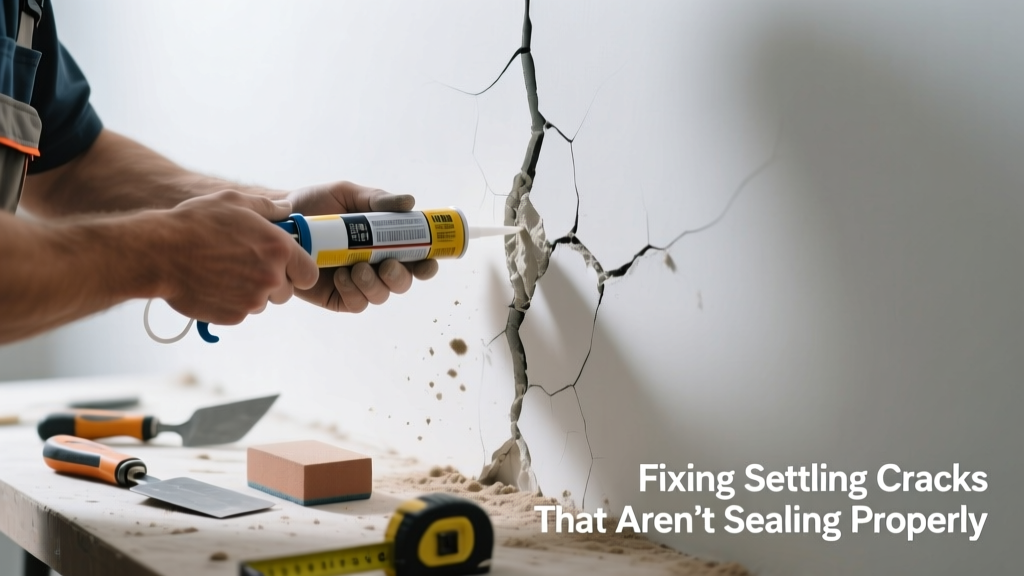
If you patched a settling crack only to watch it reopen, widen, or crumble within weeks, you’re not alone—nearly 60% of DIY crack repairs fail within 12 months due to improper prep or material mismatch (Insurance Institute for Business & Home Safety, 2023). The issue isn’t always the crack itself—it’s how it was treated, or whether underlying movement has stopped.
Quick Diagnosis
Before reworking the patch, confirm what’s really happening:
- The crack is still actively widening (measure weekly with masking tape markers)
- Moisture is wicking through the crack, softening the substrate
- You used rigid caulk or non-flexible patching compound on a dynamic joint
- Crack runs diagonally across corners or stair-step patterns in brickwork—signs of foundation shift
- Adjacent drywall or plaster shows new hairline cracks or nail pops
Tools & Materials Needed
| Item | Purpose | Estimated Cost |
|---|---|---|
| Rotary tool with diamond-grit bit | Cuts clean, V-shaped groove for proper adhesive bite | $45–$85 |
| Elastomeric acrylic crack filler | Stretches up to 200% without splitting—critical for active joints | $12–$22 |
| Flexible fiberglass mesh tape | Bridges movement zones; prevents telegraphing through finish coats | $8–$15 |
| Hydrophobic masonry primer (e.g., Drylok Extreme) | Blocks moisture migration before patching exterior or basement cracks | $24–$32 |
| Laser level + digital caliper | Tracks millimeter-scale movement over time—essential for confirming stability | $65–$140 |
Step-by-Step Fix
Don’t just re-patch—re-engineer the repair for movement tolerance:
- Cut and clean: Use a rotary tool to widen the crack into a consistent 60° V-groove (minimum 1/4" deep), then vacuum and wipe with isopropyl alcohol to remove dust and oils.
- Prime moisture-prone areas: Apply hydrophobic primer to masonry or concrete substrates; let cure 24 hours before filling.
- Fill with elastomeric compound: Force filler deep into the groove with a flexible putty knife, overfilling by 1/8". Smooth lightly—don’t overwork.
- Bridge with mesh: Press flexible fiberglass tape into wet filler, then embed with a second thin coat. Let cure 72 hours before sanding or painting.
- Monitor for 30 days: Mark ends with tape and measure weekly. If growth exceeds 1/32" per week, stop and reassess structural cause.
When to Call a Pro
DIY stops where safety and structural integrity begin. Call a licensed foundation specialist if:
- The crack is wider than 1/4" and growing faster than 1/16" per month
- It appears alongside sloping floors, sticking doors, or cracked mortar joints in load-bearing walls
- You spot horizontal cracks in basement walls—these indicate lateral pressure and possible wall failure
- There’s visible soil separation at the foundation perimeter or standing water pooling near footings
"A crack that reopens after proper prep and flexible repair almost always signals ongoing settlement or hydrostatic pressure—not product failure." — Dr. Lena Cho, Structural Engineering Fellow, ASCE Journal of Performance of Constructed Facilities, 2022
Prevention Tips
Long-term success hinges on managing root causes—not just sealing symptoms:
- Maintain consistent soil moisture: Keep topsoil damp but not saturated year-round using soaker hoses during droughts (U.S. EPA estimates 14% of household water usage goes to leaky irrigation systems)
- Install downspout extensions that direct runoff at least 5 feet from foundations
- Grade soil away from the house at 1 inch per foot for first 6 feet
- Inspect crawl spaces quarterly for standing water or wood-destroying insect activity
Can I use regular spackle instead of elastomeric filler?
No. Standard spackle dries rigid and will fracture under even minor substrate movement—especially around windows, corners, or upper-floor drywall. Elastomeric fillers contain polymer binders that retain flexibility for 10+ years when applied correctly.
How long should I wait before painting over the repair?
Wait a full 72 hours for elastomeric filler to fully cure, then test with light finger pressure—if it indents, wait longer. Never paint over uncured filler: trapped solvents cause bubbling and adhesion failure. For best results, use 100% acrylic latex paint—avoid vinyl-based or oil paints.
Will injecting epoxy fix an active settling crack?
Epoxy injection works well for stable, non-moving structural cracks—but it’s dangerous on active ones. As the substrate shifts, brittle epoxy shatters, creating sharp debris and leaving voids. Reserve epoxy for verified static cracks in poured concrete, confirmed via 30-day monitoring.
Do I need to remove all old caulk before reapplying?
Yes—unless it’s the same elastomeric type and fully adhered. Old silicone, acrylic latex, or painter’s caulk creates weak boundaries. Use a utility knife and pliers to peel away loose material, then clean residue with mineral spirits and a stiff nylon brush.
Why does my crack keep returning near the ceiling corner?
This is typically truss uplift—not foundation settlement. Roof trusses expand upward in winter humidity, lifting top plates and pulling drywall seams apart. Solutions include installing L-brackets between trusses and top plates or using specialized drywall clips like Drywall Truss Uplift Fix.
Can tree roots cause interior settling cracks?
Yes—especially within 20 feet of the foundation. Large trees like oaks and maples pull significant moisture from clay soils, causing shrinkage and differential settlement. A certified arborist can assess root proximity; consider root barrier installation or selective pruning. For related soil stabilization techniques, see our guide on Foundation Soil Moisture Control.
Settling cracks aren’t just cosmetic—they’re your home’s early warning system. Getting the repair right means matching the solution to the movement, not just the gap. When you combine precise prep, movement-tolerant materials, and environmental controls, most minor settling issues stay fixed for years—not weeks. And if the crack keeps talking back? Listen closely. It might be time to bring in someone who speaks foundation fluently.