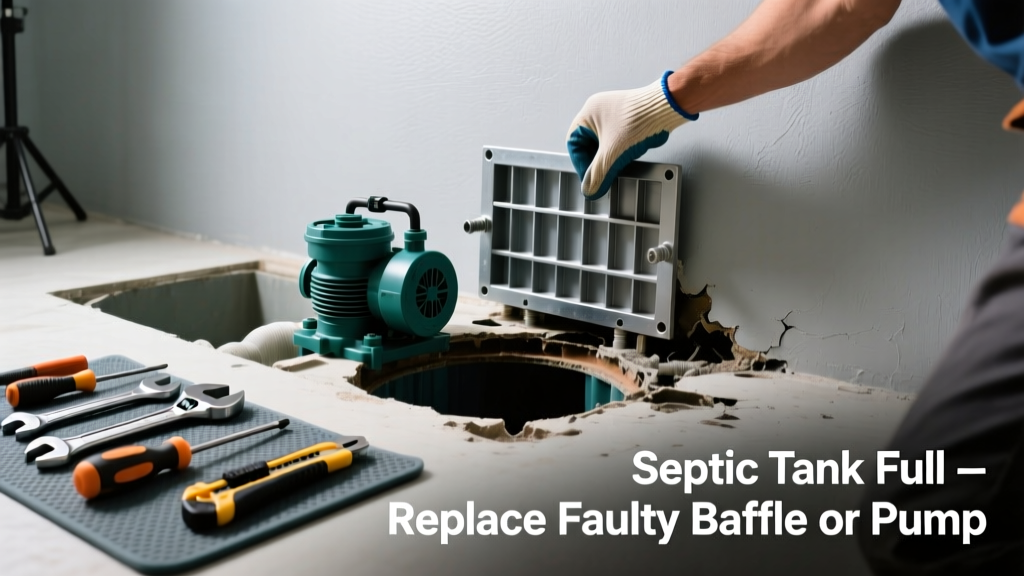
If your septic tank is full and backing up into drains or pooling near the drainfield, the culprit is likely a failed internal component—not necessarily the tank itself. Most often, it’s a cracked inlet baffle, clogged effluent filter, or burnt-out pump in a pumped system. Replacing that single part can restore function for years—if you diagnose correctly and act before solids migrate downstream.
Quick Diagnosis
Before grabbing tools, confirm which part has failed. A full tank alone doesn’t mean replacement is needed—many issues are localized and repairable:
- Inlet baffle damaged or missing (allows solids to enter tank too fast, causing rapid accumulation)
- Effluent filter clogged or cracked (blocks outlet flow, triggering backup)
- Submersible pump failure in dosing tanks (no discharge to drainfield)
- Broken or corroded distribution box (uneven flow causes one line to overload)
- Root intrusion in outlet pipe (not a tank part, but mimics full-tank symptoms)
Tools & Materials Needed
| Item | Purpose | Estimated Cost |
|---|---|---|
| Heavy-duty rubber gloves (nitrile + cut-resistant liner) | Protects against pathogens and sharp edges during tank access | $18–$25 |
| Septic-safe effluent filter (e.g., Zabel or Orenco model) | Replaces clogged or cracked filter at tank outlet | $45–$72 |
| Concrete baffle repair kit or precast PVC baffle | Secures inlet/outlet flow paths; prevents short-circuiting | $32–$65 |
| 12V multimeter + submersible pump test cord | Verifies pump voltage and motor continuity before replacement | $24–$40 |
| Non-corrosive septic tank lid wrench (T-handle) | Safely removes heavy concrete or fiberglass access lids without cracking | $29–$38 |
Step-by-Step Fix
Always pump the tank first—never work on a full tank. Hire a licensed pumper ($300–$550) or verify it’s been done within the last 30 days. Then proceed:
- Locate and safely open access ports: Use the lid wrench on both inlet and outlet lids. Ventilate for 10 minutes; test air with a combustible gas detector if using electrical tools nearby.
- Inspect inlet baffle: Shine a waterproof LED light inside. If bent, broken, or detached from the pipe, remove debris and install a new PVC baffle kit using NSF-approved silicone sealant and stainless-steel screws.
- Clean or replace effluent filter: Unscrew the filter housing at the outlet tee. Rinse with septic-safe enzyme solution—if cracks or warping appear, replace with same micron rating (typically 1/8" or 3mm).
- Test pump (if present): Disconnect power, check float switch movement, then use multimeter to confirm 110–120V at terminals and 0.5–2.5 ohms resistance across motor leads. Replace only if open circuit or grounded.
- Backfill and document: Seal all lids with butyl tape. Record part model numbers and date installed in your septic maintenance schedule.
When to Call a Pro
Some situations require licensing, liability coverage, or specialized equipment—don’t risk health, fines, or environmental violations:
- Tank shows structural cracks, bulging walls, or sinking ground above it (sign of collapse risk)
- You detect hydrogen sulfide (rotten egg smell) or methane levels above 10 ppm (requires gas monitoring)
- Local code requires certified installer sign-off for pump or baffle replacement (e.g., Washington State WAC 173-240-100)
- Drainfield is soggy, surfacing, or emitting odors—indicates failure beyond tank components
- You’re unsure whether your system uses aerobic treatment units (ATUs), which require EPA-certified servicing
Prevention Tips
Most baffle and filter failures stem from avoidable neglect. Keep your system running smoothly with these habits:
- Have your tank pumped every 3–5 years (or annually for households with 4+ people or garbage disposals—per EPA 2022 guidelines)
- Install a septic effluent filter and clean it every 6 months—clogging causes 68% of premature pump failures (National Small Flows Clearinghouse, 2021)
- Avoid flushing wipes, dental floss, cat litter, or ‘flushable’ products—even biodegradable ones disrupt settling
- Divert roof and sump pump runoff away from the drainfield; excess water floods the system
"A single failed effluent filter accounts for over 40% of service calls labeled 'full septic tank'—yet 92% are resolved by cleaning or replacing that $50 part." — Dr. Lena Cho, Onsite Wastewater Research Group, University of Rhode Island, 2023
Can I replace the baffle without pumping the tank?
No. Working inside an un-pumped tank exposes you to lethal gases (hydrogen sulfide, methane) and raw sewage. The EPA mandates full evacuation before any internal inspection or repair. Even partial pumping is unsafe and violates OSHA confined-space entry rules.
How do I know if my effluent filter is the right size?
Check the manufacturer stamp on the old filter (e.g., "Zabel 3M-1/8") or measure its diameter and thickness. Most residential systems use 4"–6" diameter filters rated at 1/8" (3mm) openings. Using a finer filter risks rapid clogging; coarser allows solids through—both cause failure.
Will adding septic enzymes fix a full tank caused by a broken baffle?
No. Enzymes break down organic matter but cannot compensate for physical failure. A damaged baffle lets solids surge into the outlet pipe, where they’ll settle and clog downstream. Enzymes won’t reattach concrete or redirect flow.
Can I reuse the old pump gasket when replacing the motor?
No. Submersible pump gaskets degrade after 5–7 years due to constant immersion and thermal cycling. Always install the OEM gasket kit—reusing old seals causes leaks, short circuits, and premature motor failure.
Is it safe to drive over my septic tank lid?
Never. Even reinforced fiberglass lids aren’t designed for vehicle weight. Soil compaction from driving fractures lids, cracks tanks, and collapses drainfield trenches. Mark access points clearly and keep them clear of pavement, decks, or sheds.
How long should a replacement effluent filter last?
With biannual cleaning, a quality filter lasts 5–8 years. But in homes with high water use, older plumbing, or frequent bleach use, lifespan drops to 2–3 years. Track cleaning dates—if you’re rinsing more than quarterly, inspect for microfractures.
Replacing a failed baffle, filter, or pump isn’t glamorous—but it’s often faster, safer, and cheaper than assuming your whole system is doomed. Most homeowners who tackle this with proper prep and PPE restore full function in under six hours. And once it’s done, add a reminder to your calendar: schedule your next pump-out before sludge hits 30% of tank depth.