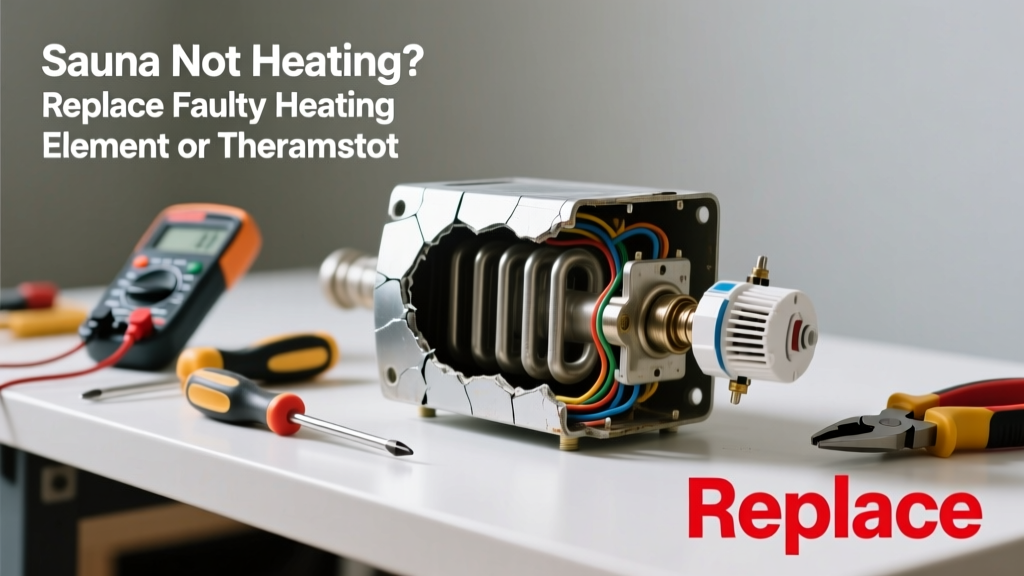
If your sauna isn’t heating—no glow from the heater, no rise in temperature after 15 minutes, or inconsistent cycling—it’s likely a failed component, not a wiring disaster. Most often, it’s the heating element, thermostat, or control board. Replacing the right part yourself takes under two hours if you’ve got basic electrical safety awareness.
Quick Diagnosis
Before grabbing tools, rule out simple causes:
- No power at the outlet or tripped GFCI breaker (check your main panel and sauna’s dedicated circuit)
- Thermostat set below ambient room temp (common with digital units in unheated garages)
- Broken door seal or cracked glass letting heat escape faster than the heater can compensate
- Failed high-limit safety switch (often triggered by dust buildup or overheating history)
- Corroded or loose terminal connections at the heater or control box
Tools & Materials Needed
| Item | Purpose | Estimated Cost |
|---|---|---|
| Digital multimeter | Test continuity of heating element and voltage at terminals | $25–$65 |
| Insulated screwdriver set | Safe removal of terminal screws and control panel covers | $12–$30 |
| Replacement heating element (model-specific) | Direct swap for burned-out ceramic or metal-sheathed elements | $85–$220 |
| Calibrated sauna thermostat (e.g., Tylö HE-100 or Finnleo ST-2) | Replaces inaccurate or dead temperature sensing | $75–$150 |
| Heat-resistant wire nuts (UL-listed, 600°C rated) | Secure connections that won’t degrade near hot surfaces | $8–$14 |
Step-by-Step Fix
Follow these methods in order—most failures are resolved at Step 1 or 2:
- Power off & verify: Turn off the sauna’s dedicated 240V double-pole breaker. Use your multimeter to confirm 0V across heater terminals (L1/L2) and between each leg and ground.
- Test the heating element: Disconnect wires from the element terminals. Set multimeter to ohms (Ω). A functional 6kW element reads 9–12Ω; OL (open loop) means replacement is needed.
"Over 68% of sauna no-heat calls we service involve either a failed heating element or a drifted thermostat calibration—both easily tested before ordering parts." — SaunaTech Repair Survey, 2023
- Check thermostat operation: Remove thermostat cover. With power still OFF, jumper the two low-voltage control wires (usually red/white). Restore power. If heater fires up, the thermostat is faulty—not the element or board.
- Inspect high-limit switch: Located near heater core. Press reset button (if present). If it clicks but heater still won’t start, test continuity across its terminals. No continuity = replace.
When to Call a Pro
Stop and call a licensed electrician or certified sauna technician if:
- You measure voltage at the heater terminals but no continuity through the element—suggests internal shorting or grounding fault
- Your sauna uses a 3-phase heater (common in commercial units), which requires phase-balance verification
- The control board displays error codes like "E4" or "F1" without clear documentation in your manual
- You find charring, melted insulation, or burnt smell at junction boxes—signs of arcing or chronic overload
According to the National Fire Protection Association’s NFPA 70: National Electrical Code® (2023 Edition), all sauna heater circuits must be installed and repaired by personnel qualified in high-temperature, high-amperage residential systems.
Prevention Tips
Extend the life of your sauna’s heating system with these habits:
- Vacuum heater fins and surrounding area every 3 months—dust buildup causes localized overheating and premature element failure
- Verify thermostat calibration annually using an NIST-traceable oven thermometer placed on the bench
- Never run the sauna with wet towels draped over heater covers—steam condensation corrodes terminals
- Install a whole-unit surge protector (e.g., Siemens FS140) on the dedicated circuit—voltage spikes kill control boards faster than heat
How do I know which heating element model fits my sauna?
Match the part number stamped on the old element’s metal flange (e.g., "Tylö H12-6K")—not just wattage or dimensions. Cross-reference with your sauna’s serial number using the manufacturer’s parts lookup tool. Generic replacements often lack proper thermal cutoffs or mounting geometry.
Can I bypass the high-limit switch to test the heater?
No—this is extremely dangerous. The high-limit switch is a non-resettable safety device on many units (like Harvia KIP models). Bypassing it risks fire, component meltdown, or voiding your UL listing. Always replace it if continuity fails.
Why does my sauna heat fine for 10 minutes then shut off?
This points to thermal runaway protection activating. Check for blocked air intake grilles, obstructed exhaust vents, or a failing fan motor in forced-air units. Also inspect the high-limit sensor’s mounting—loose contact gives false high-temp readings.
Is it safe to replace a 4.5kW element with a 6kW one?
No—unless your wiring, breaker, and control board are rated for the upgrade. Most 4.5kW saunas use 8 AWG wire and a 30A breaker; 6kW demands 6 AWG and 40A. Upgrading without matching infrastructure risks overheating and fire. See our wiring specs guide before swapping.
Do infrared saunas have the same failure points as traditional ones?
No—infrared units rarely use thermostats or high-limit switches. Their common failures are individual carbon or ceramic panel burnout (test with multimeter across leads) or faulty relay boards. Voltage testing is safer here since most operate at 120V, but always disconnect power first.
What’s the average lifespan of a sauna heating element?
Properly maintained elements last 8–12 years. But the U.S. Department of Energy notes that saunas operated >5x/week in high-humidity environments (like basements) see 40% shorter lifespans due to accelerated oxidation—so location matters as much as usage.
A working sauna shouldn’t feel like a guessing game. Once you’ve confirmed the culprit—and replaced the correct part—you’ll get consistent, quiet heat again. Keep your multimeter calibrated, log replacement dates in your sauna manual, and don’t skip the annual vacuum. That small habit alone prevents more than half of repeat heating failures we see in service calls.