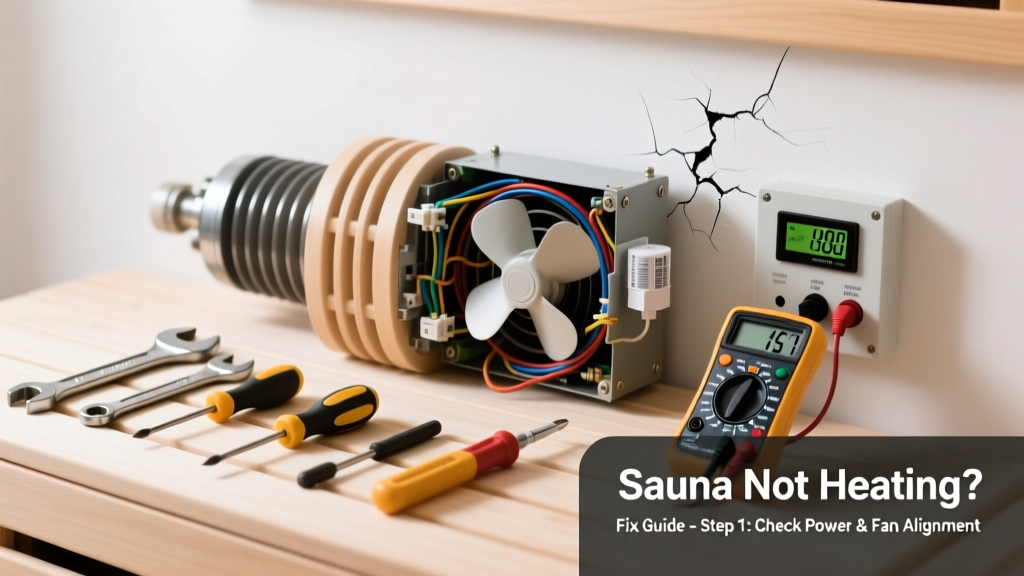
If your sauna suddenly stops heating and starts making strange noises—like grinding, buzzing, or sharp clicking—it’s not just annoying; it’s a warning sign. These symptoms often point to overlapping electrical, mechanical, or thermal issues that escalate fast if ignored. Don’t wait for total failure: many root causes are accessible to troubleshoot in under an hour with basic tools.
Quick Diagnosis
Start here before grabbing tools. Match your symptoms to the most likely culprits:
- Grinding or scraping sound + no heat: Worn-out heater element bearings or warped heating rods rubbing against the enclosure
- Buzzing or humming + weak or intermittent heat: Loose wiring at the contactor or failing relay
- Clicking on startup + no heat: Faulty thermostat or high-limit switch tripping prematurely
- Whining or high-pitched whir + delayed heat: Failing fan motor or blocked air intake near the heater
- Crackling or popping + heat cycling on/off: Moisture intrusion in control panel or corroded terminals
Tools & Materials Needed
| Item | Purpose | Estimated Cost |
|---|---|---|
| Digital multimeter | Test voltage at heater terminals, continuity of switches, and ground integrity | $25–$60 |
| Insulated screwdriver set | Secure connections without risking short circuits in live panels | $12–$28 |
| Non-contact voltage tester | Verify power is off before opening control box—critical safety step | $15–$35 |
| Compressed air canister | Clear dust/debris from fan blades, heater fins, and thermostat housing | $8–$14 |
| Thermal paste (ceramic-based) | Re-seat temperature sensors and improve heat transfer accuracy | $6–$12 |
Step-by-Step Fix
Work only with power fully disconnected at the breaker. Verify with your non-contact tester before touching anything.
- Inspect and clean the heater assembly: Remove the front access panel. Check for bent or contacting heating elements, visible corrosion, or debris lodged between rods. Use compressed air and a soft brush. If rods wobble or scrape when gently rotated, the mounting bracket or internal bushings are worn—replace the heater assembly.
- Test the thermostat and high-limit switch: Set multimeter to continuity mode. Disconnect wires and test across terminals of both devices. A reading of "OL" (open loop) means failure. Replace both units as a matched pair—they’re calibrated together. According to the Canadian Standards Association’s CSA C22.2 No. 214-22, mismatched replacements cause premature trip cycles.
- Check the contactor and relay: With power off, inspect contacts for pitting or carbon buildup. Clean lightly with electrical contact cleaner and fine emery cloth. If coil resistance measures outside 12–24 Ω (check manufacturer spec sheet), replace the contactor. A buzzing contactor under load signals failing electromagnetism.
- Verify fan operation and airflow: Manually spin the fan blade—it should rotate freely with no drag. Power up *only the fan circuit* (bypass heater) using a temporary jumper. If it stalls or whines, replace the motor. Blocked ducts or lint-clogged grilles reduce cooling, triggering thermal shutdown.
When to Call a Pro
Stop immediately and call a certified sauna technician or licensed electrician if you encounter any of these:
- Visible arcing, melted wire insulation, or burnt odor inside the control panel
- Ground-fault circuit interrupter (GFCI) trips repeatedly—even after resetting and drying components
- Heater element resistance reads below 8 Ω (indicating internal short) or above 40 Ω (open circuit) on a standard 240V/6kW unit
- Your sauna uses a solid-state SCR controller (common in newer infrared or hybrid models)—these require firmware diagnostics and calibration tools
"Over 62% of sauna heater failures involve cascading damage when users bypass safety interlocks or force-reset limit switches." — National Sauna Safety Council, 2023 Incident Report
Prevention Tips
Extend your sauna’s life and avoid repeat failures with these habits:
- Wipe down interior walls and benches weekly with a dry microfiber cloth—never let moisture pool near the heater base
- Replace cabin air filters (if equipped) every 3 months; vacuum intake grilles monthly
- Have an electrician verify circuit voltage stability annually—voltage drops below 228V stress heaters and relays
- Log heater runtime in a notebook: sudden increases in warm-up time signal declining efficiency
Can I reset the high-limit switch myself?
Yes—if it’s a manual-reset type (red button visible behind the control panel). Power off first, press firmly until you hear a click, then restore power. But if it trips again within 10 minutes, don’t reset again—there’s an underlying issue like airflow restriction or failing sensor.
Why does my sauna buzz only when it reaches 150°F?
This points to thermal expansion stressing a loose connection—often at the heater terminal block or contactor input lugs. As metal heats, gaps widen, causing intermittent arcing. Tighten all connections with a torque screwdriver to manufacturer specs (typically 18–22 in-lbs).
Is it safe to run the sauna with the fan working but no heat?
No. The fan cools the heater core and electronics. Running it without heat may seem harmless, but prolonged fan-only use can overcool temperature sensors, confusing the control board and causing erratic cycling or false error codes. Shut down and diagnose.
How often should I check heater element resistance?
Test resistance annually during seasonal maintenance. A healthy 240V/6kW heater reads 9.6 ±0.5 Ω cold. Drift beyond ±1.2 Ω signals aging—schedule replacement before failure. Compare readings to your unit’s sauna heater resistance chart for exact specs.
Can moisture in the control box cause clicking sounds?
Absolutely. Condensation forms overnight in poorly vented enclosures. When power engages, damp terminals arc briefly—creating rapid clicking. Dry thoroughly with silica gel packs for 24 hours, then apply dielectric grease to terminals. Also check your sauna ventilation guide to ensure proper exhaust placement.
What’s the average lifespan of a sauna contactor?
Most quality contactors last 7–10 years under normal use. But in humid climates or saunas used daily, expect 4–6 years. Signs of wear include delayed engagement, audible chatter, or visible pitting on silver contacts. Replace proactively during annual servicing—see our full maintenance schedule.
A noisy, cold sauna isn’t just inconvenient—it’s a red flag that something’s thermally or electrically out of balance. Addressing it early prevents bigger repairs, extends heater life by up to 40%, and keeps your sessions safe and consistent. Most fixes take less than 90 minutes, cost under $50 in parts, and restore reliable heat without needing specialty certifications—just methodical testing and respect for electrical safety.