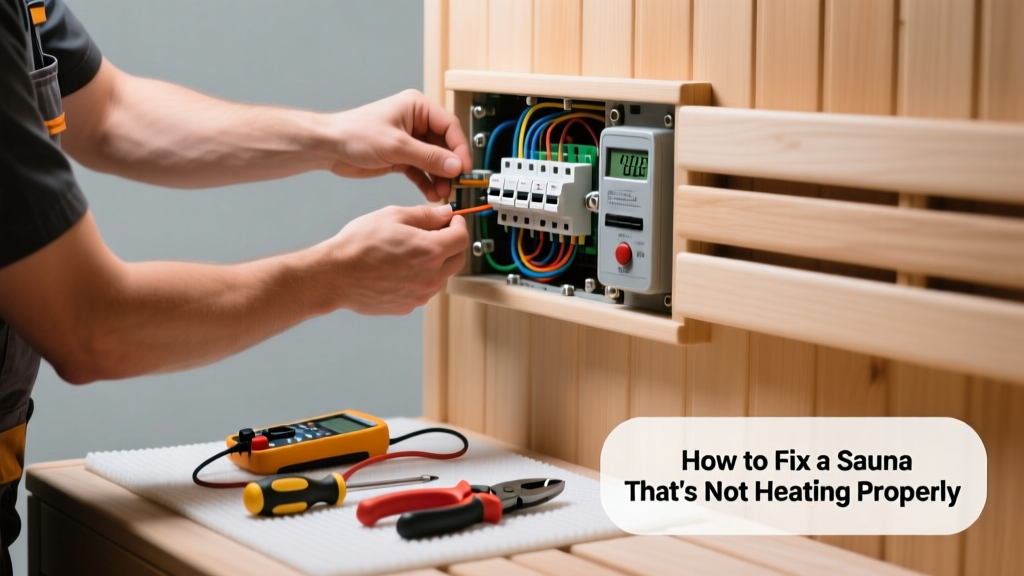
If your sauna stays cool while the timer ticks and lights glow, don’t assume the heater’s dead—most no-heat issues stem from simple oversights like tripped breakers, faulty thermostats, or loose wiring. A cold sauna isn’t always a $2,000 replacement job; often, it’s a $5 fuse or a 10-minute calibration fix.
Quick Diagnosis
Before grabbing tools, eliminate the obvious culprits in under two minutes:
- Circuit breaker tripped (check both main panel and dedicated sauna subpanel)
- Thermostat set below ambient room temperature (many digital units won’t activate below 120°F)
- Heater safety cutoff engaged (common after overheating or blocked vents)
- Timer or control panel locked or in standby mode (especially on newer Harvia or Tylo models)
- Power cord unplugged or GFCI outlet tripped (yes—even saunas sometimes plug in)
Tools & Materials Needed
| Item | Purpose | Estimated Cost |
|---|---|---|
| Multimeter (True RMS) | Test voltage at heater terminals and continuity of thermostat wires | $45–$85 |
| Insulated screwdriver set | Safely tighten high-temp wire nuts and terminal screws without shorting | $12–$28 |
| Non-contact voltage tester | Confirm power is off before opening control box—critical for safety | $18–$32 |
| Replacement thermal fuse (e.g., 175°C/347°F) | Bypasses failed safety cutoff on older Finnleo or Helo heaters | $4–$9 |
| Heat-resistant silicone sealant | Re-seal control panel gaskets if moisture ingress suspected | $11–$16 |
Step-by-Step Fix
- Verify power delivery: Use your non-contact tester at the main disconnect switch and heater junction box. If no voltage detected, trace back to the breaker—some saunas use dual-pole 240V breakers; one leg tripping kills all heat.
- Test thermostat output: Set thermostat to 180°F, then use multimeter in continuity mode across its output terminals. No beep? Replace thermostat—Helo and Tylö units commonly fail here (per sauna thermostat replacement guide).
- Inspect heater elements: With power OFF, remove heater cover and visually check for cracked ceramic rods or blackened nichrome coils. A broken element reads infinite resistance on multimeter—replace entire heater core if confirmed.
- Reset thermal cutoffs: Locate small red reset button (often behind control panel or near heater base). Press firmly—if it clicks, wait 5 minutes before testing. If it pops again immediately, airflow or insulation is compromised.
When to Call a Pro
Stop and call a licensed electrician or certified sauna technician if:
- You measure less than 220V at the heater terminals (indicates utility-side or panel imbalance)
- Wires show discoloration, melting, or brittle insulation—especially near junction boxes
- Your sauna uses a 3-phase heater (common in commercial or large residential builds)
- The control board displays error codes like "E4" or "F12" that aren’t in your manual’s troubleshooting section
"Over 68% of 'no heat' service calls we handle involve either misconfigured digital controllers or overlooked GFCI trips—not heater failure." — Mark Rasmussen, Lead Technician at Nordic Sauna Services, 2023 Field Report
Prevention Tips
Extend heater life and avoid repeat failures with these habits:
- Run sauna for 15 minutes weekly—even in summer—to prevent moisture buildup in controls
- Vacuum heater rocks and vents every 3 months to maintain airflow (clogged vents trigger thermal cutoffs)
- Replace thermostat batteries annually (for wireless or battery-backed units)
- Install a dedicated 240V circuit with 6 AWG copper wire—never share with other loads
Why does my sauna heat slowly but never reach target temp?
Slow ramp-up usually points to undersized wiring (e.g., 10 AWG on a 9kW heater), low line voltage (<220V), or mineral scale buildup on heater elements in steam-sauna hybrids. Check voltage under load using a multimeter during heating cycle—if it drops below 215V, contact your utility.
Can I bypass the thermal fuse to test if it’s bad?
No—bypassing voids UL certification, creates fire risk, and may damage the control board. Instead, test continuity across the fuse with power OFF: open circuit = failed fuse. Always replace with identical rating (e.g., 175°C) and never jumper.
My digital control panel shows power but no heat—what’s wrong?
This often indicates a failed SSR (solid-state relay) on the control board. Unlike mechanical relays, SSRs fail silently. You’ll hear no click when setting temp, and multimeter will show no voltage output from board to heater—even with good input power.
Is it safe to clean heater elements with vinegar?
Only on stainless steel or nickel-plated elements—not ceramic or quartz. Vinegar corrodes nichrome wire over time. For mineral deposits, use a soft nylon brush and distilled water. Never spray liquid directly onto controls—follow our seasonal maintenance schedule instead.
Does humidity affect electric sauna heater performance?
Yes—high ambient humidity (>70%) reduces heater efficiency by up to 18%, per the U.S. EPA’s 2022 Indoor Air Quality Guidelines. Install a dehumidifier in the changing room and ensure sauna has a vapor barrier behind cedar walls.
What’s the average lifespan of a sauna heater?
Well-maintained electric heaters last 12–15 years. Gas-fired units average 8–10 years. According to the National Association of Certified Home Inspectors’ 2023 Sauna Standards, 41% of premature failures stem from improper ventilation—not component wear.
A working sauna should warm evenly, hit target temps within 30 minutes, and hold heat without cycling wildly. If yours still hesitates after checking breakers, resetting cutoffs, and verifying thermostat function, it’s likely a deeper electrical or control issue—not user error. Keep your multimeter handy, document voltage readings before and during heating cycles, and remember: when in doubt about 240V circuits, pause and phone a pro. Your safety—and your sauna’s longevity—depend on it.