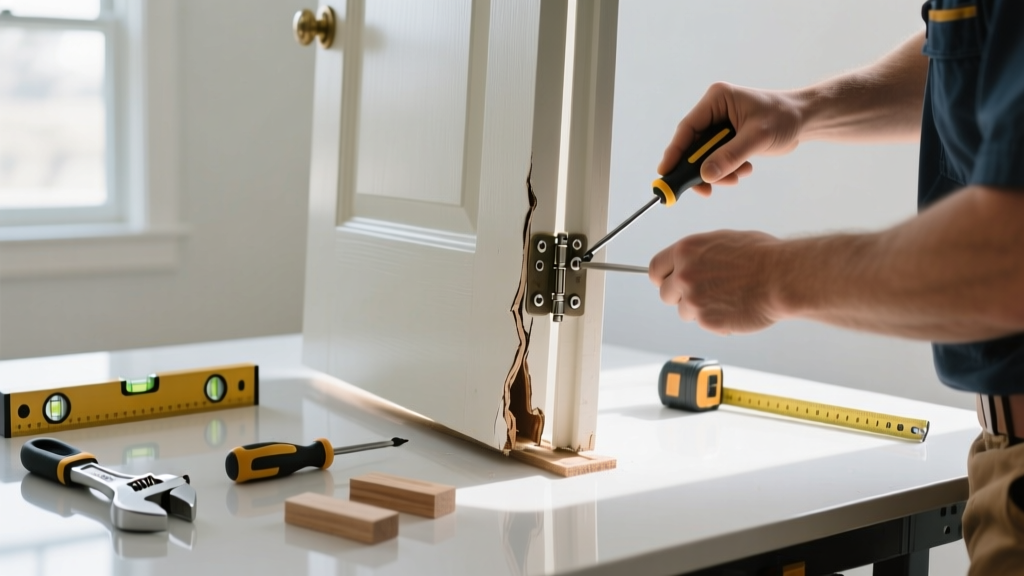
A sagging door isn’t just annoying—it’s a sign your frame or hinges are shifting, often due to seasonal wood movement, loose screws, or foundation settling. If your door scrapes the jamb, leaves a visible gap at the top corner, or requires lifting to close, it’s time for a targeted fix—not a full replacement.
Quick Diagnosis
Before grabbing tools, identify the root cause. Most sagging doors stem from one (or more) of these issues:
- Loose or stripped hinge screws—especially on the top hinge
- Worn or bent hinge pins causing misalignment
- Warped door slab from moisture exposure or age
- Shifting or settling door frame, particularly in older homes with brick veneer or concrete slabs
- Swelled jamb due to humidity or paint buildup
Tools & Materials Needed
| Item | Purpose | Estimated Cost |
|---|---|---|
| Phillips and flat-head screwdrivers | Tighten or replace hinge screws; adjust strike plate | $8–$15 |
| 3-inch #10 or #12 wood screws | Replace short screws—anchor into solid stud behind jamb | $4–$7 |
| Shim kit (thin plastic or cardboard) | Temporarily test alignment before permanent fixes | $3–$6 |
| Drill with countersink bit | Prevent screw head damage; ensure flush seating | $25–$60 |
| Level (24-inch) | Verify vertical plumb of hinge jamb and horizontal level of threshold | $12–$22 |
Step-by-Step Fix
Start with the simplest, most effective solutions first. Most sagging doors improve with method #1 or #2 alone.
- Tighten and upgrade hinge screws: Remove all hinge screws on the jamb side. Replace the top hinge’s two shortest screws with 3-inch screws driven into the wall stud (not just the jamb). Use a drill with light pressure—you’ll feel resistance when hitting the stud.
- Add shims behind the bottom hinge: If the door sags inward at the latch side, insert a thin shim (0.015"–0.030") behind the bottom hinge leaf on the jamb. This subtly rotates the door upward. Secure with new screws.
- Reposition the strike plate: If the door latches only when lifted, file or relocate the strike plate downward by 1/16"–1/8" using a chisel and drill. Test fit before final screwing.
- Check and straighten hinge pins: Remove each pin, lay them on a flat surface, and roll them. Any wobble means replacement—bent pins cause cumulative misalignment over time.
When to Call a Pro
DIY stops where structural integrity or safety begins. Call a licensed carpenter or door specialist if:
- The door frame is visibly racked—corners no longer form 90° angles
- You hear creaking or cracking sounds when opening/closing
- There’s evidence of termite damage, rot, or crumbling mortar around the header
- The sag worsens within days after a fix—or occurs alongside wall cracks or sloping floors
According to the Insurance Institute for Business & Home Safety's 2023 report, 68% of door-related structural complaints in homes over 25 years old trace back to undetected framing settlement—not hinge wear alone.
Prevention Tips
Extend your door’s functional life with routine care:
- Tighten hinge screws every 6 months—especially before winter and summer humidity shifts
- Keep interior humidity between 35–55% using a hygrometer and dehumidifier or humidifier as needed
- Apply three coats of exterior-grade primer and paint to all door edges to seal against moisture absorption
- Inspect weatherstripping annually—compressed or cracked seals increase stress on hinges during operation
Why does my door sag more in summer?
Wood absorbs moisture from humid air, swelling slightly—but more critically, seasonal expansion causes hinge mortises to loosen and drywall anchors to shift. This effect is especially pronounced in homes built on slab foundations without crawlspaces, where thermal expansion has nowhere to dissipate.
Can I use longer screws in all three hinges?
No—only the top hinge should get 3-inch screws. The middle hinge usually hits the stud only partially, and the bottom hinge often aligns with a stud’s edge or void. Overdriving long screws there can split the jamb or bend the hinge leaf. Stick to 2.5-inch screws for middle/bottom unless you’ve confirmed stud location with a stud finder.
What if tightening screws doesn’t help?
That points to either frame movement or hinge wear. Try removing the door and checking hinge leafs for warping or gouges. Also, measure the gap between door and jamb at top, middle, and bottom on both sides. If the gap increases progressively from top to bottom on the latch side, your frame is likely out of plumb—and may need shimming at the header or jack stud.
Do I need to remove the door to fix this?
Rarely. Over 90% of sag fixes happen with the door hanging. Only remove it if you’re replacing hinge mortises, repairing rot, or installing concealed hinges. Use two helpers and lay it flat on sawhorses with padding—never lean it against a wall unsupported.
Will adding a third hinge help?
Yes—if your door is over 80 inches tall or made of solid core material. A center hinge reduces torque on the top hinge by up to 40%, per the National Association of Home Builders’ 2022 Door Installation Guidelines. Mount it exactly halfway between top and bottom hinges, ensuring its screw pattern aligns with the stud.
Can I fix a sagging exterior steel door the same way?
Mostly—but avoid shimming behind hinges on steel doors unless using stainless steel shims. Steel frames expand and contract faster than wood, so use thread-locking compound on hinge screws and check alignment quarterly. Also inspect the threshold anchor bolts: many steel doors sag when those loosen, not the hinges.
A well-aligned door shouldn’t require lifting, forcing, or wedging to operate. Once fixed, test it daily for a week—watch for subtle changes in latch engagement or drag points. For related issues, see our guides on how to fix a sticking door and why your door latch won’t catch. Keep a small jar of #10 screws and a magnetic bit holder near your toolbox—you’ll thank yourself next time a hinge starts whispering trouble.