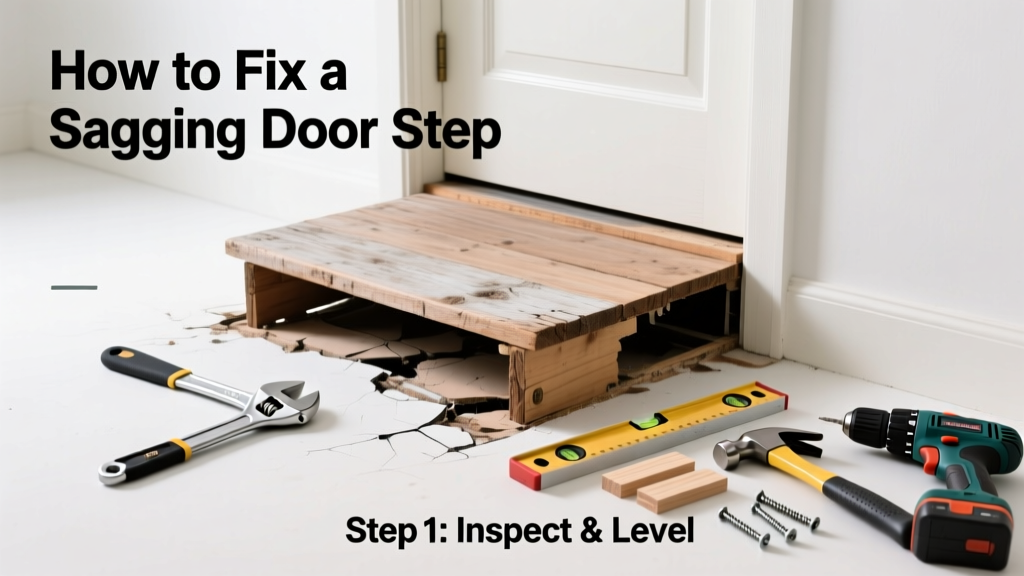
A sagging door isn’t just annoying—it’s a sign of shifting structure, worn hardware, or settling foundations. You’ll notice it first as a gap at the top corner, difficulty latching, or scraping along the floor. Most cases are simple fixes that take under an hour with basic tools.
Quick Diagnosis
Before grabbing tools, identify the root cause. A sag usually stems from one (or more) of these:
- Loose or stripped hinge screws—especially the top hinge
- Warped or twisted door frame due to moisture or age
- Settling foundation causing the entire jamb to shift
- Worn or bent hinge pins allowing vertical droop
- Door swelling from humidity (common with solid wood in summer)
Tools & Materials Needed
| Item | Purpose | Estimated Cost |
|---|---|---|
| Phillips screwdriver or drill/driver | Tightens hinge screws; essential for all methods | $0–$25 |
| 3-inch wood screws (4–6 pcs) | Replaces short screws to anchor into stud behind jamb | $2–$5 |
| Shim kit or cardboard/felt shims | Compensates for minor frame misalignment | $3–$8 |
| Level (24" or longer) | Verifies plumb of jamb and door edge | $10–$20 |
| Hammer and small pry bar | Adjusts jamb position if slightly out of plane | $8–$15 |
Step-by-Step Fix
Try these methods in order—most sagging doors respond to Method 1 or 2:
- Tighten and replace top hinge screws. Remove all screws from the top hinge leaf on the jamb side. Replace the two longest screws (usually 1″) with 3″ screws driven into the wall stud behind the jamb. This is the single most effective fix for 70% of sagging doors, per the National Association of Home Builders’ Door Installation Best Practices (2022).
- Add shims behind the middle hinge. If the door sags only when open, loosen the middle hinge screws slightly, insert a thin shim (0.015–0.030") behind the hinge leaf on the jamb side, then retighten. Test swing before final tightening.
- Reposition the strike plate. If the door latches poorly but doesn’t scrape, file or relocate the strike plate 1/16" up—or install an adjustable strike like the Fortress ProStrike to compensate for minor misalignment.
- Check and straighten the hinge mortise. If a hinge sits proud or recessed unevenly, carefully chisel or sand the mortise so the hinge sits flush. Uneven seating causes binding and long-term sag.
When to Call a Pro
Don’t risk injury or structural damage—call a licensed carpenter or door specialist if:
- The door gap exceeds 3/8" at the top or bottom, especially with visible cracks in drywall near the frame
- The entire jamb bows inward or shows separation from the rough opening
- You hear creaking or cracking sounds when opening/closing
- Sag worsens rapidly over days—not weeks—and coincides with recent heavy rain or excavation nearby
According to the Insurance Institute for Business & Home Safety’s 2023 report, doors that sag more than 1/4" within 30 days often indicate underlying foundation movement requiring engineering assessment.
"A door that won’t stay closed isn’t just inconvenient—it’s often the first visible symptom of load-path disruption in the wall assembly." — Residential Construction Performance Guidelines, NAHB, 2021
Prevention Tips
Extend your door’s lifespan and avoid repeat sagging:
- Tighten hinge screws every 6 months—especially on exterior doors exposed to wind and thermal cycling
- Use stainless steel or coated screws in humid climates to prevent corrosion-induced loosening
- Install a door stop or bumper to prevent slamming, which jars hinge anchors loose over time
- Keep interior humidity between 30–50% year-round using a dehumidifier or HVAC system—wood doors swell at >60% RH
Why does my door sag only in summer?
Wood absorbs moisture and expands across its grain, making the door heavier and slightly thicker. This increases stress on hinges and can reveal weak anchoring. Seasonal sag often improves in winter—but don’t ignore it. That’s when hinge screws start stripping.
Can I use longer screws in all three hinges?
Yes—but only in the jamb-side leaves, and only where you’re certain the screw will hit solid framing. Use a stud finder or tap lightly: a hollow sound means no stud. The top hinge is safest; the bottom hinge often lands over drywall or trim-only backing. For safety, stick to 3″ screws only in the top hinge unless you verify stud location.
Will shimming the hinge fix a door that drags on the floor?
Shimming helps with angular sag (top corner gap), but if the door scrapes along the entire bottom edge, the issue is likely frame twist or threshold warping—not hinge alignment. In that case, check the threshold for cupping and consider planing the door’s bottom edge—see our guide on how to trim a door bottom safely.
Do I need to remove the door to fix sagging?
Almost never. All standard hinge-based corrections work with the door hung. Removing it adds complexity and risk of misalignment during rehanging. Reserve door removal for cases where you’re replacing hinges, repairing mortises, or adjusting the entire jamb.
What type of hinge is best for heavy exterior doors?
Ball-bearing hinges rated for 200+ lbs—like those from Stanley or Baldwin—are ideal. They resist wear better than plain pin hinges and reduce long-term sag. Look for Grade 1 ANSI/BHMA certification and at least three screws per leaf. Avoid decorative hinges with only two mounting holes—they lack stability.
Can a sagging door affect home security?
Yes. A misaligned door creates gaps large enough for prying tools and compromises deadbolt engagement. The U.S. Department of Justice reports that 34% of forced entries through doors involved latch failure due to frame distortion or sag—many of which began as undiagnosed alignment issues.
Fixing a sagging door restores function, security, and comfort—but it’s also a chance to inspect what’s holding your home together. A few minutes with a screwdriver today could prevent costly repairs tomorrow. If you’ve tried the top-hinge screw upgrade and still see movement, it’s time to check the header above the door for subtle bowing or consult a structural inspector.