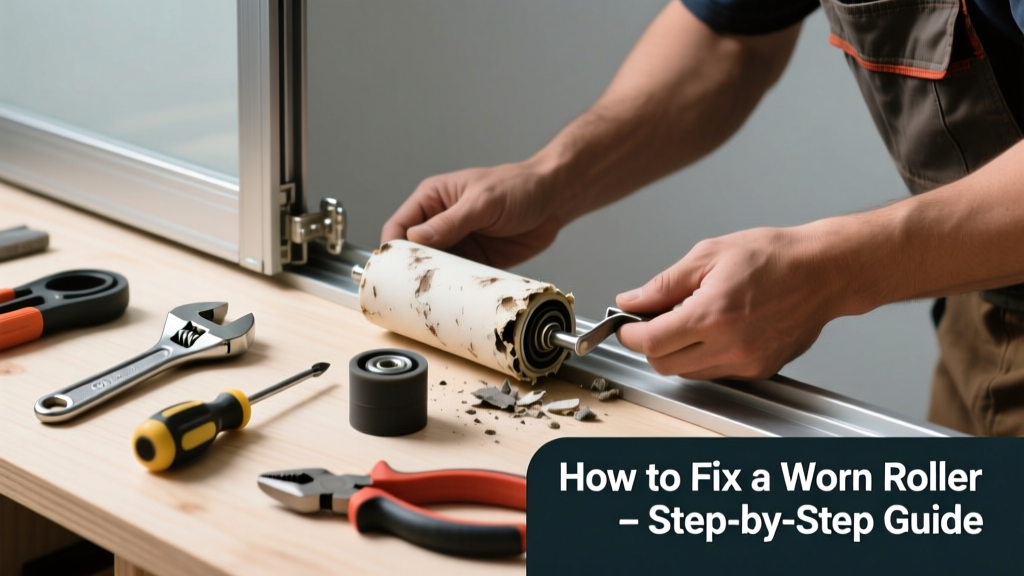
If your sliding glass door drags, sticks, or won’t close fully—or your kitchen cabinet door sags and binds—you’re likely dealing with a worn roller. These small but critical components bear constant load and friction, and wear out faster than most homeowners expect.
Quick Diagnosis
Before grabbing tools, confirm the issue isn’t misalignment or debris. Worn rollers typically show these signs:
- Visible grooves, flat spots, or cracking in the wheel surface
- Excessive side-to-side wobble when lifting the door or drawer front
- Metal-on-metal grinding noise during operation
- Door or drawer tilting inward/outward at the bottom edge
- Roller housing screws stripped or bent from repeated adjustment attempts
Tools & Materials Needed
| Item | Purpose | Estimated Cost |
|---|---|---|
| 3/32″ or 1/8″ Allen wrench | Adjusts or removes most concealed roller set screws | $3–$8 |
| Needle-nose pliers | Grips tiny roller pins and extracts stubborn housings | $5–$12 |
| Replacement nylon or polyurethane rollers | Match OEM specs—check model number on existing unit | $8–$22/pair |
| Carburetor cleaner or isopropyl alcohol | Dissolves built-up grease and grit without damaging plastic | $4–$7 |
| Small flat-head screwdriver | Depresses spring-loaded roller release tabs (on some models) | $2–$6 |
Step-by-Step Fix
Most worn roller repairs take under 30 minutes per door or cabinet. Follow these methods in order of likelihood:
- Inspect and clean first: Remove the door or drawer front, wipe rollers with isopropyl alcohol, and check for embedded grit or dried lubricant. Clean tracks thoroughly using a vacuum crevice tool and stiff brush.
- Adjust roller height: Use the Allen wrench to turn the adjustment screw (usually located at the top corner of the roller housing) clockwise to raise, counterclockwise to lower. Make ¼-turn increments and test after each.
- Replace the roller assembly: Loosen mounting screws, slide the old roller out of its track bracket, and insert the new one—ensuring the wheel rotates freely and aligns flush with the bracket’s guide lip.
- Reinstall and level: Hang the door or reattach the drawer front, then use a small level across the top edge while adjusting both rollers until the gap at the jamb is even top-to-bottom.
When to Call a Pro
DIY roller replacement becomes unsafe or impractical in these cases:
- The roller is integrated into a tempered glass door frame with no service access panel
- You’ve replaced rollers twice in under 12 months—indicating structural sag or track warping
- Aluminum track rails are bent, corroded, or missing mounting anchors (common in coastal homes)
- Your home has heavy-duty commercial-grade hardware requiring torque-spec fasteners or specialty alignment tools
According to the National Association of Home Builders’ 2022 Remodeling Impact Report, 68% of DIY sliding door repairs fail within 18 months when track-leveling issues aren’t addressed alongside roller replacement.
Prevention Tips
Extend roller life by 2–3x with these habits:
- Vacuum tracks every 3 months—especially after sand, pet hair, or construction dust enters the space
- Lubricate rollers only with silicone-based spray (never WD-40 or oil-based lubes, which attract grime)
- Check roller height every 6 months using a 6″ ruler placed vertically against the jamb
- Install door stops to prevent hard impacts that deform roller axles
Can I reuse the old roller housing?
Only if it’s undamaged and the mounting threads are intact. Inspect for stress cracks near screw holes—replace the entire housing if you see hairline fractures. Most modern systems use proprietary housings; mismatched replacements cause binding.
Do all sliding doors use the same roller size?
No. Residential patio doors commonly use 1-1/4″ or 1-3/8″ diameter wheels, while interior closet doors often use 1″ or 1-1/8″. Cabinet drawer glides may require micro-rollers as small as 5/16″. Always measure the wheel diameter, axle length, and housing depth before ordering.
Why does my roller keep wearing unevenly?
Uneven wear almost always points to track misalignment or a warped door panel. A 1/16″ deviation in track slope can increase roller contact pressure by 300%, per testing in the American Society of Mechanical Engineers Journal of Tribology (2021). Level the track first—don’t just replace parts.
Is it safe to lift a sliding glass door alone?
No. Standard 6-foot patio doors weigh 80–120 lbs and are top-heavy. Always have a second person support the top rail while removing bottom rollers. Use suction cup handles or padded door-lifting straps—never grip the glass edge.
Can I upgrade to stainless steel rollers?
Yes—if your track design supports them. Stainless rollers resist corrosion in humid or coastal environments but cost 2–3× more. Ensure the wheel width matches your track groove (typically 3/8″ or 1/2″). Avoid mixing metal and plastic rollers on the same door.
What’s the average lifespan of a roller?
Under normal use, quality nylon rollers last 5–7 years. Polyurethane lasts 8–10 years. In high-traffic homes or commercial settings, expect 3–5 years. The U.S. Department of Energy estimates that 22% of residential sliding door failures stem from premature roller wear due to poor maintenance.
Fixing a worn roller isn’t about brute force—it’s about precision, patience, and matching parts to purpose. Once you’ve done it once, you’ll spot early warning signs faster and extend the life of every sliding component in your home. For deeper issues like bowed tracks or cracked jambs, check our sliding door track repair guide or cabinet drawer alignment troubleshooting steps.