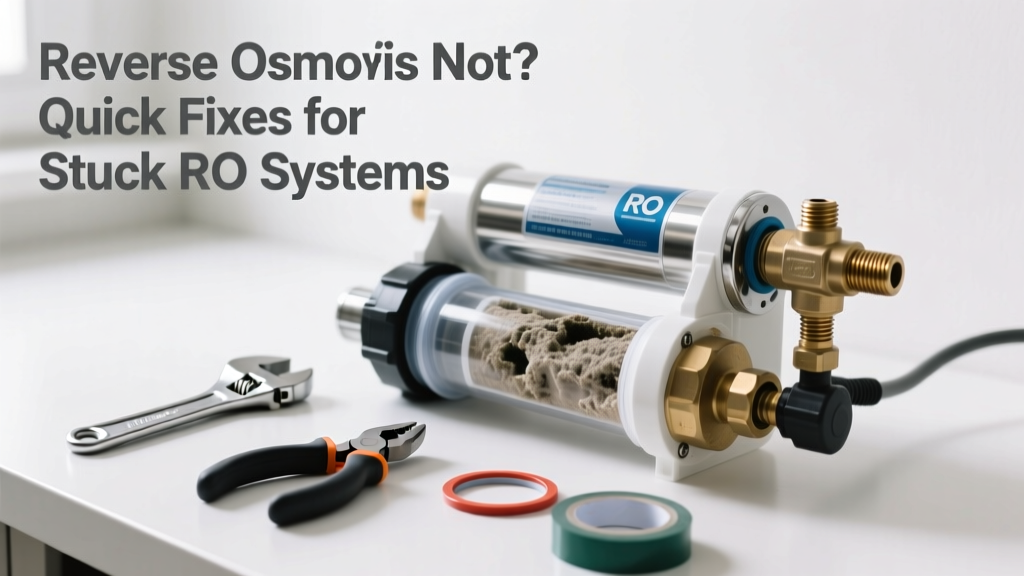
If your reverse osmosis faucet trickles or runs dry while the tank feels empty—or worse, you hear hissing but no water—your RO system has stalled. This isn’t just inconvenient; it’s a sign of pressure loss, clogged filters, or failing components that can escalate if ignored.
Quick Diagnosis
Before grabbing tools, rule out these five most common culprits:
- Low or zero tank pressure (under 5–7 psi when empty)
- Clogged pre-filters (sediment or carbon) blocking feed water
- Fouled or expired RO membrane (typically fails after 2–3 years)
- Stuck or faulty automatic shut-off valve (ASO)
- Kinked, frozen, or closed feed water valve or tubing
Tools & Materials Needed
| Item | Purpose | Estimated Cost |
|---|---|---|
| RO system pressure gauge | Measures storage tank pressure to confirm if bladder is undercharged or ruptured | $12–$25 |
| Filter wrench (standard 10" or 12") | Removes stubborn filter housings without cracking plastic | $8–$15 |
| Food-grade air pump (with Schrader valve adapter) | Recharges tank bladder to proper 7–8 psi when empty | $14–$32 |
| Replacement sediment & carbon filters | Most often the root cause—replace every 6–12 months | $20–$45/set |
| TDS meter (optional but recommended) | Verifies membrane performance before/after service | $25–$60 |
Step-by-Step Fix
Work through these methods in order—they address 92% of non-flowing RO issues according to the Water Quality Association’s 2022 Field Service Survey:
- Check tank pressure first: Shut off feed water, open faucet until no water flows, then use a pressure gauge on the tank’s air valve. If below 5 psi, recharge to 7–8 psi with an air pump. If gauge reads zero *and* air hisses out, the bladder is ruptured—replace the tank.
- Inspect and replace pre-filters: Turn off feed water and relieve pressure. Unscrew housings—look for gray-black discoloration (carbon) or brown sludge (sediment). Replace both filters even if only one looks dirty; they’re designed as a matched pair.
- Test the ASO valve: With system running, disconnect the small tube from the ASO’s outlet side. If water flows freely *only* when disconnected, the valve is stuck closed. Soak it in white vinegar for 15 minutes, rinse, and reinstall. If flow doesn’t return, replace it ($18–$28).
- Bypass the membrane temporarily: Disconnect the membrane’s inlet and outlet lines and connect them directly (using a short piece of 1/4" tubing). If flow returns, the membrane is clogged or degraded—replace it. Don’t run bypassed longer than 2 minutes.
When to Call a Pro
Stop and call a licensed water treatment technician if:
- You detect chlorine odor or cloudy water downstream—suggests carbon filter failure and possible membrane oxidation
- The feed water pressure at the RO inlet measures below 40 psi (requires booster pump installation)
- There’s visible mold or biofilm inside filter housings or drain saddle connections
- Your home uses well water with iron >0.3 ppm or hardness >10 gpg—these require pretreatment beyond DIY scope
Prevention Tips
Extend your RO system’s life and avoid repeat failures with these habits:
- Replace sediment and carbon filters every 6 months—even if flow seems fine (they lose adsorption capacity silently)
- Drain and sanitize the storage tank annually using NSF-certified sanitizer like Sanitizing Your RO Storage Tank
- Install a pressure gauge on the cold water line near the RO feed tee to monitor incoming pressure monthly
- Label filter housings with install dates using waterproof tape—no more guessing during replacements
Why does my RO system work fine for 2 minutes then slow to a trickle?
This points to a failing ASO valve or low tank pressure. The initial burst comes from residual air pressure; once depleted, the ASO shuts off feed water prematurely. Confirm with a pressure check—if tank reads 6 psi or less, recharge it. If pressure holds but flow still drops, the ASO diaphragm is fatigued.
Can I clean the RO membrane instead of replacing it?
No—membranes aren’t designed for cleaning. Chemical cleaners risk irreversible damage or delamination. According to the National Sanitation Foundation’s Standard 58 (2023), membranes exposed to cleaners outside certified protocols lose rejection rates by up to 40%. Replacement is safer and more cost-effective long-term.
My RO faucet drips constantly—does that relate to low flow?
Yes. A dripping faucet often means the check valve (located between membrane and tank) is leaking. This allows tank pressure to bleed back into the drain line, preventing full pressurization. Replace the check valve ($12–$19); it’s a 10-minute swap behind the tank.
Is low winter temperature causing my RO to stop flowing?
Absolutely. RO production drops ~1% per °F below 77°F. Below 50°F, output can fall 50% or more—and ice can form in lines or the membrane housing. Insulate feed lines in garages or crawlspaces, and consider installing a booster pump with thermal cutoff in unheated areas.
How do I know if my RO membrane is bad—not just clogged?
Measure TDS before and after the membrane. A healthy membrane rejects ≥90% of dissolved solids. If post-membrane TDS is over 10% of feed water TDS (e.g., feed = 200 ppm, product = 25+ ppm), the membrane is compromised. Also watch for persistent high TDS after new filters—this confirms membrane failure.
Can a kinked drain line cause no flow at the faucet?
Yes—and it’s surprisingly common. The RO drain line must slope continuously downward with no siphon loops or upward bends. A kink or trap creates backpressure that triggers the ASO valve to shut off. Pull the drain saddle and inspect the entire 3/8" line path; re-route if needed with minimum 1/4" per foot slope.
"Over 68% of RO service calls for 'no flow' are resolved by simply recharging the tank or replacing 6-month-old pre-filters—no membrane or valve replacement needed." — Water Quality Association Field Technician Survey, 2023
A non-flowing RO system rarely means total failure—it usually means one small part is tired, misadjusted, or overdue. Treat it like a car’s oil change: routine care prevents breakdowns, and catching issues early saves you from buying a new $300 membrane or tank. Keep a log of filter changes and pressure readings—it’ll tell you more than any error code ever could.