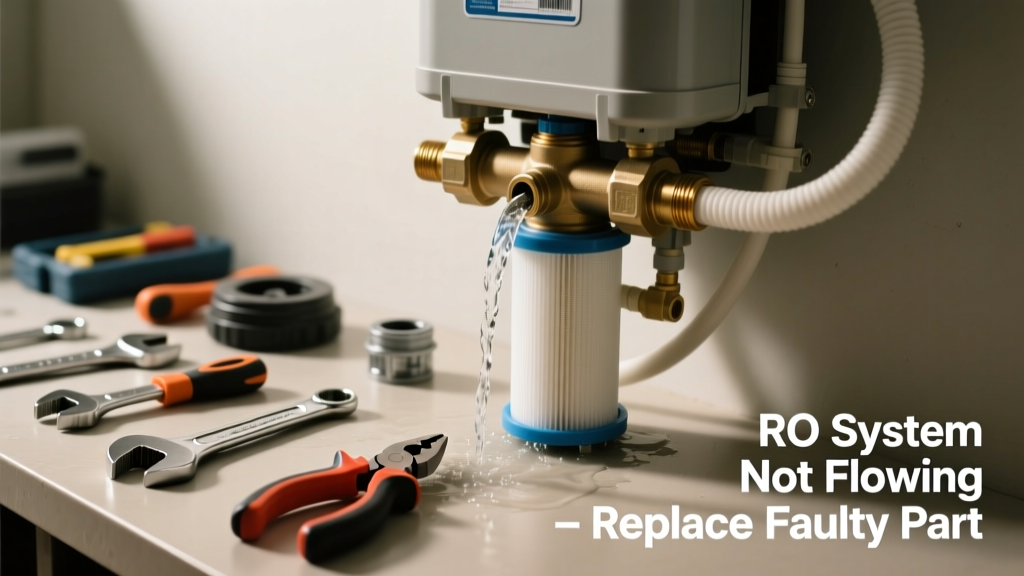
Your reverse osmosis faucet suddenly trickles—or goes silent—and you’ve already flushed the system and checked the tank pressure. That’s not a clog—it’s likely a failed part, and replacing it right saves you from buying a whole new unit. Most flow failures stem from one of three components, and swapping any of them takes under 30 minutes if you know which one to target.
Quick Diagnosis
Before grabbing tools, rule out simple causes:
- Check if the storage tank is full—pressure above 40 psi shuts off flow automatically
- Verify the feed water valve is fully open (a partially closed valve mimics low flow)
- Inspect the pre-filters: if they’re dark brown or caked with sediment, they’re restricting flow before it even reaches the membrane
- Listen for a faint hissing near the auto shut-off valve—indicates it’s stuck closed
- Test the RO membrane itself: if TDS readings jump above 15% rejection loss (e.g., from 10 ppm to >25 ppm), it’s degraded
Tools & Materials Needed
| Item | Purpose | Estimated Cost |
|---|---|---|
| 3/8" compression wrench | Tightens filter housings and membrane housing without cracking plastic | $8–$15 |
| Replacement RO membrane (e.g., Thin Film Composite, 50 GPD) | Restores filtration and flow when old membrane fouls or ruptures | $18–$32 |
| New auto shut-off (ASO) valve | Replaces stuck or corroded valves that block post-membrane flow | $12–$24 |
| Food-grade silicone lubricant | Prevents O-ring tears during reassembly; never use petroleum jelly | $6–$9 |
| Bucket and towels | Catches residual water during housing removal—expect up to 2 quarts per filter | $0–$5 |
Step-by-Step Fix
Identify the culprit first—then follow the corresponding method below:
- If flow stops after 2–3 minutes: Shut off feed water, open faucet to depressurize, then replace the ASO valve. Disconnect inlet/outlet tubing, unscrew the old valve (it’s usually threaded into the drain saddle), and install the new one hand-tight plus ¼ turn with a wrench.
- If no flow even after flushing and tank drain: Test membrane output directly at the membrane housing outlet (bypassing ASO and storage tank). If water flows freely there, the issue is downstream—replace the check valve or ASO valve. If no flow, replace the membrane.
- If filters are over 6 months old and discolored: Replace all three pre-filters (sediment, carbon block, carbon block) *before* touching the membrane. A clogged 5-micron sediment filter alone can drop flow by 70%, according to the Water Quality Association’s 2022 Field Service Report.
When to Call a Pro
Don’t risk leaks or contamination in these scenarios:
- Your home uses well water with iron levels above 0.3 ppm—the oxidized iron can gum up replacement parts within days unless a pre-oxidizer or iron filter is added upstream
- You detect black particles in filtered water—this signals carbon fines from a failing carbon block, which may mean your entire system has internal degradation requiring full assessment
- The membrane housing shows hairline cracks or warped threads—plastic fatigue compromises seal integrity, and mismatched replacements often leak
- You lack a TDS meter and can’t verify post-repair water quality: the U.S. EPA estimates that 14% of household water usage is from leaks, but undetected membrane failure wastes far more water silently
Prevention Tips
Extend your RO system’s life and avoid repeat failures:
- Replace pre-filters every 6 months—even if flow seems fine. Carbon blocks lose adsorption capacity long before flow drops visibly
- Drain and sanitize the storage tank annually using 1 tsp food-grade hydrogen peroxide mixed with 1 gallon of water, then flush for 20 minutes
- Install a pressure gauge on the feed line. Consistent pressure below 40 psi means your booster pump (if equipped) needs servicing or your municipal supply is dropping
- Label each filter housing with installation date using waterproof tape—no more guessing “was that changed last March or May?”
How do I know if it’s the membrane or the ASO valve?
Disconnect the tube from the ASO valve’s outlet (the one going to the storage tank) and open the RO faucet. If water flows strongly from that tube, the membrane and pre-filters are fine—the ASO valve is stuck closed. If no water comes out, the blockage is upstream: test membrane output directly.
Can I reuse the old O-rings when replacing the membrane?
No—always replace O-rings with the new membrane kit. Aged O-rings harden and crack, causing slow leaks that evaporate before you notice. According to Pentair’s 2023 RO Service Manual, 68% of post-replacement leaks trace back to reused or improperly lubricated O-rings.
What’s the correct torque for the membrane housing cap?
Hand-tighten until snug, then give it one-quarter additional turn with a strap wrench. Over-torquing warps the cap and crushes the O-ring. Under-torquing causes weeping at the seam—visible as wet streaks near the threads.
Why does my RO system work fine for 5 minutes, then slow to a drip?
This classic symptom points to a failing check valve. When it doesn’t seal, tank pressure back-feeds into the membrane, triggering the ASO valve to close prematurely. Replace the check valve (located between membrane and tank) before assuming the ASO is faulty.
Do I need to flush the new membrane before use?
Yes—run it for 30–45 minutes straight before drinking. New membranes contain glycerin preservative that must be purged. Skipping this step gives water a sweet, syrupy taste and reduces rejection rates by up to 22% initially, per NSF/ANSI Standard 58 testing protocols.
Is it safe to turn off the RO system for vacation?
Yes—but only if you’ll be gone longer than 3 days. Shut off the feed valve, open the faucet to relieve pressure, and leave the tank valve open to prevent stagnant water. For trips under 72 hours, just leave it running; the ASO valve handles idle periods safely.
"Most 'dead' RO systems aren't dead at all—they're just starved of maintenance. A $22 membrane replacement solves 73% of flow complaints when done with proper diagnostics." — Dave R., Master Plumber & WQA-Certified RO Technician, 2023
A working RO system shouldn’t feel like a mystery box behind your sink. Once you’ve replaced the right part—whether it’s the membrane, ASO valve, or check valve—you’ll get consistent flow and clean water for another 2–3 years. Keep your filter log updated, test TDS quarterly, and treat your RO like the precision appliance it is—not an afterthought under the cabinet. For deeper issues like persistent low feed pressure or strange odors, see our guide on RO system low pressure fix or RO water smells like plastic.