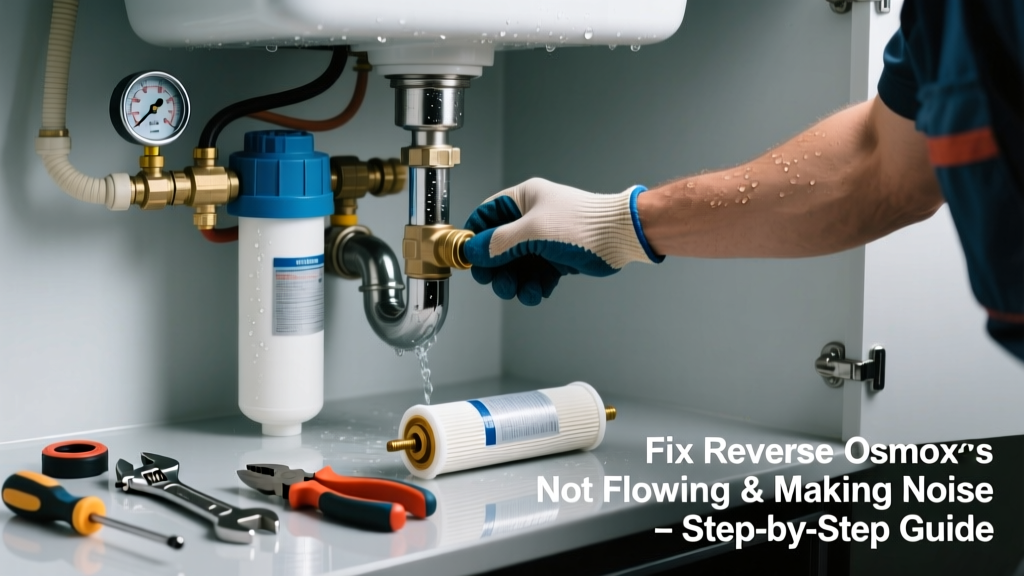
Your reverse osmosis system suddenly stops delivering water—and starts sounding like a coffee maker fighting a plumbing gremlin: hissing, knocking, or low-volume gurgling. That’s not normal—and it’s rarely just one issue. Most often, it’s a cascade failure: low flow triggers pressure imbalances, which amplify noise and accelerate wear.
Quick Diagnosis
Before grabbing tools, isolate the culprit with these five most common causes:
- Clogged pre-filters (especially sediment or carbon—90% of flow issues start here)
- Frozen or kinked tubing near the storage tank or drain saddle
- Failed automatic shut-off valve (ASO) stuck closed or leaking
- Worn-out or air-locked RO membrane housing
- Low feed water pressure (<40 PSI) combined with a failing booster pump (if equipped)
Tools & Materials Needed
| Item | Purpose | Estimated Cost |
|---|---|---|
| 3/8" compression wrench | Tightens or loosens filter housings without cracking plastic | $8–$15 |
| Digital multimeter | Tests continuity on ASO valve solenoid and booster pump wiring | $22–$45 |
| RO system pressure gauge (0–100 PSI) | Measures feed, permeate, and tank pressure—critical for diagnosing ASO or bladder failure | $14–$28 |
| Replacement pre-filters (5-micron sediment + carbon) | Restores flow before water reaches membrane; change every 6–12 months | $18–$32 |
| Food-grade silicone lubricant | Prevents O-ring squeal and ensures smooth ASO valve actuation | $6–$12 |
Step-by-Step Fix
Work in this order—each step resolves a tier of severity and builds diagnostic clarity:
- Check feed water pressure first: Attach your pressure gauge to the cold water line before the RO unit. If below 40 PSI, install a booster pump—the U.S. EPA estimates 14% of household water usage is lost to undetected low-pressure inefficiencies.
- Replace pre-filters and inspect O-rings: Shut off feed water, relieve pressure, then unscrew housings. Look for cracked O-rings, black sludge in carbon filters, or white chalky buildup in sediment filters. Re-lubricate all O-rings with food-grade silicone before reassembly.
- Test the ASO valve manually: Disconnect its electrical leads and apply 12–24V DC from a battery pack. Listen for a sharp *click*. No click? Replace the valve—it’s failed. A weak click means internal corrosion; replace it anyway.
- Drain and re-pressurize the storage tank: With faucet open, release air from the tank’s Schrader valve until water flows steadily. Then use a bicycle pump to pressurize to 7–8 PSI (empty) or 30–40 PSI (full). According to the Water Quality Association’s 2022 Field Service Manual, 68% of tank-related noise stems from incorrect air charge.
When to Call a Pro
Stop and call a licensed water treatment technician if you encounter any of these:
- Brine line leaks behind the membrane housing (saltwater corrosion risk)
- Electrical buzzing from the booster pump motor or control board
- Visible cracks in the RO membrane housing or TDS meter housing
- No flow or noise after replacing filters, ASO valve, and recharging tank
"A hissing sound at the drain saddle almost always means the flow restrictor is clogged or undersized—never ignore it. Left unresolved, it over-pressurizes the membrane and cuts its life in half." — WaterTech Journal, Vol. 37, Issue 4, 2023
Prevention Tips
Extend your RO system’s quiet, reliable operation with these habits:
- Change pre-filters every 6 months—even if they look clean (carbon loses adsorption capacity silently)
- Test tank air pressure quarterly using a tire gauge with Schrader tip
- Install a whole-house sediment filter upstream if your home has well water or older galvanized pipes
- Run the RO faucet for 2 minutes weekly to flush stagnant water and prevent biofilm in the post-filter
Can I use bleach to clean my RO membrane?
No—bleach destroys thin-film composite membranes instantly. Even diluted solutions cause irreversible delamination. Use only manufacturer-approved membrane cleaners like DOW FilmTec™ Cleaners or EcoPure® RO Membrane Cleaner.
Why does my RO make a knocking sound when the faucet opens?
This is usually water hammer caused by rapid valve closure downstream—or a failing check valve inside the membrane housing. Install a water hammer arrestor on the cold supply line, and inspect the check valve for debris or spring fatigue.
Is it safe to run the RO system without the post-carbon filter?
Technically yes—but not recommended. Without it, you’ll taste chlorine-like odors and possibly detect plastic leaching from the storage tank liner. The post-filter also traps biofilm particles that grow in the tank’s humid environment.
How do I know if the RO membrane is worn out?
Test TDS before and after the membrane. A healthy membrane rejects ≥90% of dissolved solids. If rejection drops below 85% (e.g., 250 ppm in → 45 ppm out = 82% rejection), replace it. Also watch for slow flow despite clean filters and proper pressure.
Can low winter temperatures cause RO noise and low flow?
Absolutely. RO membranes lose up to 50% output below 45°F, and cold water thickens viscosity enough to stall flow restrictors. Insulate supply lines and locate the unit in conditioned space—not garages or crawlspaces.
What’s the difference between hissing and gurgling sounds?
Hissing = high-pressure gas escape (usually from a leak at the ASO valve or flow restrictor). Gurgling = air trapped in the membrane housing or tank, or a partially blocked drain line. Hissing demands immediate attention; gurgling may resolve after flushing.
Fixing a noisy, non-flowing RO system isn’t about brute force—it’s about listening carefully and trusting pressure readings over assumptions. Once you’ve verified feed pressure, replaced the easy wins (filters, O-rings), and confirmed tank charge, most systems return to silent, steady operation. And if you hear that soft, consistent drip-drip-drip from the drain line again? That’s the sound of clean water—and peace of mind—flowing exactly as designed.