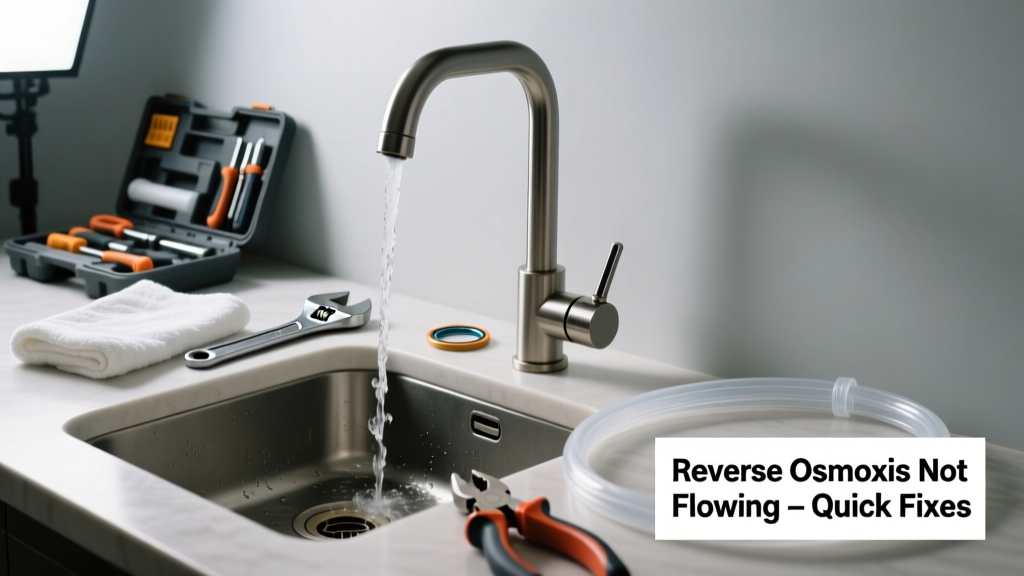
Your kitchen RO faucet suddenly drips—or worse, delivers nothing but silence. That’s not just inconvenient; it’s a sign something’s wrong with pressure, flow, or filtration. Most causes are simple and fixable in under an hour—if you know where to look.
Quick Diagnosis
Before grabbing tools, rule out the obvious:
- No water supply valve turned on (check under sink—often labeled "RO Feed")
- Tank pressure too low (should be 7–8 psi when empty)
- Frozen or kinked tubing (look behind fridge or near cold water line connection)
- Auto shut-off valve stuck closed (a frequent culprit after long disuse)
Tools & Materials Needed
| Item | Purpose | Estimated Cost |
|---|---|---|
| 3/8" wrench or adjustable crescent wrench | Tightens or loosens feed valve, tank fitting, and filter housings | $8–$22 |
| Food-grade air pressure gauge (0–30 psi) | Measures RO tank air pressure—critical for diagnosing low output | $12–$28 |
| Replacement pre-filters (5-micron sediment + carbon) | Most common cause of slow/no flow; replace every 6–12 months | $24–$42 |
| Bucket and towels | Catches water during filter changes and tank depressurization | $0–$5 |
Step-by-Step Fix
Try these methods in order—they’re ranked by likelihood and ease:
- Check and open the feed water valve: Locate the 1/4" line feeding the RO unit (usually blue or black). Turn the handle parallel to the pipe. If it’s perpendicular, it’s closed—even slightly.
- Test tank air pressure: Shut off feed water, open faucet until no water flows, then disconnect tank’s Schrader valve cap. Press gauge firmly onto valve stem. If reading is below 6 psi, add air with a bicycle pump until 7–8 psi. Never exceed 10 psi—over-pressurizing ruptures the bladder.
- Inspect and replace pre-filters: Shut off feed water and open faucet to relieve pressure. Unscrew filter housings (use wrench if tight). Look for brown discoloration (carbon) or gray sludge (sediment). Replace both pre-filters—even if only one looks dirty. According to the Water Quality Association’s 2022 Maintenance Guidelines, 68% of low-flow RO complaints trace back to overdue pre-filter changes.
- Bypass the RO membrane temporarily: Disconnect the tube from the membrane outlet and hold it over a bucket. Open feed valve. If water gushes freely, the membrane is clogged or failed. If still weak, problem lies upstream—likely feed line, valve, or filters.
When to Call a Pro
Stop and call a licensed water treatment technician if:
- You detect a strong chlorine or sulfur odor at the faucet—indicating possible membrane failure or bacterial growth inside the system
- The storage tank leaks, bulges, or hisses when you press the Schrader valve (bladder rupture)
- Water pressure at the feed line measures below 40 psi (your home’s main pressure may need boosting)
- You’ve replaced filters and re-pressurized the tank twice, yet flow remains under 0.25 gallons per minute after 24 hours
"A properly maintained RO system should produce 0.5–1.0 gallons per minute at the faucet. Anything less than 0.3 GPM after 15 minutes of continuous run signals a mechanical or pressure issue—not just 'waiting longer.'" — Certified Water Specialist Manual, NSF International, 2023
Prevention Tips
Extend your RO system’s life and avoid repeat failures:
- Mark your calendar: Change pre-filters every 6 months, post-filter every 12 months
- Drain and re-pressurize the tank annually—even if flow seems fine
- Install a TDS meter ($25–$45) and test monthly; readings above 15 ppm suggest membrane degradation
- Shut off feed water and drain lines before winter vacations to prevent frozen lines
Can I use vinegar to clean my RO membrane?
No. Vinegar is acidic and damages thin-film composite membranes. It may remove minor scale *temporarily*, but accelerates delamination. Instead, use NSF-certified membrane cleaners like Klenzoid RO-100—and only if manufacturer instructions permit it.
Why does my RO faucet sputter before flowing?
Sputtering usually means air trapped in the lines or low tank pressure. After replacing filters or servicing, open the faucet for 15–20 minutes to purge air. If sputtering persists beyond 30 minutes, check tank pressure—it’s likely under 6 psi.
Is low water temperature causing slow RO flow?
Absolutely. RO production drops ~1% per degree Fahrenheit below 77°F. At 50°F, output falls nearly 30%. Insulate feed lines running through unheated cabinets or garages. Don’t install RO units in garages or crawlspaces unless ambient temps stay above 40°F year-round.
Do I need to replace the membrane every year?
No—most residential RO membranes last 2–3 years with proper pre-filtration. Replace only if TDS rejection drops below 85% (e.g., tap water reads 120 ppm, RO water reads >18 ppm) or flow drops irreversibly after filter changes and pressure checks.
What’s the white film in my RO tank or faucet?
That’s likely calcium carbonate precipitate from hard water scaling the post-filter or faucet aerator. Soak the aerator in white vinegar for 30 minutes. For persistent scaling, consider adding a sediment + scale-inhibiting pre-filter—like the Pentek DGD-5000—before the carbon stage.
Can I hook up my RO to my refrigerator’s ice maker?
You can—but only with a dedicated booster pump and accumulator tank. Standard RO systems lack the pressure (typically 35–60 psi) needed for ice makers, which require ≥65 psi. Without it, you’ll get hollow cubes and slow fill cycles. See our guide on connecting RO to refrigerator ice makers for safe configurations.
Fixing a silent RO faucet isn’t about guessing—it’s about checking pressure, flow paths, and timing. Most kitchen RO issues resolve with a $30 filter change and 10 minutes of pressure testing. Keep a spare set of pre-filters under the sink, and you’ll rarely face more than a 20-minute interruption. For deeper concerns—like recurring low pressure or odd tastes—review our guide to RO water taste issues or consult a certified installer before investing in new components.